


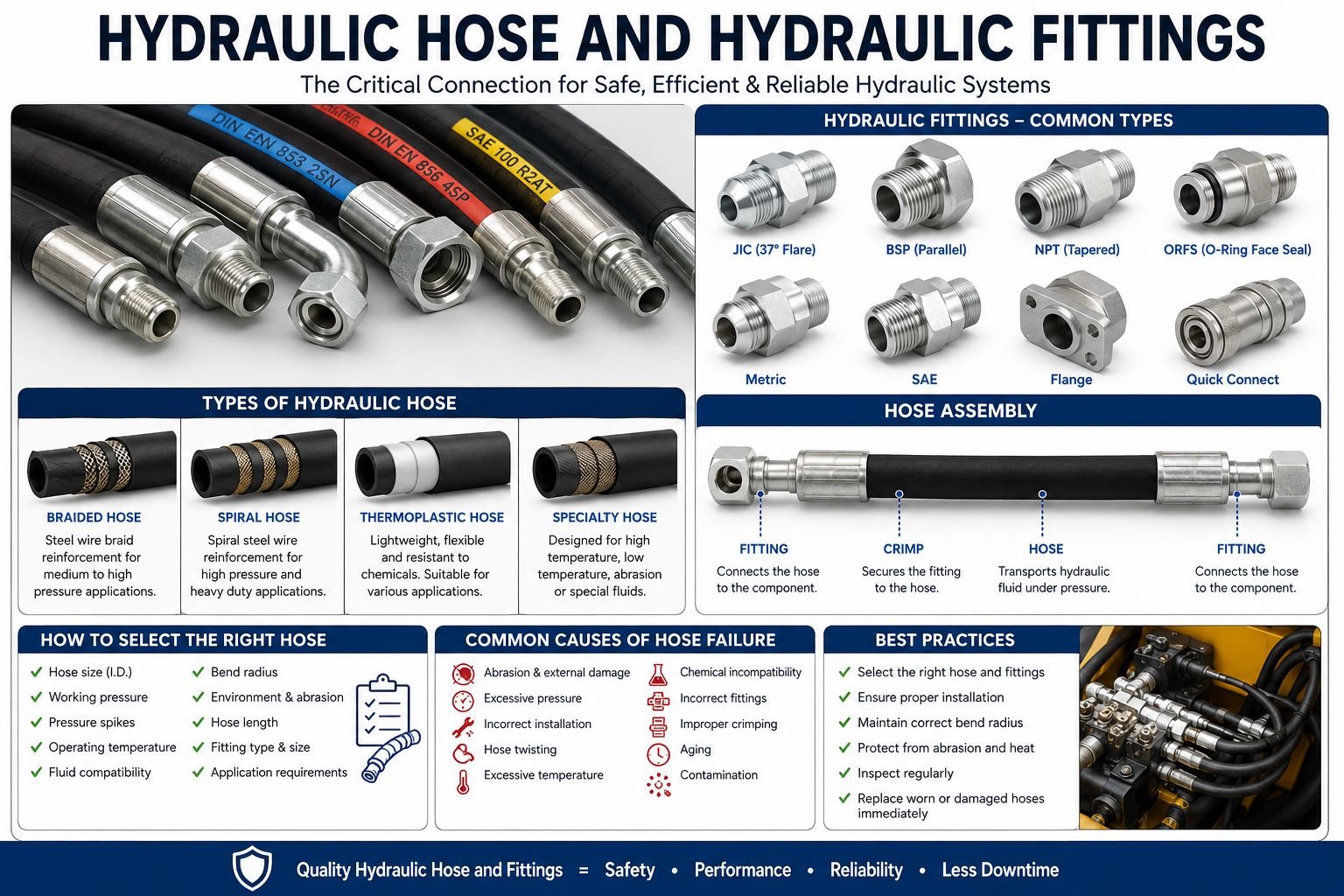
Industrial equipment is becoming faster, more powerful, and increasingly dependent on reliable fluid-power technology. From construction machinery lifting enormous loads to automated manufacturing equipment performing repetitive movements, hydraulic systems remain essential across numerous industries. Behind these powerful systems are two components that often receive less attention than they deserve: Hydraulic Hose and Hydraulic Fittings.
These components create the pathways through which pressurized hydraulic fluid travels. Their quality affects equipment efficiency, operational safety, maintenance requirements, and overall system reliability. Understanding how they work and how to select them can help businesses prevent expensive hydraulic problems.
A hydraulic system works by transferring energy through pressurized fluid. Pumps generate flow, valves control its direction, and cylinders or motors convert hydraulic energy into mechanical movement.
However, fluid needs a reliable route between these components.
That is where Hydraulic Hose becomes essential. It creates flexible connections capable of accommodating movement and vibration while transporting hydraulic fluid.
Hydraulic Fittings, meanwhile, secure hoses to pumps, valves, cylinders, manifolds, and other components.
A weakness in either component can affect the entire hydraulic circuit.
A Hydraulic Hose is not simply a rubber tube. It is an engineered component designed to operate under specific pressure, temperature, fluid, and environmental conditions.
Most hoses contain three basic layers:
Steel-wire braid, spiral steel reinforcement, textile fibers, and specialized synthetic materials may be used depending on application requirements.
The construction selected should correspond to the pressure cycles and physical conditions experienced by the equipment.
Hydraulic hoses are found anywhere flexible fluid transmission is required.
Typical applications include:
Applications can vary significantly, which is why there is no universal hose suitable for every hydraulic system.
Hydraulic Fittings are engineered connectors responsible for creating reliable joints between hoses and other hydraulic components.
A fitting must maintain a dependable connection despite pressure fluctuations, vibration, temperature changes, and mechanical movement.
Common connection standards include JIC, BSP, NPT, ORFS, SAE, metric, and flange systems.
Some use threaded sealing principles, while others rely on O-rings, flare surfaces, or specially designed sealing faces.
Identifying the connection standard accurately is therefore extremely important.
One common mistake is selecting hoses and fittings independently.
A hose may have the correct pressure capability, but an incompatible fitting can make the complete assembly unreliable.
The correct Hydraulic Hose and Hydraulic Fittings combination should consider:
Manufacturers’ specifications should always guide assembly selection and fabrication.
Different hose constructions provide different performance characteristics.
| Hose Type | Major Characteristic | Typical Application |
| Wire braided | Flexible with good pressure capability | General industrial hydraulics |
| Spiral wire | Designed for demanding pressure cycles | Heavy construction equipment |
| Textile reinforced | Lightweight and flexible | Lower-pressure applications |
| Thermoplastic | Lightweight and chemically resistant | Specialized hydraulic systems |
The best option depends on the actual operating environment rather than simply choosing the strongest available hose.
Hose diameter directly affects hydraulic performance.
If the internal diameter is too small, fluid velocity can become excessive. This may contribute to pressure losses, increased heat generation, reduced efficiency, and undesirable system behavior.
An unnecessarily large hose can increase cost, weight, and routing difficulty.
Correct sizing should therefore consider required flow rate, recommended fluid velocity, hose length, system design, and manufacturer specifications.
Hydraulic systems can generate extremely high pressure, making pressure rating one of the most important selection criteria.
The working-pressure rating should be suitable for the maximum pressure expected during operation.
Pressure spikes and impulse cycles also matter.
Repeated pressure fluctuations can place significant stress on a Hydraulic Hose, particularly in demanding mobile and industrial equipment.
Another important principle is that the complete assembly is limited by its lowest-rated component. A high-pressure hose does not make an inadequately rated fitting suitable for the same pressure.
Heat can significantly influence hose durability.
Excessive hydraulic-fluid temperatures may accelerate deterioration of the inner tube, while external heat sources can damage the outer cover.
Cold environments can also affect flexibility.
When selecting a hose, both fluid temperature and ambient temperature should be considered.
In applications located close to engines, exhaust systems, furnaces, or other heat sources, additional protective measures may be necessary.
Hydraulic systems can operate with different fluids, including petroleum-based oils, synthetic hydraulic fluids, biodegradable oils, and water-based formulations.
The hose inner tube, seals, and related materials must be compatible with the fluid being transported.
Using incompatible materials may cause:
Compatibility information should be confirmed through reliable manufacturer documentation.
Even premium Hydraulic Hose can fail early if installation and routing are poor.
A hose should not be twisted, excessively stretched, sharply bent, or continuously rubbed against surrounding equipment.
Installers should maintain the recommended minimum bend radius and provide enough hose length to accommodate normal machine movement.
Where abrasion cannot be completely avoided, protective sleeves or guards may provide additional protection.
Understanding failure causes can help maintenance teams prevent recurring problems.
Common causes include:
Instead of simply replacing a failed hose, technicians should identify why the failure occurred.
Otherwise, the replacement may experience the same problem.
A leaking connection is often treated as a simple tightening problem, but the actual cause may be more complicated.
Leaks around Hydraulic Fittings can result from damaged O-rings, incorrect thread combinations, contaminated sealing surfaces, corrosion, excessive vibration, improper installation, or damaged fitting seats.
Overtightening is not always the solution.
In some cases, excessive tightening can damage threads or deform sealing surfaces, making leakage worse.
Unexpected hydraulic failure can stop production and increase maintenance costs. Preventive inspection is therefore more economical than waiting for complete component failure.
Maintenance teams should routinely inspect:
Any hose showing exposed reinforcement, severe abrasion, cracking, blistering, or significant leakage should receive immediate attention.
Hydraulic systems deserve careful handling because pressurized fluid can create serious hazards.
Never use bare hands to locate a suspected high-pressure leak. A tiny hydraulic-fluid jet may penetrate skin and cause severe injection injury.
Equipment should be properly isolated and depressurized according to applicable safety procedures before maintenance is performed.
Qualified personnel should handle critical hose assembly replacement and fitting installation.
A Hydraulic Hose transports pressurized hydraulic fluid while providing flexibility between moving or vibrating system components.
Hydraulic Fittings connect hoses with pumps, cylinders, valves, motors, manifolds, and other components.
The best hose depends on pressure, temperature, fluid, diameter, environment, movement, and application requirements.
No. Different fitting standards use specific threads and sealing mechanisms that may not be compatible.
Possible causes include excessive pressure, abrasion, aging, heat, incorrect routing, damaged reinforcement, or improper installation.
Correct selection, routing, installation, abrasion protection, temperature control, and routine inspection can improve service life.
Yes. Excessive tightening can damage threads, seals, or sealing surfaces and potentially create leakage.
It is the maximum pressure specified for continuous hose operation under defined conditions.
Excessive bending can damage hose reinforcement, restrict flow, and shorten the hose’s expected service life.
Replacement should be considered when significant cracking, leakage, exposed reinforcement, severe abrasion, blistering, or other unacceptable damage appears.
https://newsgrow.blogspot.com/2026/08/industrial-hose-technology-evolves-as.html