


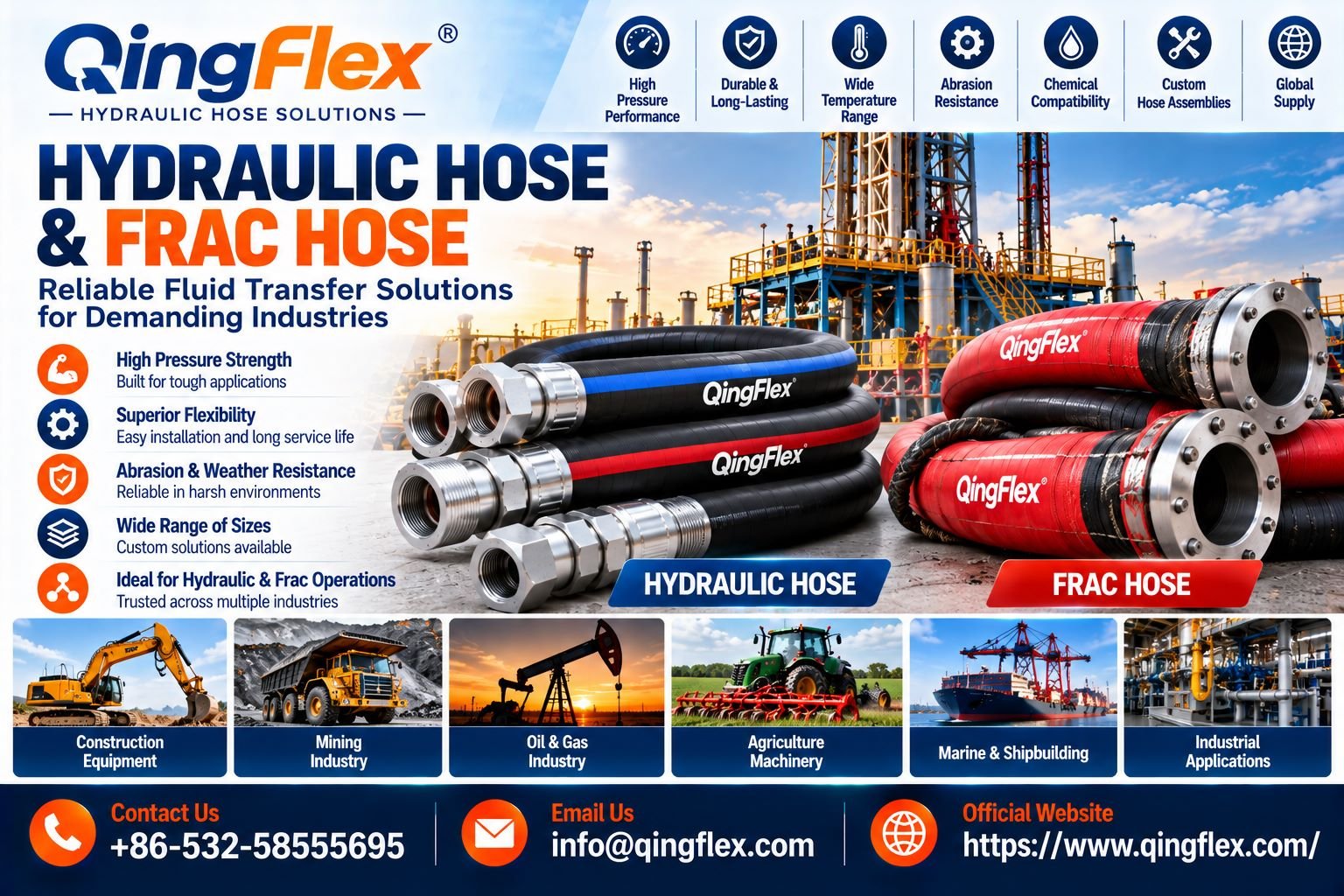
While pumps and control systems receive considerable attention, the hoses connecting equipment are equally important to overall performance.
A Hydraulic Hose provides a flexible connection for transferring pressurized hydraulic fluid between components. Its construction must match the system’s working pressure, operating temperature, fluid characteristics, and installation conditions.
In oilfield operations, specialized frac hose assemblies perform a different but equally demanding function. They may be used to transfer fracturing fluids and other compatible media within pressure-pumping equipment arrangements.
These applications create a particular challenge: maintaining dependable fluid movement while managing pressure, vibration, equipment movement, and potentially abrasive materials.
The operational focus extends beyond hose strength. Proper routing, connection security, inspection procedures, and pressure-control practices all contribute to reliable system performance.
Although both products support industrial fluid transfer, their intended applications can differ significantly.
A conventional hydraulic hose commonly transfers hydraulic oil or another specified hydraulic medium to transmit power through machinery.
A frac hose, by comparison, is specifically designed for designated oilfield fluid-transfer applications. Depending on the product, it may handle fracturing fluids containing chemicals, additives, or suspended solids.
The differences involve several engineering considerations:
Understanding these differences helps prevent unsuitable substitutions between hose categories.
Hydraulic fracturing involves pumping fluid into geological formations under controlled high-pressure conditions.
Equipment used in these operations may experience significant pressure changes, vibration, and mechanical loading.
The hose assembly must be suitable for the intended operating conditions, but hose design alone cannot control every risk.
Effective pressure management also depends on system configuration, equipment condition, operating procedures, and personnel training.
A practical engineering principle highlights this relationship:
This perspective encourages operators to assess pumps, valves, manifolds, fittings, and flexible connections as an integrated arrangement.
A hose with an appropriate pressure rating can still become hazardous if installed incorrectly or connected to incompatible equipment.
Hose routing is sometimes treated as a secondary installation concern. In demanding industrial environments, however, the physical arrangement of flexible connections can influence system safety and maintenance requirements.
Poor routing can expose hoses to unnecessary bending, twisting, contact with sharp surfaces, or interference from moving equipment.
For specialized frac hose installations, routing decisions should account for equipment movement, pressure loading, personnel exposure, and the manufacturer’s installation guidance.
Avoid excessive bending: Hose assemblies should remain within their specified minimum bend radius.
Prevent unnecessary twisting: Twisting during installation can place additional stress on reinforcement and fittings.
Protect against abrasion: Suitable positioning or approved protection can reduce contact damage.
Allow for movement: Flexible connections should accommodate anticipated equipment movement without overstressing the assembly.
Control personnel exposure: High-pressure hose arrangements should follow applicable exclusion-zone and restraint requirements.
These measures can reduce avoidable mechanical damage and support more consistent equipment operation.
Industrial hose connections must withstand the demands of their intended service.
An unsuitable fitting, damaged connector, or improperly assembled connection can compromise an otherwise appropriate hose.
For this reason, connection integrity should be addressed throughout equipment planning and maintenance.
Operators should verify that fittings, seals, couplings, and other connection components are compatible with the selected hose and system.
Where applicable, documented assembly procedures and pressure-testing requirements should also be followed.
It is particularly important not to assume that components with similar dimensions are interchangeable.
Differences in connection design, pressure rating, material compatibility, and assembly methods can affect suitability.
Regular inspection remains an important part of industrial hose management.
High-pressure fluid-transfer equipment can experience gradual wear that is not always obvious during routine operation.
Maintenance personnel should look for visible damage, unusual deformation, abrasion, fitting deterioration, leaks, and evidence of movement-related stress.
Inspection procedures should be consistent with manufacturer recommendations and applicable site safety requirements.
A useful maintenance principle is:
Maintenance planning should also include appropriate documentation.
Recording installation information, operating conditions, inspection findings, and replacement decisions helps organizations maintain a clearer understanding of equipment condition.
Suspected damaged hoses should not be repaired or pressure-tested through improvised methods. They require assessment according to authorized procedures.
Material selection plays an important role in both hydraulic equipment and specialized fracturing-fluid applications.
A hose assembly typically uses an inner tube, reinforcement structure, outer covering, and compatible end connections.
Each element performs a different function.
The inner tube must withstand contact with the transferred fluid, while reinforcement supports the intended pressure requirements.
The outer cover helps protect the assembly against suitable environmental and mechanical exposures.
However, no single material combination is appropriate for every application.
Fluid chemistry, abrasive content, operating temperature, and installation conditions should guide product selection.
This makes technical documentation and fluid-compatibility verification important parts of equipment planning.
The purchase cost of a Hydraulic Hose or specialized fluid-transfer assembly represents only one part of its overall operational value.
An unsuitable product may require additional maintenance, contribute to equipment interruptions, or increase replacement requirements.
Conversely, a properly specified hose can support reliable operation when combined with suitable installation and maintenance practices.
Industrial procurement teams should therefore consider the complete application rather than comparing products solely by purchase price.
Important evaluation areas include documented operating limits, installation compatibility, fitting suitability, expected mechanical demands, and availability of appropriate technical information.
For high-pressure oilfield systems, these considerations become especially significant because the consequences of equipment failure can be severe.
The wider lesson for industrial fluid-transfer operations is that equipment reliability depends on coordinated engineering decisions.
Hose construction, operating pressure, routing, connection quality, inspection procedures, and personnel protection must work together.
A properly specified frac hose contributes to this system, but it should never be considered a substitute for appropriate pressure-control equipment or safe operating procedures.
Organizations that treat flexible connections as essential engineered components can make more informed decisions about installation, maintenance, and replacement.
A Hydraulic Hose transfers pressurized hydraulic fluid between system components. It is commonly used in construction machinery, manufacturing equipment, agricultural machinery, and other hydraulic applications.
A frac hose is a specialized hose designed for specified fluid-transfer duties associated with hydraulic fracturing operations. Its suitability depends on pressure, fluid compatibility, temperature, and other operating requirements.
Not automatically. Conventional hydraulic hoses and specialized fracturing-service hoses may have different construction, pressure, fluid-compatibility, and connection requirements. Substitution requires proper engineering verification.
Potential causes include excessive pressure, incompatible fluids, abrasion, incorrect installation, damaged fittings, mechanical stress, and deterioration. Regular inspection and correct operating practices help manage these risks.
Operators should select correctly specified products, verify connection compatibility, follow approved installation procedures, inspect assemblies regularly, and replace damaged components according to manufacturer guidance.
Department: Media Relations & Industrial Product Enquiries
Industry: Industrial Hose Manufacturing and Fluid Transfer Solutions
Contact: +86-532-58555695
Email: info@qingflex.com
Official Website: https://www.qingflex.com/