


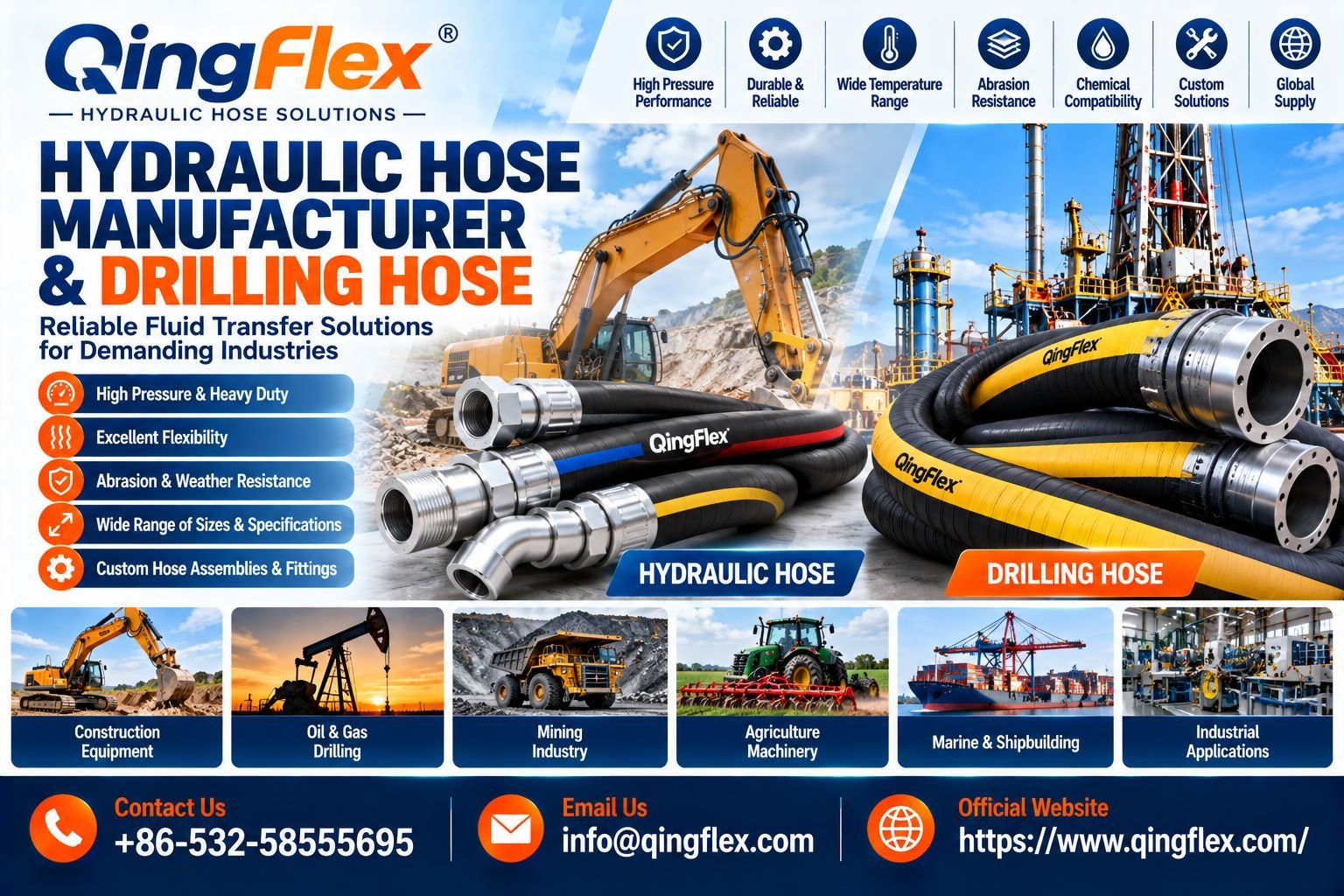
Every connection, fitting, and fluid-transfer pathway contributes to how equipment operates under demanding conditions.
For drilling equipment, flexible hoses are essential components that must work alongside pumps, valves, moving assemblies, and structural supports.
This makes cooperation with a qualified Hydraulic Hose Manufacturer an important consideration during equipment development.
Rather than treating hoses as accessories selected after machinery construction, engineers can incorporate hose requirements into the initial design process.
This approach is particularly relevant to drilling hose applications, where fluid characteristics, equipment movement, pressure conditions, and limited installation space can influence product selection.
The central engineering challenge is straightforward: a hose must not only meet technical specifications but also function correctly within the complete equipment arrangement.
Equipment designers frequently face competing requirements involving compact construction, maintenance accessibility, and operational efficiency.
Flexible hose assemblies must fit within these constraints without creating unnecessary mechanical stress.
Consulting a manufacturer during equipment development can help engineering teams evaluate hose length, diameter, connection orientation, and routing requirements before finalizing the equipment layout.
Early coordination can also identify situations where standard products may not meet the intended application.
For example, a drilling machine with moving components may require hose routing that accommodates repeated movement without exceeding specified bending limits.
Addressing such requirements during design can reduce the need for modifications after equipment assembly.
An important engineering principle captures this approach:
Not every industrial machine operates under identical conditions.
Different equipment configurations may require distinct hose dimensions, reinforcement arrangements, fitting styles, and material characteristics.
A technically capable Hydraulic Hose Manufacturer can support product selection by evaluating the operational requirements of the intended application.
For specialized drilling machinery, engineering considerations may include:
Customization does not automatically improve performance. Every modification must remain consistent with applicable design requirements, component compatibility, and validated manufacturing procedures.
Drilling operations introduce challenges that differ from those encountered in many stationary industrial systems.
A drilling hose intended for drilling-fluid service may need to transfer fluid containing suspended solids and chemical additives while accommodating equipment vibration or movement.
Its design requirements depend on the specific service, including whether the application involves rotary drilling-fluid transfer, auxiliary hydraulic power, or another fluid-handling function.
These applications should not be treated as interchangeable simply because they use flexible hoses.
For example, a general-purpose hydraulic power hose is not automatically suitable for high-pressure rotary drilling-fluid service.
Engineers must consider fluid properties, operating pressure, temperature, mechanical movement, connection requirements, and any applicable technical standards.
This distinction makes accurate application information essential when specifying products.
Equipment development frequently includes design reviews, prototype assembly, and operational evaluation.
Hose integration should form part of these activities.
Before equipment enters regular service, engineering teams can examine whether the selected hose assembly fits the intended installation and remains within its specified operating limits.
A physical inspection can reveal routing problems that may not be obvious in technical drawings.
Engineers can check hose clearance, connection accessibility, and possible contact with moving components.
Where equipment components move, the installed assembly should be assessed throughout the intended movement range.
This helps identify excessive bending, twisting, or tension that could affect hose performance.
Product suitability should be confirmed through appropriate manufacturer documentation and applicable verification procedures.
Pressure ratings, component compatibility, and assembly requirements should be reviewed before the equipment is approved for operation.
These activities help connect the original equipment design with real installation conditions.
Design compatibility is only one part of successful hose integration.
Consistent manufacturing practices are also important because industrial hose assemblies rely on multiple materials and components working together.
Production controls may include material identification, dimensional inspection, reinforcement processing, fitting assembly, and relevant testing.
The specific procedures depend on the hose construction, intended application, and applicable requirements.
For equipment manufacturers purchasing specialized products, clear technical records can support product identification and future maintenance decisions.
Where required, traceability information can help establish which components and manufacturing specifications apply to a particular hose assembly.
This is especially useful when equipment designs undergo revisions or when replacement parts must match previously approved configurations.
One frequently overlooked engineering consideration is how easily a hose assembly can be inspected or replaced after equipment installation.
A technically suitable hose may still create maintenance difficulties if access is restricted or surrounding components must be removed.
Design teams can address these issues by providing adequate installation clearance and considering the accessibility of fittings and connections.
Clear component identification can also support accurate replacement selection.
For drilling systems, maintenance personnel should be able to distinguish between assemblies intended for different fluids, pressures, and operating functions.
An effective design philosophy can be summarized as follows:
Replacement planning does not eliminate wear or mechanical damage, but it can support more organized inspection and maintenance procedures.
Successful hose integration depends on accurate technical communication.
Equipment builders should provide information about operating pressure, fluid properties, temperature limits, movement conditions, connection requirements, and installation constraints.
Manufacturers, in turn, should communicate documented product capabilities, limitations, and compatibility requirements.
Where specialized assemblies are involved, engineering teams may also need to confirm applicable testing procedures and design standards.
This exchange reduces the risk of selecting products based on incomplete specifications.
It also supports clearer purchasing requirements when equipment manufacturers work with multiple suppliers or develop different machinery configurations.
The broader engineering lesson is that flexible connections should be considered part of the overall machinery design.
A correctly specified drilling hose can support effective fluid transfer, but its performance depends on its compatibility with the surrounding equipment and operating conditions.
For manufacturers and equipment developers, collaborative engineering offers a practical way to evaluate potential installation challenges before they affect operations.
By connecting product specification, equipment layout, manufacturing documentation, and maintenance planning, organizations can make more informed design decisions.
Early consultation can help identify suitable hose dimensions, materials, fittings, and routing requirements before the equipment layout is finalized.
A drilling hose transfers specified fluids within drilling equipment. Its construction depends on the particular application, including pressure, fluid characteristics, temperature, and mechanical movement.
Yes. Depending on manufacturer capabilities and approved specifications, assemblies may be configured with suitable lengths, diameters, materials, and connection arrangements.
Proper routing helps prevent excessive bending, twisting, abrasion, and unnecessary mechanical loading. It also supports installation accessibility and maintenance.
They can review complete application requirements, coordinate during equipment design, verify component compatibility, evaluate prototype installations, and maintain accurate technical documentation.
Department: Media Relations & Industrial Product Enquiries
Industry: Industrial Hose Manufacturing and Fluid Transfer Solutions
Contact: +86-532-58555695
Email: info@qingflex.com
Official Website: https://www.qingflex.com/