


Think about the last time you walked through a large airport or entered a multi-storey commercial building. A moving walkway may have carried you comfortably toward your terminal, while an elevator transported you to another floor within seconds.
Most passengers rarely think about what happens underneath the walkway or behind the elevator doors. Yet both systems contain sophisticated mechanical, electrical, and safety technologies that operate repeatedly throughout the day.
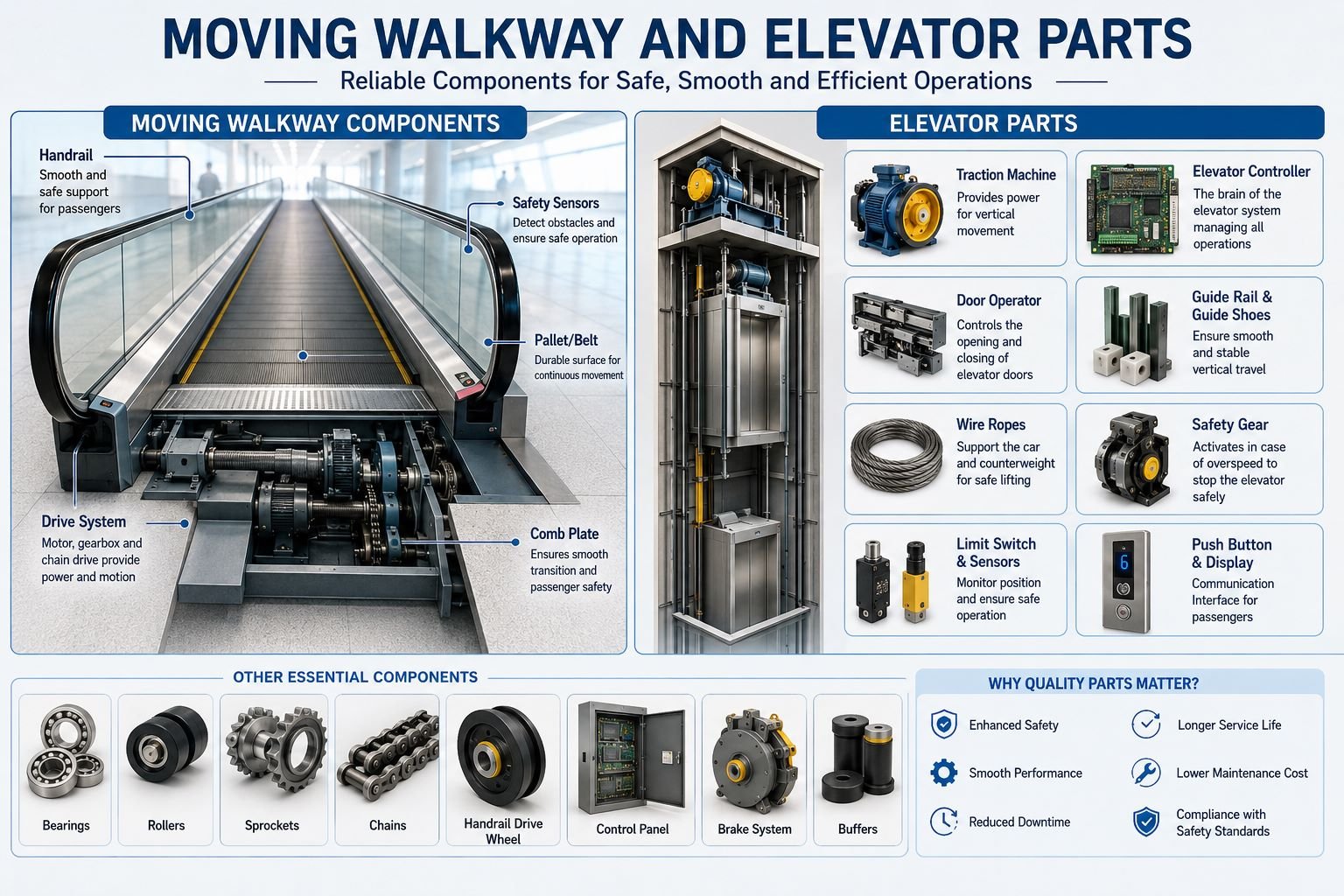
From motors and controllers to sensors, handrails, brakes, and door mechanisms, every component has a specific purpose. Understanding elevator parts and moving walkway components is especially useful for building owners, facility managers, maintenance professionals, contractors, and businesses responsible for passenger transportation systems.
Large public spaces are getting bigger. Airports have longer terminals, shopping centres cover enormous areas, and transportation hubs handle thousands of passengers daily.
A moving walkway provides a practical solution by helping passengers cover longer distances with less physical effort.
You will commonly find these systems in:
Unlike elevators, moving walkways provide continuous passenger flow. People can enter and exit without waiting for a cabin to arrive.
This makes them particularly useful in locations experiencing steady pedestrian traffic.
The visible surface represents only a small portion of the complete system.
Underneath a moving walkway is a carefully synchronized collection of mechanical components responsible for keeping the passenger surface moving consistently.
At the heart of the equipment is its drive system.
An electric motor generates power, while components such as gearboxes, drive chains, shafts, and sprockets transfer that power to the travelling surface.
These components experience continuous operational stress. Proper alignment, lubrication, tension, and inspection are therefore important for reliable operation.
Depending on the equipment design, passengers stand on interconnected metal pallets or a reinforced moving belt.
These surfaces need adequate strength and traction while providing comfortable movement.
Any excessive wear, deformation, alignment problem, or surface damage should be investigated during routine maintenance.
The handrail may appear simple, but it has its own operating mechanism.
Handrail belts, drive wheels, rollers, guides, and tensioning components work together to keep the handrail travelling consistently with the passenger surface.
Poor synchronization can affect passenger comfort and may indicate that maintenance is required.
An elevator ride may last less than a minute, but many processes happen during that short journey.
After a passenger presses a button, the elevator system must receive the command, identify the destination, determine direction, control the motor, operate the doors, monitor cabin position, regulate speed, and communicate with multiple safety devices.
This coordination is possible because numerous elevator parts work together as an integrated system.
Every component has a role, but some parts are especially important to daily elevator operation.
The controller can be considered the decision-making centre of the system.
It processes passenger requests and coordinates different elevator parts to deliver controlled movement.
Modern controllers may manage:
Advanced systems can also communicate with building management and access-control platforms.
The traction machine provides the mechanical power necessary to move the elevator cabin.
Traditional installations may use geared machines, while many modern buildings use gearless systems designed for efficient and smooth operation.
The appropriate machine depends on elevator capacity, travel height, speed, building configuration, and engineering requirements.
Doors are among the hardest-working elevator parts because they operate at almost every stop.
Door assemblies can include motors, operators, tracks, rollers, hangers, belts, interlocks, and safety sensors.
Frequent door problems can lead to operational delays, making preventive inspection particularly important.
Passenger safety depends on several independent protective mechanisms.
Elevators may incorporate brakes, overspeed governors, safety gears, limit switches, interlocks, buffers, and various monitoring devices.
These systems should be inspected and tested according to manufacturer requirements and applicable safety regulations.
| Factor | Moving Walkway | Elevator |
| Main direction | Horizontal/slight incline | Vertical |
| Passenger flow | Continuous | Individual trips |
| Moving platform | Belt or pallets | Enclosed cabin |
| Typical application | Airports and stations | Multi-storey buildings |
| Main components | Motor, chain, pallets, handrail | Motor, controller, doors, brakes |
| Main purpose | Reduce walking distance | Connect different floors |
Although their applications differ, both systems depend on accurate engineering and regular maintenance.
When an elevator component needs replacement, choosing the cheapest available option can appear financially attractive.
However, component compatibility matters significantly.
Quality elevator parts should match the equipment’s technical specifications, operating conditions, electrical requirements, dimensions, and load characteristics.
Two components that look identical may perform differently when installed.
Maintenance should ideally begin before equipment develops a serious fault.
Routine inspections allow technicians to identify wear, looseness, contamination, abnormal noise, vibration, or performance changes before they cause larger problems.
A practical maintenance routine may involve:
Detailed maintenance records can reveal recurring patterns and help maintenance teams plan future servicing.
Elevators and moving walkways are becoming increasingly connected.
Sensors can now monitor equipment conditions and generate valuable operating information.
A modern system may track motor temperature, vibration, door cycles, operating hours, travel frequency, energy consumption, speed variations, and fault codes.
This creates opportunities for predictive maintenance.
Rather than waiting for a component to fail, technicians can use performance information to identify unusual behaviour and investigate potential problems earlier.
Modern mobility equipment is also being designed with energy efficiency in mind.
A moving walkway, for example, may use sensors to detect passenger demand. During quiet periods, the equipment can operate at reduced speed depending on system design and applicable requirements.
Elevators can incorporate efficient motors, intelligent control systems, standby modes, LED lighting, and regenerative technologies.
These improvements can help reduce unnecessary energy consumption while maintaining passenger convenience.
1. What exactly is a moving walkway?
A moving walkway is a mechanical transportation system that continuously carries passengers horizontally or along a slight incline.
2. Where are moving walkways most useful?
They are particularly useful in airports, railway stations, shopping malls, exhibition centres, and large public facilities.
3. What components are inside a moving walkway?
Major components include motors, gearboxes, pallets, belts, chains, rollers, handrails, sensors, comb plates, and controllers.
4. What are the essential elevator parts?
Essential elevator parts include motors, controllers, doors, brakes, guide rails, suspension systems, sensors, buttons, and safety devices.
5. Why do elevator doors develop frequent problems?
Doors operate repeatedly throughout the day, causing rollers, tracks, belts, sensors, and other components to experience significant wear.
6. Can any elevator replacement part be used?
No. Replacement components should match the elevator’s technical, dimensional, electrical, operational, and safety specifications.
7. What causes moving walkway vibration?
Possible causes include worn rollers, bearings, chains, incorrect tension, misalignment, or problems within the drive assembly.
8. How frequently should elevators be maintained?
Maintenance frequency depends on equipment type, usage, manufacturer recommendations, local regulations, and operating conditions.
9. What is smart elevator maintenance?
It uses sensors and operational data to monitor equipment performance and identify potential maintenance requirements.
10. Can older elevators be modernized?
Yes. Depending on equipment condition, controllers, drives, doors, displays, safety devices, and other components may be modernized.
https://gosarkarijobs.com/how-escalator-companies-and-cargo-lifts-are-transforming-modern-buildings/
https://newsgrow.blogspot.com/2026/08/vertical-transportation-enters-new-era.html