


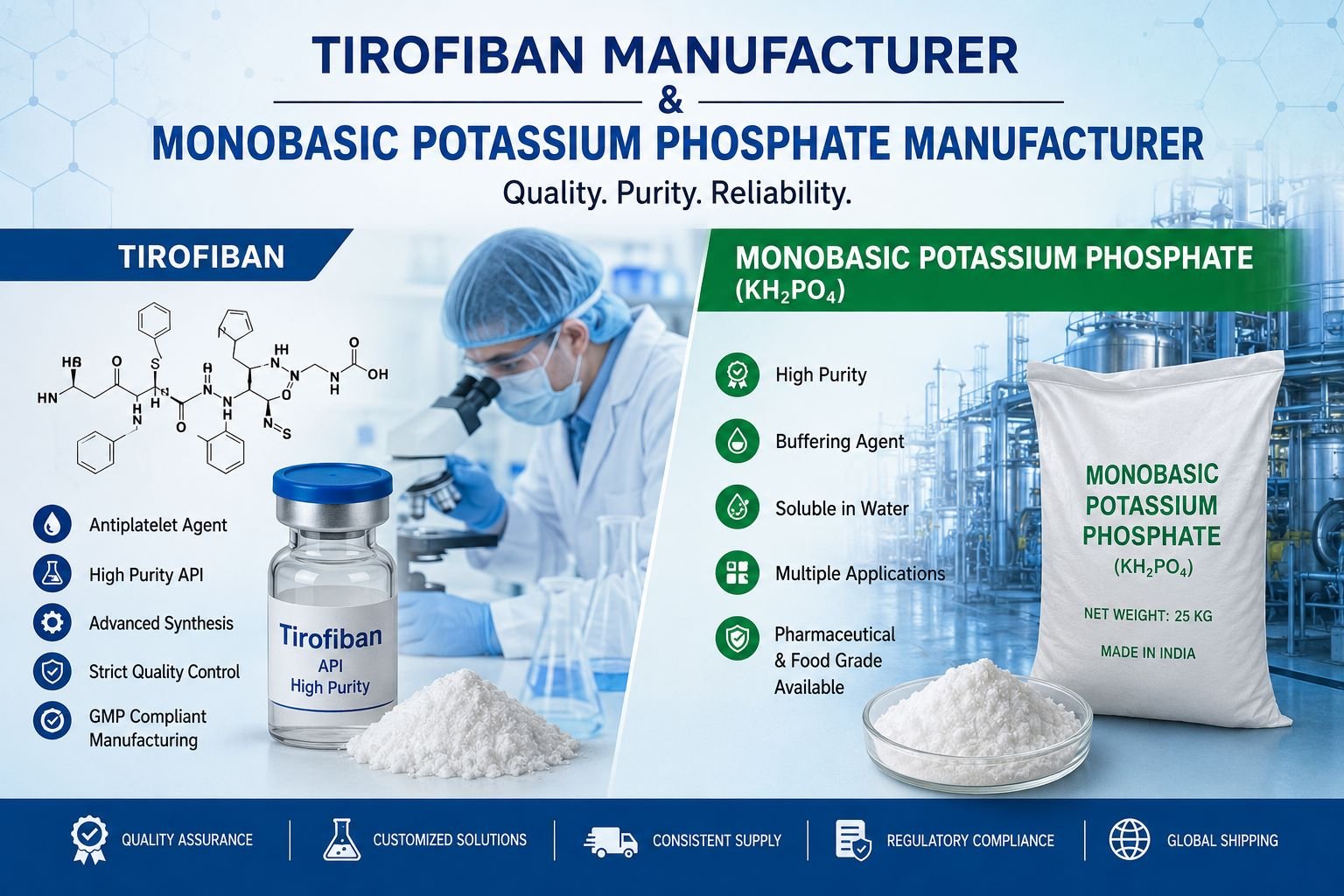
Behind every reliable pharmaceutical formulation or specialty chemical application is a carefully managed supply chain. Raw-material quality, manufacturing consistency, analytical testing, documentation, and storage can significantly influence the performance of downstream products.
This makes supplier selection especially important when businesses are searching for a Tirofiban manufacturer or Monobasic potassium phosphate manufacturer.
While tirofiban is associated primarily with pharmaceutical applications, monobasic potassium phosphate serves pharmaceutical, laboratory, food, agricultural, and industrial sectors. Their applications are different, but manufacturers of both products need strong quality-control systems and consistent production capabilities.
In this blog, we explore what buyers should know about these two materials, their manufacturing requirements, applications, quality parameters, and the factors that separate a dependable supplier from an ordinary chemical vendor.
Finding a chemical online is relatively easy. Finding a manufacturer capable of supplying the same required quality consistently is more challenging.
Industrial buyers increasingly evaluate the complete manufacturing ecosystem rather than focusing exclusively on price.
A dependable supplier should demonstrate:
These considerations become particularly significant when dealing with pharmaceutical compounds.
Tirofiban is a pharmaceutical compound used in antiplatelet therapy. It acts as a glycoprotein IIb/IIIa receptor antagonist, helping inhibit platelet aggregation.
From a manufacturing perspective, producing pharmaceutical-quality tirofiban requires considerable attention to chemical synthesis, purification, impurity profiles, analytical characterization, and storage.
A professional Tirofiban manufacturer therefore needs more than basic chemical production equipment. Strong process understanding and pharmaceutical-quality systems are equally important.
Commercial pharmaceutical manufacturing depends on repeatability. A successful process should consistently produce material that conforms to established specifications.
Quality begins before synthesis starts.
Manufacturers should establish specifications for starting materials and evaluate incoming materials before using them in production. Supplier qualification and raw-material traceability can further strengthen process control.
Several variables can affect chemical synthesis, including reaction conditions, temperature, processing time, solvents, and purification procedures.
A capable Tirofiban manufacturer establishes controlled procedures for critical manufacturing stages instead of treating every batch as an independent production exercise.
Producing the intended compound is only part of pharmaceutical manufacturing. Process-related impurities and residual substances also require careful attention.
Suitable purification strategies help manufacturers achieve the targeted purity while maintaining consistent product characteristics.
Finished material may be examined for parameters such as:
Manufacturing without documentation creates significant difficulties for regulated customers.
Certificates of analysis, specifications, safety information, batch details, storage recommendations, and other technical documents help customers evaluate material before incorporating it into their processes.
Before finalizing a supplier, procurement and quality teams should ask meaningful technical questions.
For example:
A transparent Tirofiban manufacturer should be prepared to discuss relevant technical and quality information.
Monobasic potassium phosphate is an inorganic salt with the chemical formula KH₂PO₄. It is also widely known as potassium dihydrogen phosphate.
Its useful chemical properties have created applications across numerous industries.
Unlike a highly specialized pharmaceutical compound, monobasic potassium phosphate can be produced in different grades depending on its intended use.
This means selecting a Monobasic potassium phosphate manufacturer begins with one important question: which grade does your application require?
The compound’s versatility is one of the primary reasons for its widespread industrial importance.
Suitable high-purity grades can be used for laboratory reagents, buffer preparation, analytical applications, pharmaceutical processes, and research activities.
Appropriate food-grade monobasic potassium phosphate may be used for applications involving acidity regulation, buffering, or formulation requirements, subject to applicable regulations.
Potassium and phosphorus are important plant nutrients. Suitable monobasic potassium phosphate grades can therefore be incorporated into certain fertilizer and nutrient formulations.
The compound can also serve as a raw material in technical chemical formulations, buffering processes, specialty manufacturing, and other industrial applications.
A professional Monobasic potassium phosphate manufacturer should define clear specifications for each available grade.
Quality testing may include:
The precise limits depend on product grade, application, regulatory requirements, and customer specifications.
Using an inappropriate grade can create unnecessary quality or compliance risks.
A laboratory requiring high-purity material, for example, has different requirements from an agricultural business purchasing material for fertilizer production.
Buyers should communicate the intended application clearly before ordering.
| Feature | Tirofiban | Monobasic Potassium Phosphate |
| Product type | Pharmaceutical compound | Inorganic phosphate salt |
| Formula | Complex pharmaceutical molecule | KH₂PO₄ |
| Main sectors | Pharmaceutical | Pharma, laboratory, food, agriculture, industrial |
| Production focus | Synthesis and purification | Purity and grade control |
| Critical quality area | Impurity profile | Grade-specific specifications |
| Supplier evaluation | Pharmaceutical capabilities | Application-specific manufacturing capability |
Although the products are fundamentally different, quality assurance remains essential for both.
The best supplier is not necessarily the company offering the lowest price.
Businesses should evaluate manufacturers according to their ability to provide repeatable quality over the entire relationship.
Consider:
For international procurement, buyers should additionally discuss logistics, documentation, shelf-life expectations, transportation requirements, and packaging protection.
A sample can demonstrate product quality at one point in time, but commercial customers need consistency across multiple batches.
Batch-to-batch variation can potentially affect processing conditions, analytical results, formulations, or finished-product characteristics.
An experienced Monobasic potassium phosphate manufacturer should therefore maintain standardized production and testing procedures.
The same principle becomes even more significant when evaluating a Tirofiban manufacturer, where pharmaceutical customers may operate within stringent quality and regulatory frameworks.
Tirofiban is associated with antiplatelet therapy and inhibition of platelet aggregation in specific cardiovascular clinical settings.
Evaluate pharmaceutical manufacturing experience, purity control, analytical capabilities, documentation, traceability, capacity, and applicable quality standards.
Controlled purity helps pharmaceutical companies maintain defined specifications and manage process-related impurities in their supply chain.
It is an inorganic potassium phosphate salt with the chemical formula KH₂PO₄.
Yes. Potassium dihydrogen phosphate is another commonly used name for monobasic potassium phosphate.
Pharmaceutical, laboratory, food, agricultural, chemical-processing, and other industrial sectors may use appropriate grades.
Request specifications, certificates of analysis, available grades, packaging information, storage guidance, pricing, and relevant technical documentation.
Different applications have different purity, impurity, testing, documentation, and regulatory requirements.
Commercial manufacturers may provide bulk quantities depending on production capacity, packaging options, minimum orders, and availability.
Consistent batches support predictable manufacturing, analytical testing, formulation performance, and quality-control procedures.
https://newsgrow.blogspot.com/2026/08/the-science-behind-reliable-dextran-gmp.html