


A great product idea does not automatically become a great manufactured product. Between the first CAD drawing and final production, there are dozens of decisions involving materials, dimensions, appearance, testing, tooling and cost.
One of the biggest mistakes a product developer can make is moving into production before the design has been properly tested.
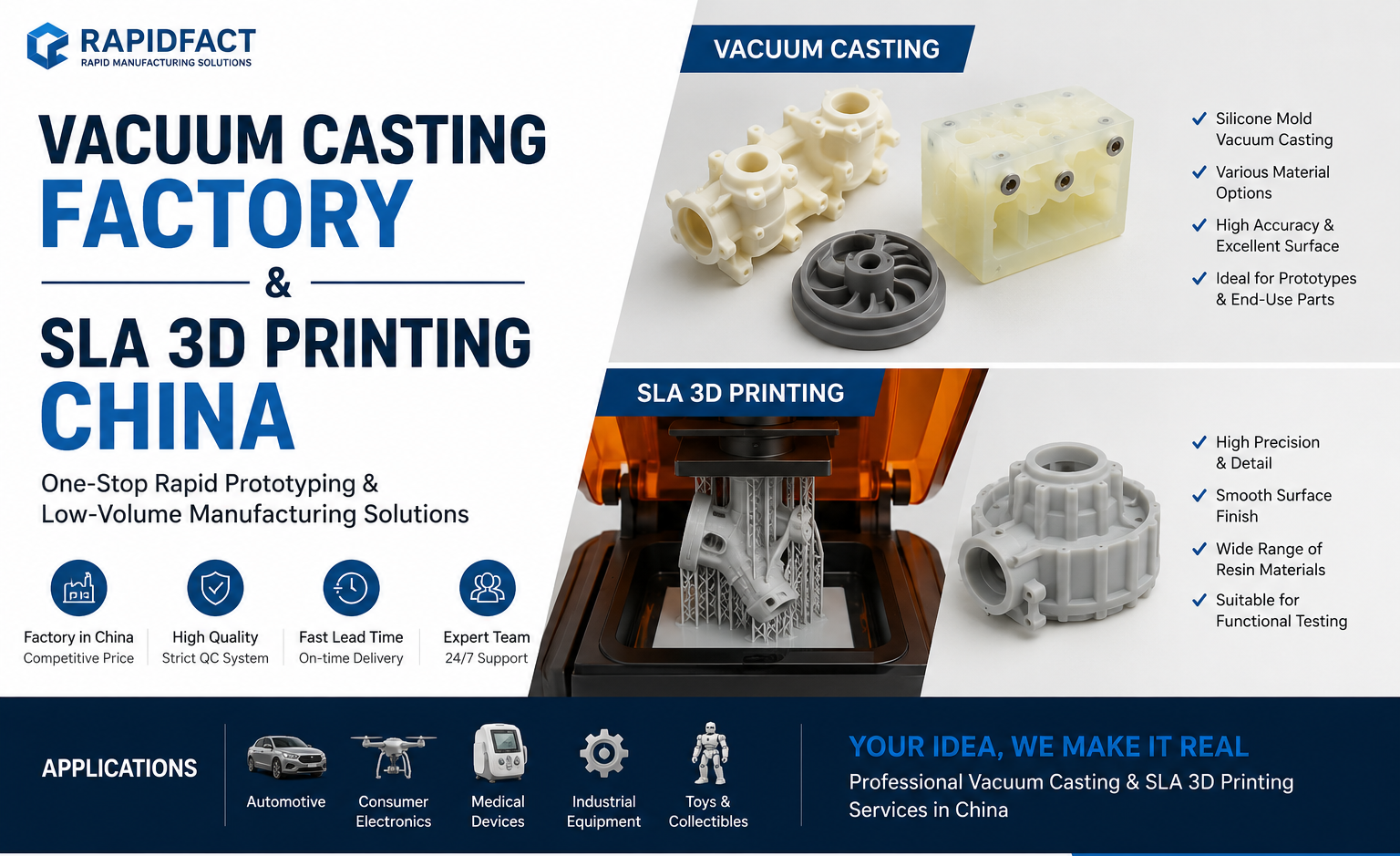
This explains why rapid prototyping has become an important part of modern manufacturing. Services offered by a professional vacuum casting factory and SLA 3D Printing China providers allow engineers to physically evaluate designs and manufacture limited quantities before considering larger-scale production.
But when should each process be used, and why are they frequently combined?
Imagine spending significant time developing an electronic enclosure. The CAD model looks correct, engineering drawings have been reviewed and the design is approved.
Then the first production components arrive.
A connector opening is slightly misplaced. The enclosure feels uncomfortable to hold. Two internal components interfere during assembly.
These may appear to be small problems, but once production tooling exists, correcting them can become considerably more complicated.
Physical prototyping provides an opportunity to discover such issues earlier.
Before committing to tooling, engineers can evaluate:
This is where additive manufacturing can become particularly useful.
SLA, or stereolithography, is a resin-based additive manufacturing technology widely used for prototype production.
With SLA 3D Printing China, a component can be produced directly from digital 3D data rather than requiring conventional mould tooling.
The process begins with liquid photopolymer resin. Controlled light selectively cures specific areas of the resin according to the digital model. Layer after layer is formed until the complete component is produced.
Printed parts then undergo post-processing, which can include washing, support removal and additional curing.
When appearance is particularly important, sanding, polishing, priming or painting may also be performed.
The real advantage of SLA is not simply that it can manufacture a prototype. It is the flexibility it provides when a product has not yet reached its final design.
If testing reveals a problem, engineers can modify the CAD model and manufacture another version.
There is no conventional production mould that must first be altered.
This makes SLA 3D Printing China useful for iterative development where Version 1 may quickly become Version 2, Version 3 or Version 4.
Fine curves, openings, decorative elements and complex geometries can be physically examined rather than judged only from computer renderings.
Once a design is approved, the SLA prototype can serve another purpose: it can become the master pattern used by a vacuum casting factory.
A single prototype may be enough during early engineering.
Later in the project, however, different departments may need samples simultaneously.
The engineering team needs components for testing. Sales needs demonstration models. Marketing wants products for photography. Potential customers may require evaluation samples.
Suddenly, one prototype becomes 10, 20 or more.
At the same time, the company may still not be ready to invest in mass-production tooling.
Vacuum casting can fill this manufacturing gap.
A vacuum casting factory typically starts with an accurate master pattern.
The master is carefully prepared because its quality can directly influence the surface of the cast components.
Silicone is formed around the master and allowed to cure. The mould is subsequently opened and the original model removed.
This leaves a cavity representing the master geometry.
A suitable liquid casting material is prepared and introduced into the silicone mould under vacuum. The controlled environment helps reduce trapped air and unwanted bubbles.
After curing, the component can be removed, trimmed, inspected and finished.
The silicone mould can then be reused to manufacture additional components until it reaches the end of its practical service life.
It is easy to compare SLA and vacuum casting as if a manufacturer must select only one.
In reality, they frequently solve different problems.
| Project Need | SLA 3D Printing | Vacuum Casting |
| First concept model | Excellent | Not normally required |
| Rapid design changes | Excellent | Less convenient |
| Detailed master pattern | Excellent | Uses the master |
| Small batch requirement | Possible | Strong application |
| Conventional hard tooling | Not required | Not required |
| Silicone mould | No | Yes |
| Material type | Photopolymer resin | Casting resin |
| Replication | Individual printing | Multiple cast copies |
The most efficient strategy may therefore involve changing processes as the project matures.
Consider a company developing a new smart-home control unit.
The first CAD design is sent to an SLA 3D Printing China supplier.
After receiving the prototype, the development team discovers that the display needs to move slightly higher and the enclosure corners should be softer.
The CAD file is updated.
A second prototype is manufactured and approved.
The company then needs several demonstration units for a distributor presentation.
Instead of immediately creating production injection-mould tooling, the approved SLA component is prepared as a master.
A vacuum casting factory creates silicone tooling and manufactures the required batch.
The business can now collect feedback before making the next major production decision.
Selecting a rapid-prototyping partner purely on price can be risky.
A technically capable supplier should understand why the component is being manufactured, not simply what its dimensions are.
Before choosing a manufacturer, investigate:
If possible, discuss critical dimensions and functional requirements directly with the supplier before approving production.
A quotation can appear attractive until poor quality creates additional work.
Imagine receiving a batch where components require extensive refinishing, important dimensions are outside agreed requirements or the appearance differs significantly between parts.
The cost of remanufacturing, shipping delays and lost development time can outweigh the original saving.
When evaluating a vacuum casting factory, buyers should therefore compare overall manufacturing capability rather than unit price alone.
A vacuum casting factory uses master patterns and silicone moulds to manufacture small quantities of resin components.
SLA 3D Printing China refers to stereolithography prototyping and additive manufacturing services supplied by manufacturers in China.
SLA can produce detailed prototypes directly from CAD data, allowing designs to be physically evaluated before conventional tooling.
Yes. SLA is frequently used to manufacture master patterns for silicone mould production.
It is particularly useful when several similar prototype or pre-production components are required.
No. Vacuum casting generally uses silicone moulds and liquid casting resins, whereas injection moulding typically uses production tooling and molten thermoplastic.
Yes. Depending on the material and requirements, SLA components can be sanded, primed and painted.
Transparent casting systems are available, although final clarity depends on material selection, master preparation and finishing.
SLA generally provides greater flexibility because an updated CAD model can be printed without creating a new conventional mould.
Provide a 3D CAD file, quantity, material requirements, critical tolerances, colour, surface finish and intended application.
Read more – https://shopnets.com/china-cnc-custom-machining-how-to-choose-the-right-manufacturing-partner/
https://newsgrow.blogspot.com/2026/08/china-cnc-custom-machining-practical.html
https://newsgrow.blogspot.com/2026/08/china-cnc-machining-suppliers-and.html
https://newsgrow.blogspot.com/2026/08/sla-3d-printing-china-and-vacuum.html
https://newsgrow.blogspot.com/2026/08/vacuum-casting-factory-and-sla-3d.html