


The heating, ventilation, and air conditioning (HVAC) manufacturing sector is focusing on precision metal fabrication as equipment manufacturers seek better ductwork compatibility, dependable airflow performance, and improved installation quality.
Commercial buildings, industrial facilities, and specialised ventilation systems require sheet metal components manufactured according to carefully defined dimensions.
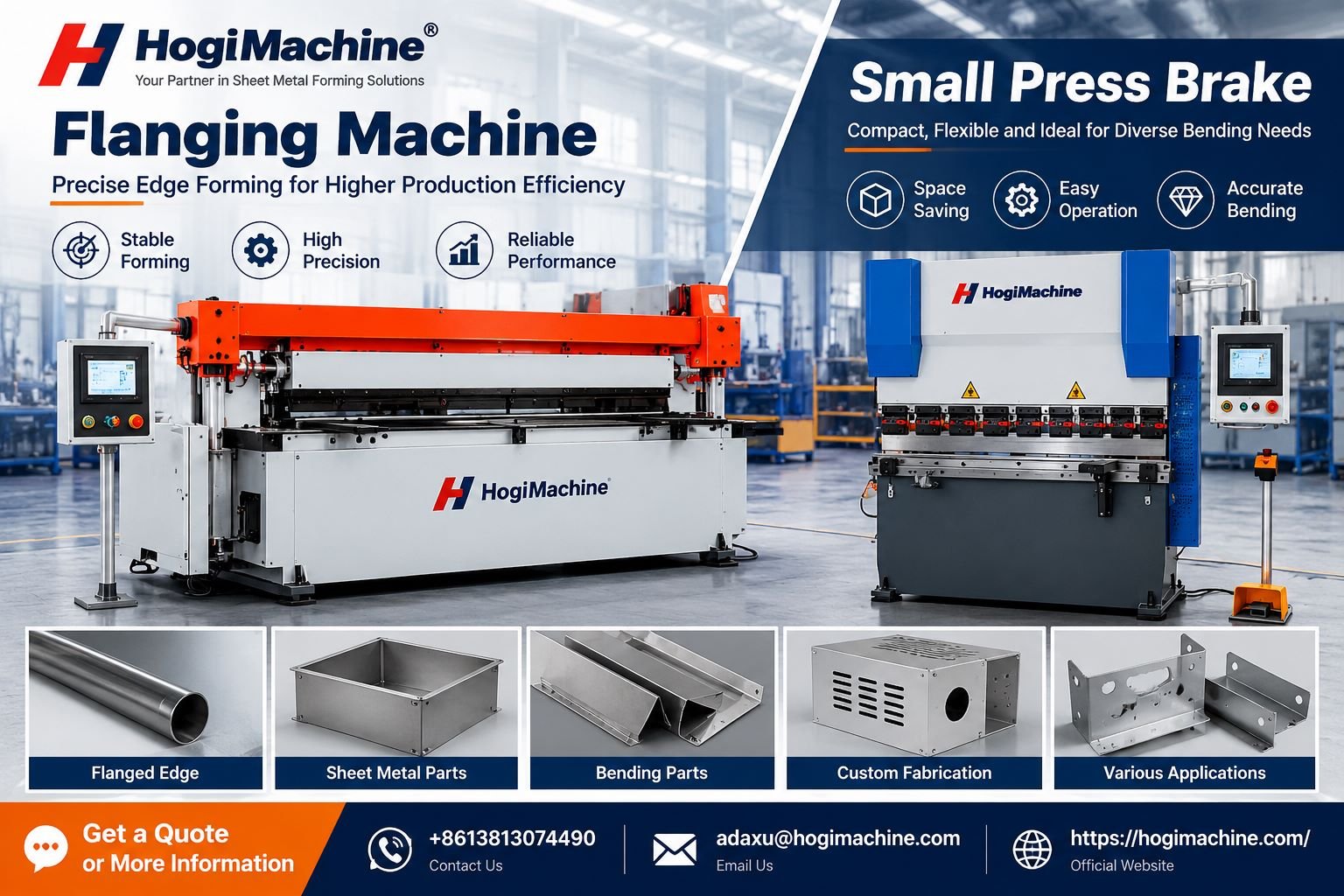
A Flanging machine helps create suitable formed edges and connection profiles for metal ducts and associated components.
Meanwhile, a small press brake supports controlled bending operations for producing rectangular duct sections, mounting brackets, and ventilation accessories.
Although these machines perform different tasks, both contribute to manufacturing ductwork components that fit together accurately.
For HVAC equipment manufacturers, ventilation contractors, and sheet metal fabrication businesses, choosing appropriate forming technology can improve manufacturing consistency and reduce avoidable assembly difficulties.
Ventilation systems rely on interconnected duct sections to transport air between equipment and designated spaces.
Poorly manufactured components may create installation difficulties, unwanted gaps, or misaligned connections.
Dimensional accuracy is particularly important where multiple duct sections must fit together.
Fabricators must consider material thickness, bend geometry, joining methods, and mounting requirements.
Accurate forming can help reduce unnecessary adjustments during assembly.
However, overall system performance also depends on duct layout, sealing, installation practices, and engineering requirements.
A Flanging machine is metal-forming equipment designed to create specified flange profiles along compatible workpiece edges.
In suitable ventilation applications, formed flanges can help prepare duct components for mechanical connections or other joining arrangements.
Different machines accommodate different workpiece shapes, materials, and flange configurations.
Certain equipment is intended for circular duct components, while other specialised machines support different edge-forming requirements.
Manufacturers should confirm whether a particular model is compatible with the intended duct geometry.
Suitable tooling and controlled forming conditions are essential for producing consistent edge profiles.
A small press brake bends sheet metal using appropriate punches and dies.
It can support fabrication of compact rectangular ducts, ventilation covers, support brackets, and equipment panels.
For example, manufacturers may bend galvanised steel sheets into specific profiles before joining them into duct assemblies.
Compact press brakes can be practical for producing smaller components and customised ventilation accessories.
However, forming capability depends on machine capacity, material thickness, bending length, and tooling.
A properly selected machine should match the actual dimensions of the components being manufactured.
Flanges may provide joining surfaces for connecting compatible duct sections.
If these surfaces are distorted or poorly aligned, assembly can become difficult.
Inconsistent flange dimensions may also affect the positioning of fasteners or sealing materials.
Manufacturers should therefore evaluate flange geometry against the approved duct design.
A correctly formed flange does not automatically create an airtight connection.
Appropriate gaskets, sealants, fastening procedures, and installation inspections may still be necessary.
| Manufacturing Requirement | Flanging Machine | Small Press Brake |
| Primary Function | Forming suitable metal edges | Bending sheet metal |
| HVAC Applications | Duct connection profiles and formed edges | Rectangular ducts, panels, and brackets |
| Main Quality Concern | Flange geometry and consistency | Bend accuracy and positioning |
| Tooling Consideration | Compatible flange-forming arrangement | Suitable punches and dies |
| Assembly Benefit | Prepared joining features | Accurate component geometry |
| Material Consideration | Edge deformation and thickness | Bend radius and springback |
Both machines should be selected according to component design rather than assuming they perform interchangeable operations.
HVAC ductwork may be manufactured using galvanised steel, stainless steel, aluminium, or other suitable materials.
Material selection depends on operating conditions, corrosion requirements, strength, and applicable design specifications.
Different metals respond differently to forming operations.
For example, material strength and thickness influence the force required for bending.
Protective coatings may also be affected by unsuitable tooling or excessive deformation.
Manufacturers should evaluate material compatibility before establishing production procedures.
This helps reduce cracking, surface damage, and unwanted dimensional variation.
Sheet metal components can experience distortion when forming forces are not distributed appropriately.
Thin sheets may be particularly sensitive to handling and forming conditions.
During duct fabrication, distortion can affect component dimensions and the fit between adjoining sections.
Suitable tooling, controlled machine settings, and careful material handling can help minimise unwanted deformation.
Bend radius and material springback should also be considered.
Manufacturers should inspect representative components before approving repeated production.
Dimensional verification supports more consistent duct assembly.
Airflow performance depends primarily on system design, duct dimensions, airflow resistance, and installation quality.
Metal-forming accuracy supports these objectives by helping manufacturers produce components that match engineering specifications.
Incorrectly sized or distorted duct sections may create alignment problems and unintended changes in flow geometry.
However, a forming machine alone cannot guarantee efficient airflow.
Duct routing, transitions, connections, sealing, and overall system design must also be evaluated.
Manufacturing quality should support, rather than replace, proper ventilation engineering.
HVAC projects can require components with different dimensions, shapes, and installation arrangements.
Industrial facilities may require specialised ventilation connections, while commercial buildings may use complex combinations of rectangular and circular ductwork.
Custom fabrication allows manufacturers to produce components suited to project-specific drawings.
Compact bending equipment can support suitable brackets, panels, and smaller duct sections.
Specialised edge-forming equipment may help manufacture compatible connection profiles.
Clear engineering specifications are essential when coordinating customised components.
Manufacturers should establish inspection procedures for formed ventilation components.
Relevant checks may include:
Where leakage performance is specified, suitable tests may be needed on completed duct assemblies.
Inspection should follow applicable project requirements and approved engineering drawings.
Before purchasing fabrication machinery, businesses should consider:
Testing representative components can help establish whether equipment meets production needs.
1. What is a Flanging machine used for in HVAC manufacturing?
A flanging machine forms suitable metal edges and connection profiles used in selected ductwork and ventilation components.
2. What is a small press brake?
A small press brake is compact sheet metal bending equipment used to manufacture compatible brackets, panels, duct sections, and other metal components.
3. Can flanging machines improve duct connection quality?
Suitable flanging equipment can improve flange consistency, but dependable connections also require correct fastening, sealing, and assembly.
4. Which metals are commonly used for HVAC duct fabrication?
Galvanised steel, stainless steel, and aluminium are commonly considered, depending on the application and engineering requirements.
5. How can manufacturers improve ventilation component accuracy?
They should use approved drawings, compatible machinery, appropriate tooling, controlled forming procedures, and systematic dimensional inspection.
Department: Industrial Metal Forming and HVAC Fabrication Machinery Enquiries
Phone: +86 138 1307 4490
Email: daxu@hogimachine.com
Official Website: https://hogimachine.com/