


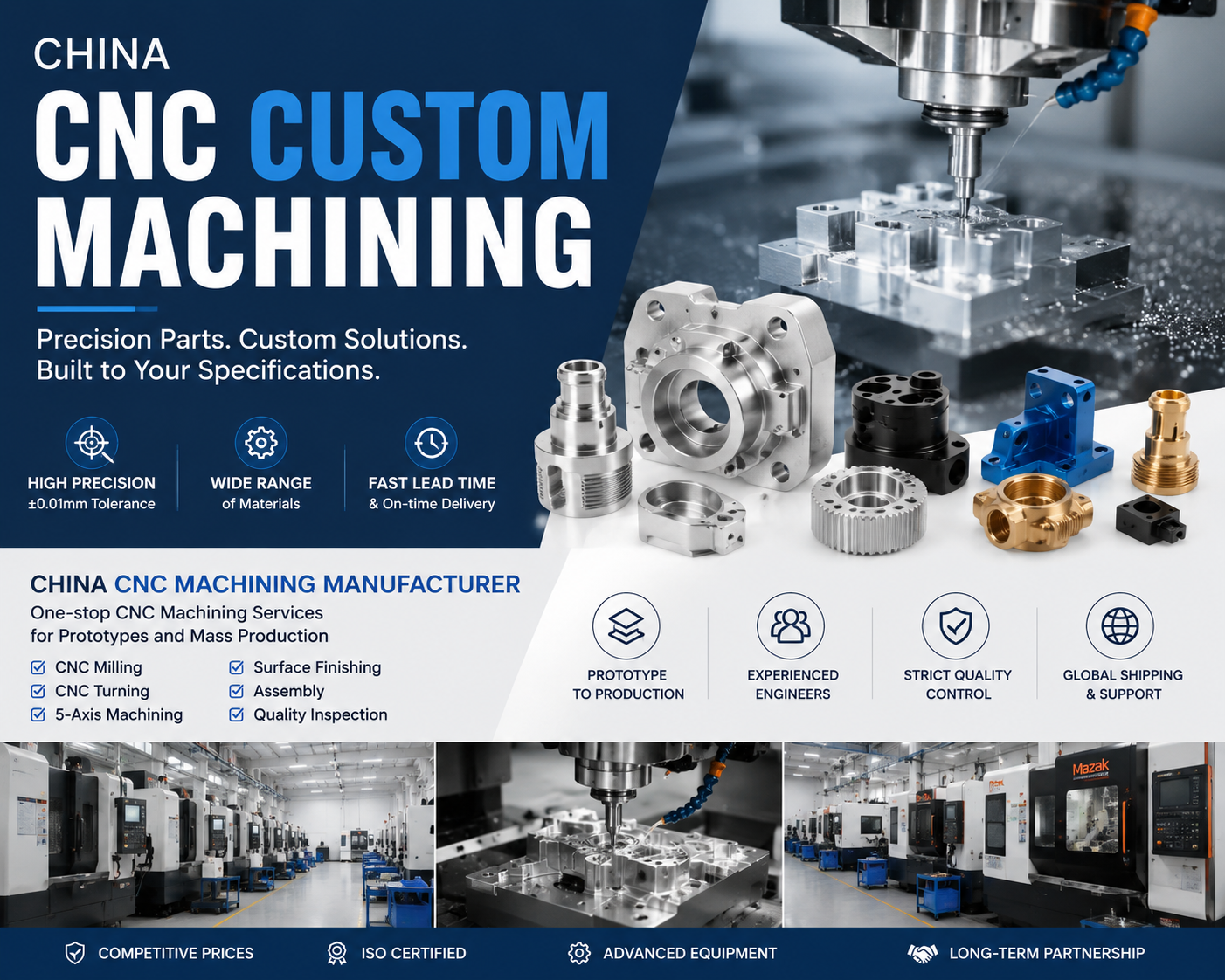
The continued evolution of precision manufacturing is creating new opportunities for companies seeking customised components for industrial machinery, automation, electronics, robotics and advanced engineering applications. With improvements in machining technology, digital production and inspection systems, china cnc custom machining is increasingly supporting businesses that require specialised parts manufactured directly from engineering designs.
The development reflects a broader shift in manufacturing. Companies are increasingly looking beyond standard components and seeking production partners capable of handling customised geometries, different materials, prototype quantities and repeat production.
Within this environment, the role of a professional china cnc machining manufacturer is expanding from basic component production towards integrated engineering and manufacturing support.
Modern mechanical products often combine compact dimensions with increasingly detailed component requirements.
A single custom part may contain threaded holes, pockets, precision bores, curved surfaces and several mounting interfaces. Producing these features consistently requires appropriate machinery, process planning and dimensional verification.
China cnc custom machining addresses these requirements by using programmed machine tools to manufacture components according to digital models and technical drawings.
Rather than manufacturing only predetermined product designs, CNC production can adapt to individual customer specifications.
This makes the process suitable for businesses developing new products as well as organisations requiring customised components for existing equipment.
The connection between digital design and physical manufacturing has become one of the most significant developments in CNC machining.
Engineers can create a component using CAD software and communicate detailed requirements electronically to the production team.
After receiving the design, the china cnc machining manufacturer can evaluate:
Manufacturing engineers then develop machining strategies and CNC programmes appropriate to the component.
This digital workflow can make design revisions easier during prototype development because engineering data can be updated before subsequent components are manufactured.
CNC technology has progressed significantly beyond conventional machining.
While three-axis machining remains highly effective for many standard geometries, four-axis and five-axis systems provide additional manufacturing flexibility.
Five-axis equipment allows cutting tools to approach components from several orientations.
For suitable components, this can offer several advantages:
A china cnc custom machining facility can therefore choose machining technology according to the actual geometry and production requirements of each project.
The need for customised precision components is not limited to one industry.
CNC machining can support numerous sectors where dimensional control and material performance are important.
| Industry | Typical CNC Machined Components |
| Automation | Fixtures, brackets, mounting parts |
| Robotics | Structural parts, joints, housings |
| Automotive | Prototype and mechanical components |
| Electronics | Enclosures and mounting components |
| Machinery | Shafts, bushes and replacement parts |
| Energy Equipment | Connectors and mechanical components |
| Scientific Equipment | Custom precision parts |
The flexibility to move between different component designs is one reason china cnc custom machining remains relevant to both specialised engineering projects and ongoing production programmes.
Modern CNC manufacturers can process numerous metals and engineering plastics.
Common options include aluminium, stainless steel, carbon steel, brass, copper, titanium, POM and nylon.
Each material presents different machining considerations.
Aluminium, for example, is frequently selected for applications requiring low weight and good machinability. Stainless steel may be preferred where strength and corrosion resistance are important.
Copper can suit electrical or thermal applications, while engineering plastics may be selected where low weight, insulation or specific friction characteristics are required.
A capable china cnc machining manufacturer should understand these differences and manufacture according to the material grade specified by the customer.
As engineering designs become more precise, inspection technology is becoming equally important.
Manufacturing a component is only one part of the process. The supplier must also determine whether the finished component meets specified requirements.
Depending on the project, inspection may involve:
Modern quality management increasingly relies on documented dimensional verification rather than visual judgement alone.
For china cnc custom machining projects containing critical dimensions, customers can establish inspection criteria before production begins.
This can be particularly important for mating components, bearing locations, alignment features and precision assemblies.
Product development involves uncertainty.
A component that appears correct in CAD software may reveal unexpected issues once it becomes a physical object.
For this reason, prototype manufacturing remains an important application of CNC machining.
Companies can use prototypes to evaluate:
If changes are required, engineers can revise the design before larger production quantities are ordered.
This ability to move from digital design to physical evaluation gives china cnc custom machining an important role within product development.
Advanced machinery alone does not guarantee economical production.
The geometry created by the product designer can have a significant effect on machining time.
Features such as extremely deep pockets, thin walls, difficult internal corners or unnecessary tight tolerances may increase manufacturing complexity.
A china cnc machining manufacturer offering Design for Manufacturability feedback can identify such issues before production.
Where functionality allows, designers may consider:
Small engineering changes can sometimes produce meaningful manufacturing efficiencies.
Finished components may move from machining into secondary processing.
Depending on material and application, available processes can include anodising, passivation, electroplating, polishing, bead blasting, powder coating and black oxide treatment.
These treatments can serve different purposes.
Some improve visual appearance, while others may provide corrosion protection or specific surface characteristics.
For this reason, surface requirements should be included within the original manufacturing specification rather than decided only after machining.
International sourcing decisions are increasingly based on more than unit price.
Businesses evaluating china cnc custom machining may examine whether a supplier can explain how components will be manufactured, inspected and controlled during repeat production.
Important evaluation areas include:
The objective is to establish whether the supplier can maintain manufacturing consistency as a project moves from prototype quantities towards repeat orders.
It is the production of customised components using computer-controlled machining equipment according to customer drawings, CAD models and technical specifications.
A manufacturer can provide CNC milling, turning, drilling and other machining processes to produce custom metal or plastic components.
CNC machining is used across automation, robotics, automotive, electronics, machinery, scientific equipment and many other engineering sectors.
Yes. CNC machining is widely used for prototype production because many components can be manufactured directly from CAD data.
Multi-axis machining enables movement across additional axes, allowing tools to reach more complex component surfaces.
Common materials include aluminium, steel, stainless steel, brass, copper, titanium and engineering plastics.
Inspection can involve CMM equipment, micrometers, callipers, gauges and optical measuring technologies.
DFM helps identify design features that may make a component unnecessarily difficult or costly to manufacture.
Yes. Anodising, plating, polishing, passivation, blasting and powder coating are among the possible options.
A detailed RFQ should contain CAD data, drawings, material grade, quantity, tolerances, finishing specifications and quality requirements.
Read more – https://shopnets.com/china-cnc-custom-machining-how-to-choose-the-right-manufacturing-partner/
https://newsgrow.blogspot.com/2026/08/china-cnc-custom-machining-practical.html