


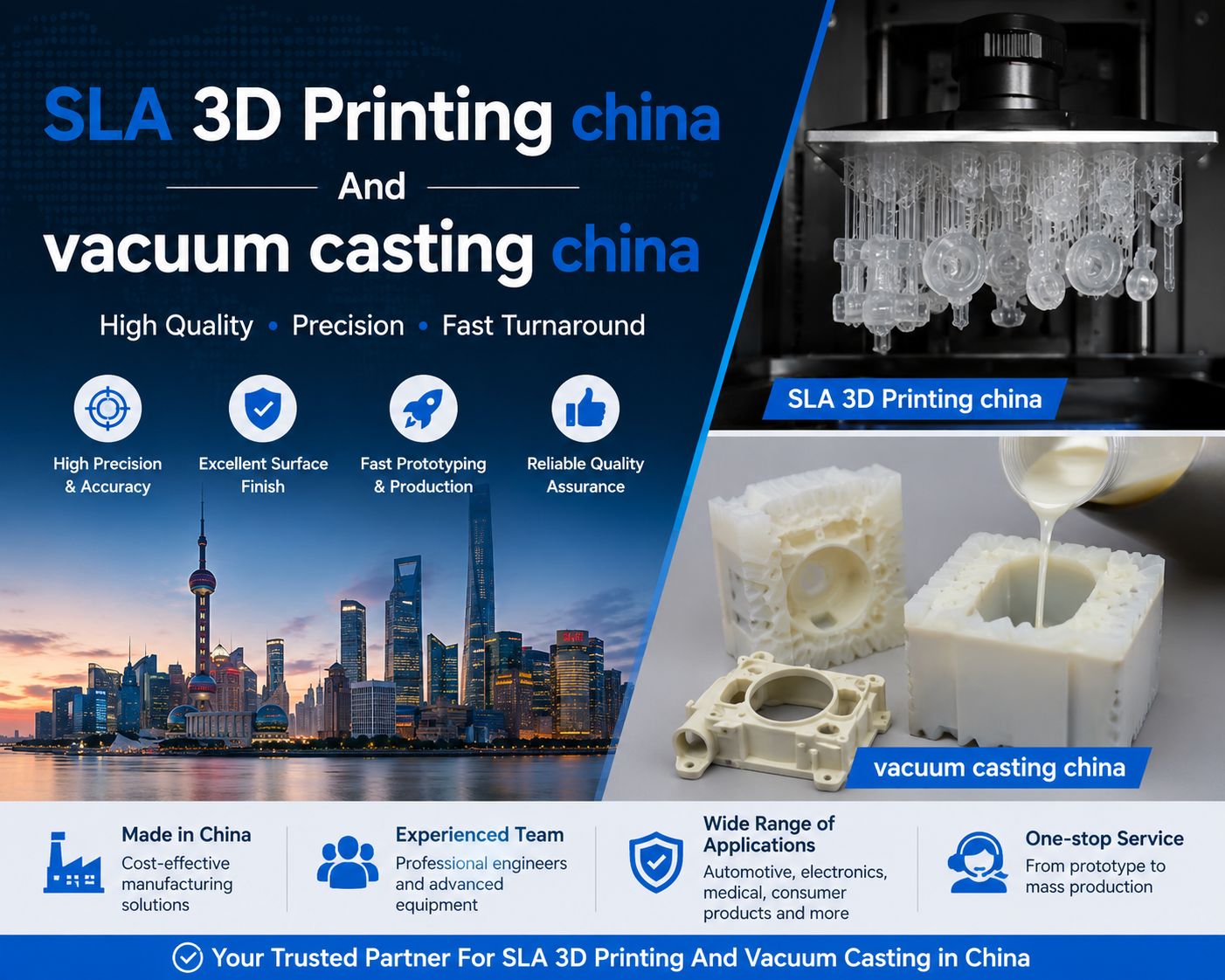
Rapid manufacturing continues to transform how companies develop, test and prepare new products for commercial production. As engineering teams face growing pressure to shorten development schedules while maintaining product quality, SLA 3D Printing China and vacuum casting China are providing flexible manufacturing routes for prototypes and low-volume components.
The two technologies address different stages of product development. SLA 3D printing enables companies to transform digital designs into detailed physical prototypes, while vacuum casting allows validated designs to be reproduced in limited quantities using silicone mould technology.
Together, these capabilities are creating a practical development pathway for businesses operating across consumer electronics, automotive, medical equipment, industrial engineering and other product-driven sectors.
Prototyping was once primarily associated with basic models used to demonstrate how a future product might look. Modern development teams increasingly expect prototypes to support dimensional reviews, assembly evaluation, ergonomic assessment and pre-production decision-making.
SLA 3D Printing China supports this changing requirement by producing physical models directly from three-dimensional CAD files.
Stereolithography uses controlled light to selectively cure liquid photopolymer resin. The component is manufactured progressively in thin layers until the complete geometry is formed.
The printed model then undergoes cleaning, post-curing and finishing according to its intended application.
This digital manufacturing approach eliminates the need for conventional hard tooling during early prototype development.
The ability to manufacture directly from CAD data means product teams can make modifications between prototype versions without rebuilding conventional production tools.
This can be valuable when developing products involving:
A company developing a new electronic enclosure, for example, can manufacture an initial SLA prototype to check dimensions and component fit.
If changes are required, engineers can update the digital design before producing the next version.
This makes SLA 3D Printing China particularly relevant during iterative development.
SLA technology can be applied to numerous product categories.
Typical applications include automotive interior prototypes, consumer electronics housings, medical equipment models, industrial components, household appliance designs and presentation models.
Another significant application is master-pattern manufacturing.
Once an SLA prototype has been validated and professionally finished, it can become the master used for vacuum casting China.
This creates a direct connection between additive manufacturing and low-volume replication.
Not every development project moves directly from a prototype to mass production.
Businesses frequently require 10, 20 or more representative components for testing, demonstrations, customer evaluations or internal trials before approving higher-volume manufacturing.
Vacuum casting China can address this intermediate requirement.
The process typically begins with an accurate master model. Silicone is formed around the master to create a flexible mould containing a detailed impression of the component.
After the master is removed, casting resin is introduced into the mould. Vacuum processing helps control trapped air and supports the reproduction of fine features.
Once cured, the component is removed, trimmed and finished according to the required specification.
Producing multiple representative components creates opportunities beyond basic dimensional inspection.
Vacuum-cast parts may be used for:
Depending on the selected casting material, components can provide rigid, flexible, rubber-like, transparent or coloured characteristics.
This makes vacuum casting China useful when development teams require multiple visually consistent prototypes without committing immediately to hard production tooling.
One of the most significant benefits comes from combining both technologies within a single product-development programme.
The process can begin with SLA 3D Printing China during early design evaluation.
Once the prototype has been reviewed and engineering changes have been completed, a final SLA master can be prepared.
That master can then be used to manufacture the silicone mould required for vacuum casting China.
The complete workflow can follow:
CAD Concept → SLA Prototype → Design Review → Engineering Changes → Approved Master → Silicone Mould → Vacuum-Cast Components → Pre-Production Evaluation
This strategy enables businesses to increase manufacturing quantities gradually as confidence in the design increases.
Although SLA and vacuum casting are often connected, they solve different manufacturing problems.
| Project Requirement | SLA 3D Printing | Vacuum Casting |
| Directly uses CAD data | Yes | Master required |
| Conventional hard tooling | No | No |
| Silicone mould required | No | Yes |
| Best suited for | Rapid prototypes | Low-volume parts |
| Design changes | Easy to implement | Can require new mould |
| Main material family | Photopolymer resin | Casting polyurethane |
| Complex geometry | Excellent | Geometry dependent |
| Cosmetic quality | High | Follows master quality |
| Multiple identical parts | Printed individually | Reproduced from mould |
| Typical stage | Design development | Pre-production |
Selecting between the processes therefore depends on development stage, required quantity and intended component performance.
Material selection is an important consideration in both processes.
For SLA 3D Printing China, available resin families may include standard, tough, clear, flexible and temperature-resistant formulations.
Standard materials may be appropriate for visual models, while specialised resins can be considered when the prototype must satisfy additional functional requirements.
Vacuum casting provides another range of material possibilities.
Manufacturers may offer:
Engineering teams should review actual material specifications rather than assuming that terms such as ABS-like mean identical performance to production-grade ABS.
As prototypes become increasingly representative of finished products, quality control becomes more important.
A professional SLA 3D Printing China or vacuum casting China project should begin with clearly documented specifications.
Buyers should provide:
This information enables manufacturing engineers to review the project before production begins.
The lowest prototype quotation does not necessarily represent the lowest overall development cost.
Poor dimensional control, incorrect materials or misunderstood cosmetic requirements can result in additional manufacturing cycles.
Companies sourcing rapid-manufacturing services in China are therefore encouraged to evaluate suppliers based on technical capability.
Important considerations include:
Strong engineering communication can be especially important for international projects involving detailed specifications.
It refers to stereolithography services offered by Chinese manufacturers for creating resin components directly from digital CAD data.
SLA provides detailed physical models without requiring conventional hard tooling, allowing designs to be revised relatively quickly.
It refers to Chinese manufacturing services that use silicone moulds and casting materials to reproduce low-volume components.
Yes. An SLA prototype can be finished and used as the master pattern for creating a silicone mould.
Applications can include automotive, electronics, medical equipment, industrial engineering, appliances and consumer products.
Yes. Depending on the manufacturer, flexible and rubber-like polyurethane materials may be available.
Yes. Both SLA and vacuum casting can offer clear-material options for suitable applications.
It is generally better suited to low-volume requirements. Higher quantities may require injection moulding or another scalable manufacturing process.
Part size, resin volume, geometry, material, support requirements, printing orientation and finishing can all affect pricing.
CAD files, drawings, quantities, tolerances, material requirements, colour and finishing specifications should be provided wherever possible.
The growing integration of SLA 3D Printing China and vacuum casting China reflects a wider movement towards flexible, digitally driven product development.
Instead of making a large manufacturing commitment immediately after completing a CAD design, businesses can progressively validate their products through physical prototypes and low-volume batches.
SLA supports fast design iteration. Vacuum casting enables approved designs to move into limited production. Together, they provide a practical bridge between concept development and scalable manufacturing.
Read more – https://shopnets.com/china-cnc-custom-machining-how-to-choose-the-right-manufacturing-partner/
https://newsgrow.blogspot.com/2026/08/china-cnc-custom-machining-practical.html
https://newsgrow.blogspot.com/2026/08/china-cnc-machining-suppliers-and.html
https://newsgrow.blogspot.com/2026/08/sla-3d-printing-china-and-vacuum.html