


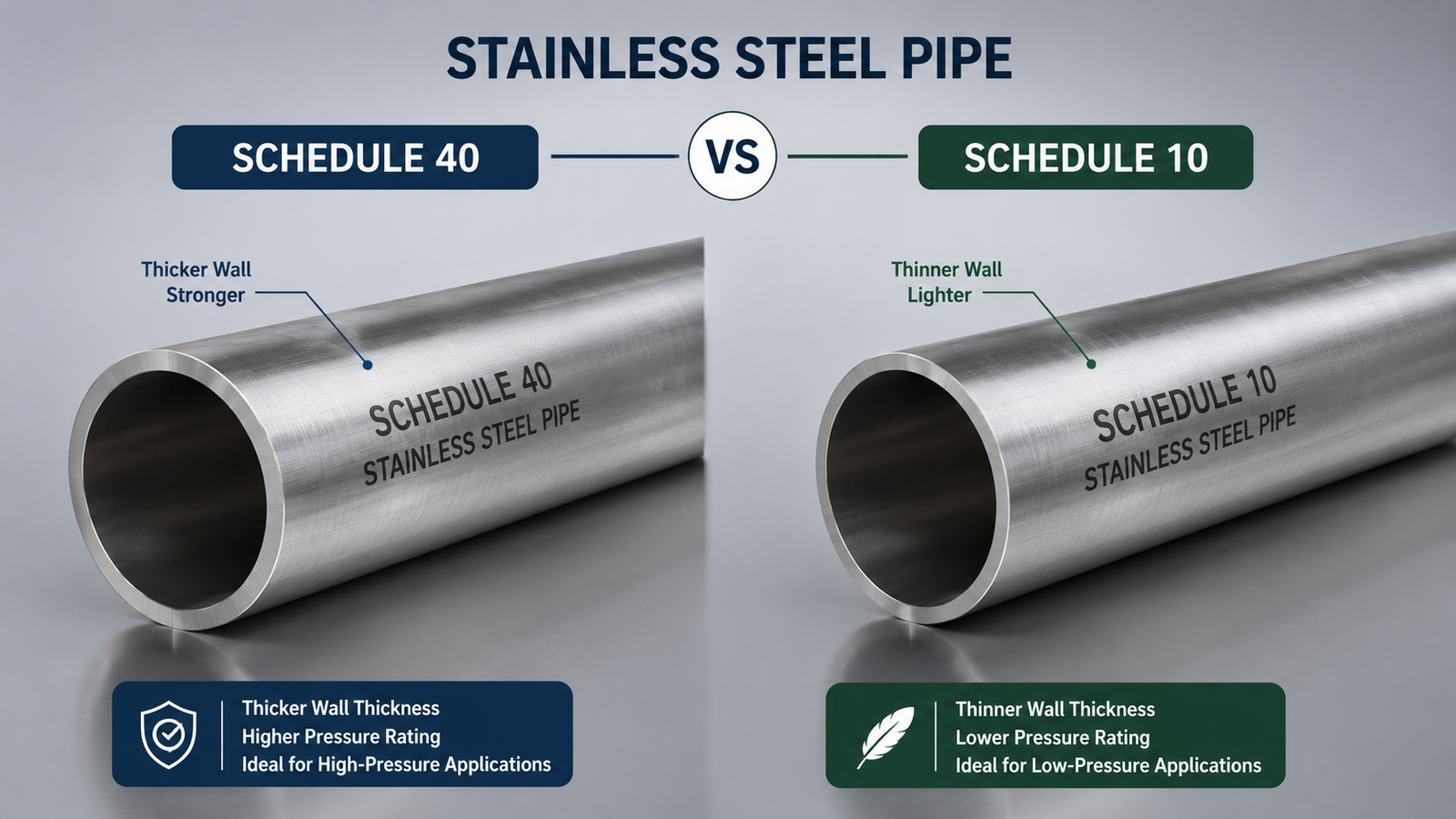
The stainless steel piping industry continues to see strong demand from chemical processing, food manufacturing, pharmaceuticals, water treatment, construction, power generation, and industrial infrastructure projects. Among the most frequently compared products are Stainless Steel Pipe Schedule 40 and Schedule 10 Stainless Steel Pipe, two options designed for different combinations of strength, weight, pressure, and project economics.
Industry buyers are increasingly paying closer attention to pipe schedules because choosing the wrong wall thickness can increase costs, complicate installation, or reduce system reliability. While both schedules are manufactured from corrosion-resistant stainless steel grades, their performance characteristics can vary significantly.
Modern piping projects are moving away from a “one-size-fits-all” approach. Instead of automatically purchasing thicker pipe, engineers are evaluating operating pressure, temperature, flow requirements, corrosion exposure, installation conditions, and lifecycle costs.
This has increased interest in both Stainless Steel Pipe Schedule 40 and Schedule 10 Stainless Steel Pipe.
Schedule 10 is often considered where lower weight and efficient material usage are priorities. Schedule 40, meanwhile, remains widely specified where additional wall thickness and mechanical strength are required.
The final decision depends on engineering requirements rather than schedule number alone.
A pipe schedule indicates the wall thickness category of a pipe. It should not be confused with the nominal pipe diameter.
For the same nominal pipe size, the outside diameter is generally standardized, while the wall thickness changes according to the schedule.
This means a Schedule 10 Stainless Steel Pipe normally has a thinner wall and larger internal opening than Schedule 40 of the same nominal size.
Common stainless steel schedules include:
Higher schedules generally indicate thicker walls, although exact dimensions should always be checked against the relevant dimensional standard.
Stainless Steel Pipe Schedule 40 continues to play an important role in industrial piping installations requiring durability and increased mechanical strength.
Its thicker wall can provide advantages in systems exposed to vibration, accidental impact, higher internal pressures, and challenging operating environments.
Common applications include:
Schedule 40 stainless steel pipes are available in popular grades such as 304, 304L, 316, and 316L.
Material grade selection remains critical because corrosion resistance can vary considerably according to the environment.
At the same time, Schedule 10 Stainless Steel Pipe has become an attractive option for projects where a thinner wall can safely satisfy operational requirements.
Lower material content generally means reduced pipe weight. This can simplify transportation, lifting, supporting, and on-site installation.
Schedule 10 pipes may be found in:
For large piping networks, weight reductions can become especially important because they may influence supporting structures and installation labor.
Industry professionals typically compare wall thickness, weight, pressure capability, flow area, and cost before specifying a pipe.
| Comparison Point | Schedule 10 Stainless Steel Pipe | Stainless Steel Pipe Schedule 40 |
| Wall thickness | Thinner | Thicker |
| Overall weight | Lower | Higher |
| Material consumption | Less | More |
| Internal diameter | Generally larger | Generally smaller |
| Mechanical strength | Moderate | Higher |
| Pressure capability | Generally lower | Generally higher |
| Installation | Easier to handle | Requires more handling |
| Material cost | Often lower | Often higher |
| Typical application | Light/moderate service | More demanding service |
The comparison shows why neither option can be considered universally better. Each serves a different engineering purpose.
Experts caution against using pipe schedule as the only indicator of pressure capability.
Actual allowable operating pressure depends on multiple factors, including:
A Stainless Steel Pipe Schedule 40 may generally withstand more demanding conditions than a comparable Schedule 10 pipe, but pressure calculations must still be completed according to recognized engineering standards.
Pipe schedule determines dimensional characteristics, while stainless steel grade influences corrosion resistance, mechanical properties, and suitability for specific environments.
304 stainless steel remains widely used for general-purpose systems. It combines corrosion resistance with good fabrication characteristics.
316 stainless steel contains molybdenum and is frequently chosen for applications involving more aggressive environments, including many chloride-containing conditions.
304L and 316L are low-carbon variations commonly used where welding requirements are important.
Project planners must therefore consider both grade and schedule when purchasing stainless steel piping.
The thinner wall of Schedule 10 Stainless Steel Pipe means that, for the same nominal size and outside diameter, it can provide a larger internal diameter than Schedule 40.
This may help improve fluid flow and reduce certain friction losses.
However, flow performance cannot be evaluated from internal diameter alone. Engineers must also consider:
A piping system should be designed as a complete network rather than as individual pipe sections.
Rising project costs have encouraged contractors and procurement teams to avoid unnecessary material usage.
Using Schedule 40 where Schedule 10 safely meets design requirements can increase project weight and material expenditure. On the other hand, selecting thinner-wall pipe solely to reduce cost can create operational risks if pressure or structural requirements are underestimated.
This is why accurate engineering specifications have become increasingly important.
The objective is to select the lightest and most economical pipe that still safely meets all operating requirements.
Demand for both pipe schedules remains diverse.
Major user industries include:
Stainless steel remains attractive because of its corrosion resistance, hygienic characteristics, durability, and ability to perform in challenging environments.
Before purchasing Stainless Steel Pipe Schedule 40 or Schedule 10 Stainless Steel Pipe, buyers should verify the complete technical specification.
Important purchasing details include:
Requesting proper documentation can help confirm that supplied material matches the engineering specification.
1. What is Schedule 10 stainless steel pipe?
It is a thinner-wall stainless steel pipe commonly used where engineering requirements do not demand heavier piping.
2. What is Stainless Steel Pipe Schedule 40?
It is a thicker-wall pipe schedule commonly selected for industrial and mechanically demanding applications.
3. Which schedule has a thicker wall?
Schedule 40 generally has a thicker wall than Schedule 10 for the same nominal size.
4. Which pipe is lighter?
Schedule 10 is generally lighter.
5. Which one costs less?
Schedule 10 may cost less because it uses less stainless steel, although actual pricing varies.
6. Does pipe schedule change outside diameter?
For the same nominal pipe size, the standardized outside diameter generally remains unchanged.
7. Which schedule offers a larger internal diameter?
Schedule 10 generally provides a larger internal diameter.
8. Can Schedule 10 be used in industrial systems?
Yes, when its calculated strength and pressure capability meet system requirements.
9. What grades are commonly available?
304, 304L, 316, and 316L are widely used.
10. How should buyers choose between the two?
They should evaluate pressure, temperature, corrosion, flow, material grade, wall thickness, and applicable engineering codes.