


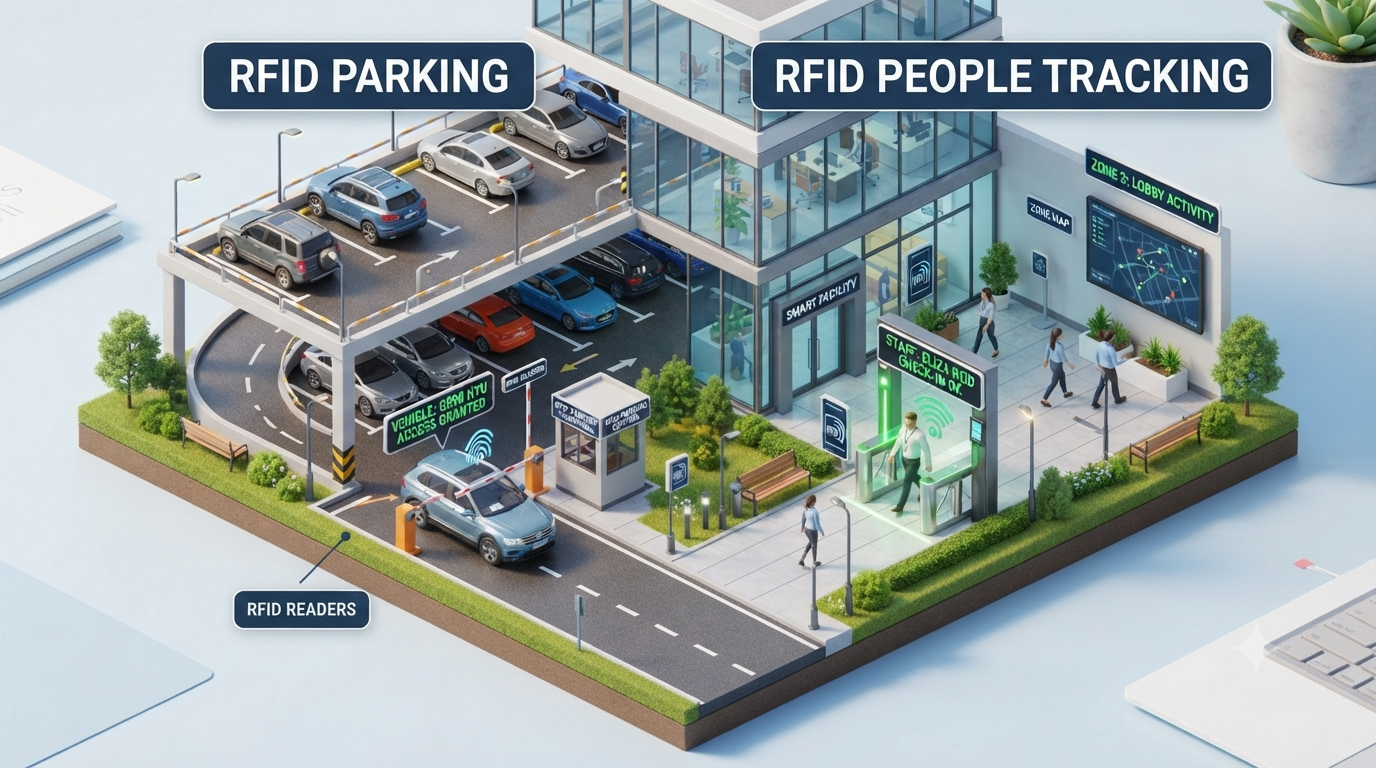
Modern organizations increasingly need faster, safer, and more accurate ways to manage vehicles and people. Technologies such as RFID Parking and RFID People Tracking provide automated solutions that reduce manual work while improving security, visibility, and operational efficiency. From corporate campuses and residential societies to factories, hospitals, schools, warehouses, and commercial buildings, RFID technology can simplify access management and generate valuable real-time data.
Radio Frequency Identification, commonly known as RFID, uses tags, readers, antennas, and management software to identify tagged vehicles or individuals automatically. Unlike traditional manual registers or paper-based systems, RFID solutions can record activity quickly with minimal human intervention.
RFID Parking is an automated vehicle identification and parking access system that uses RFID tags installed on vehicles. RFID readers positioned near entry and exit points detect authorized tags and communicate with the parking management system.
Once a registered vehicle approaches the gate, the RFID reader identifies its unique tag. If authorization is confirmed, the barrier can open automatically. The system may simultaneously record vehicle information, entry time, exit time, parking duration, and access location.
A typical RFID parking setup includes:
This automation can significantly reduce queues, manual verification, and unauthorized parking.
The working process of RFID Parking is relatively straightforward.
The same process can be followed at the exit. Administrators can review vehicle movement records whenever necessary.
Because RFID communication can occur without physical contact, drivers generally do not need to swipe cards or open vehicle windows.
Organizations implementing RFID parking systems can gain several practical benefits.
Faster Vehicle Access: Automated identification helps vehicles enter and exit quickly.
Improved Security: Only vehicles with valid RFID credentials can receive automatic access.
Accurate Records: Entry and exit activities can be stored digitally for reporting and auditing.
Reduced Manpower: Automated gates reduce dependence on employees manually checking every vehicle.
Better Traffic Management: Faster authorization can decrease congestion around parking entrances.
Centralized Control: Administrators can add, block, activate, or deactivate vehicle permissions through management software.
These capabilities make RFID suitable for offices, apartments, universities, industrial facilities, hotels, airports, and other controlled parking environments.
RFID People Tracking uses RFID-enabled identification cards, badges, wristbands, or tags to identify and monitor people within authorized environments.
RFID readers installed at selected locations detect tags as individuals move through designated areas. The system can record movement events, access activity, attendance, or presence information depending on the RFID technology and infrastructure being used.
Common applications include:
Organizations should clearly define tracking purposes and establish appropriate privacy, security, and data-retention policies before deployment.
Each authorized individual receives an RFID tag containing a unique identification number. Readers are placed at entrances, exits, rooms, checkpoints, or important operational zones.
When the person carrying the tag comes within the reader’s supported detection area, the system registers the tag and associates it with authorized information in the database.
Depending on system design, administrators may see details such as:
It is important to understand that RFID capabilities vary. Some implementations detect checkpoint-level presence, while specialized real-time location systems can provide more detailed location information.
| Feature | RFID Parking | RFID People Tracking |
| Primary Purpose | Vehicle identification | Individual identification |
| RFID Tag | Vehicle or windshield tag | Card, badge, or wristband |
| Common Reader Location | Parking gates | Doors and checkpoints |
| Main Benefit | Automated vehicle access | Movement and attendance visibility |
| Typical Users | Residents, employees, visitors | Employees, students, visitors |
| Automation | Barrier operation | Access or attendance recording |
Both technologies use the same fundamental RFID concept but solve different operational challenges.
Selecting an RFID solution requires more than choosing tags and readers. Businesses should evaluate their actual environment and objectives.
Important considerations include:
For RFID Parking, organizations should also evaluate vehicle speed, lane width, gate placement, and tag orientation. For RFID People Tracking, privacy policies and employee or visitor communication should receive equal attention.
Modern RFID platforms can become more powerful when connected with complementary systems.
RFID parking solutions may integrate with automatic barriers, license plate recognition cameras, visitor management systems, payment platforms, CCTV, and centralized access control.
Similarly, RFID People Tracking platforms may integrate with HR software, attendance systems, security dashboards, building access controls, or emergency management platforms.
Integration creates a centralized ecosystem where administrators can analyze information instead of managing multiple disconnected systems.
A successful RFID deployment should begin with proper planning.
Organizations should first identify what needs to be tracked and why. Reader positions should then be tested carefully because walls, metals, interference, distance, and environmental conditions can affect RFID performance.
Businesses should also:
Regular maintenance helps ensure long-term reliability.
1. What does RFID stand for?
RFID means Radio Frequency Identification, a technology used to identify tagged objects or individuals through radio signals.
2. What is RFID Parking used for?
It automates vehicle identification, parking access, and entry-exit record management.
3. Can RFID open parking barriers automatically?
Yes. Authorized RFID tags can trigger compatible automatic barriers after successful verification.
4. What is RFID People Tracking?
It uses RFID tags and readers to identify or record people at configured locations or checkpoints.
5. Can RFID be used for employee attendance?
Yes. RFID cards can automatically record attendance when employees interact with designated readers.
6. Does RFID require physical contact?
Generally, no. RFID technology communicates wirelessly within the supported reading range.
7. Can unauthorized RFID tags be blocked?
Yes. Administrators can usually deactivate or blacklist registered tags through management software.
8. Is RFID suitable for large organizations?
Yes. Properly designed RFID systems can support many users, vehicles, readers, and locations.
9. Can RFID work with CCTV systems?
Yes. Many RFID access systems can be integrated with cameras and other security technologies.
10. Is RFID data available in real time?
Many connected RFID systems can provide near-real-time activity information, although capabilities depend on network and system architecture.