


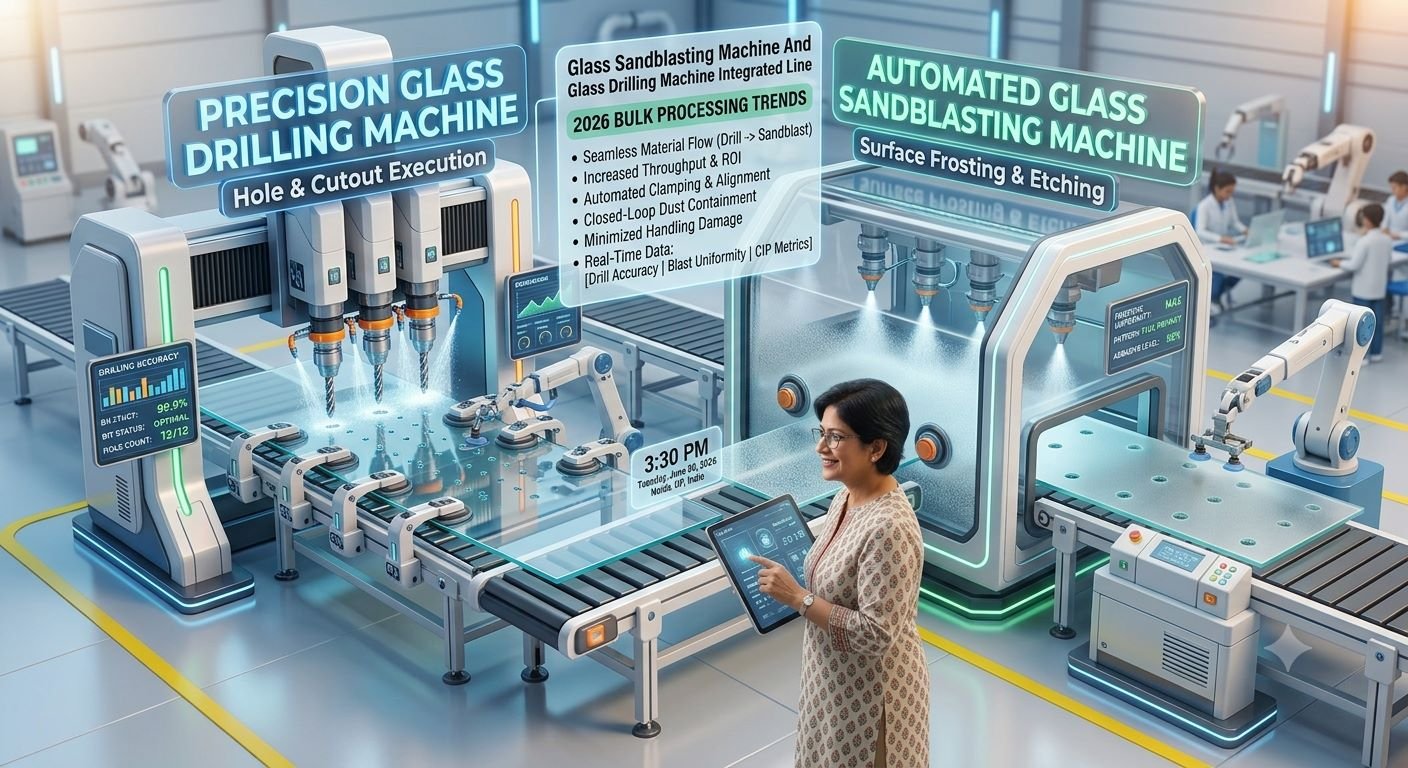
Two important pieces of equipment used by professional glass processors are the Glass Sandblasting Machine and Glass Drilling Machine. Although these machines perform completely different operations, both play essential roles in architectural glass, furniture manufacturing, decorative glass, mirrors, doors, partitions, shower enclosures, and industrial glass production.
Understanding their working principles, applications, features, and selection criteria helps manufacturers improve productivity while maintaining high-quality finished glass products.
A Glass Sandblasting Machine is specialized equipment designed to create frosted, matte, patterned, or decorative finishes on glass surfaces. It operates by directing abrasive material at controlled pressure toward the glass.
The abrasive particles remove a microscopic layer from the surface, transforming transparent glass into a partially or completely opaque finish.
Modern sandblasting systems can produce:
Compared with manual blasting, automated equipment provides greater uniformity, faster processing, controlled abrasive consumption, and consistent finishing across large glass panels.
The glass sheet enters the processing chamber through a conveyor system. Inside the enclosed chamber, blasting guns project abrasive media onto selected areas.
Automatic machines allow manufacturers to control blasting speed, pressure, gun movement, and treatment intensity.
Automated blasting minimizes variations caused by manual operation. This becomes especially important when processing hundreds of identical glass panels for commercial construction or furniture projects.
The Glass Sandblasting Machine is widely used wherever decorative appearance and privacy are important.
Typical applications include:
Architectural designers often combine transparent and frosted sections to create visually attractive glass surfaces while maintaining privacy.
A Glass Drilling Machine is designed to create accurate holes in glass sheets before tempering or installation. These holes may be required for handles, fittings, hinges, connectors, electrical components, mounting systems, or decorative purposes.
Unlike conventional drilling equipment, glass drilling machines are specifically engineered to prevent excessive vibration, cracking, chipping, and overheating.
Diamond drilling tools are commonly used because of their excellent cutting ability and durability.
Glass drilling generally involves controlled cutting from one or both sides of the sheet.
The operator positions the glass according to the required hole location. The drilling spindle then approaches the surface while water continuously cools the cutting area.
The cooling water performs several functions:
Many industrial machines drill partially from the lower side and complete the hole from the upper side. This technique significantly reduces edge breakout and produces cleaner holes.
Even a small drilling error can create installation problems. Therefore, modern systems may include digital displays, positioning stops, laser references, servo-controlled movement, or CNC technology.
| Feature | Glass Sandblasting Machine | Glass Drilling Machine |
| Main Purpose | Surface finishing | Hole creation |
| Processing Type | Abrasive blasting | Diamond drilling |
| Main Result | Frosted or decorative surface | Precision hole |
| Common Application | Privacy and decoration | Hardware installation |
| Cooling Required | Generally no water cooling | Water cooling commonly required |
| Automation | Manual to fully automatic | Manual, automatic, or CNC |
| Key Accuracy Factor | Uniform surface treatment | Hole position and diameter |
Both machines can operate independently within a glass processing factory while contributing to different production stages.
Choosing industrial glass machinery should be based on actual production requirements rather than machine price alone.
Consider:
Important specifications include:
A workshop processing occasional custom pieces may require relatively simple machinery, whereas high-volume manufacturers usually benefit from automated or CNC-controlled equipment.
Both machines require regular inspection to maintain stable performance.
For sandblasting equipment, operators should inspect blasting nozzles, dust collectors, air systems, abrasive circulation components, seals, and conveyor mechanisms.
For drilling machinery, attention should be given to diamond tools, spindle alignment, water circulation, bearings, electrical components, and positioning systems.
Proper maintenance helps:
Operators should also receive appropriate training and use recommended protective equipment.
Industrial glass processing is gradually becoming more automated and digitally controlled. Manufacturers increasingly demand machines capable of higher precision with lower dependence on manual adjustment.
Future Glass Sandblasting Machine designs are likely to focus on improved abrasive recycling, energy efficiency, automated pattern control, reduced dust emissions, and intelligent production monitoring.
Similarly, advanced Glass Drilling Machine systems are moving toward CNC positioning, automated tool management, programmable drilling patterns, production data monitoring, and integration with complete glass processing lines.
Smart manufacturing technology can further connect cutting, edging, drilling, washing, tempering, and decorative processing operations through centralized production systems.
It is mainly used for frosting, decorating, texturing, and creating privacy effects on glass surfaces.
Yes. Masking techniques and automated systems can produce logos, patterns, lettering, and customized decorative designs.
Suitable abrasive media may include specialized mineral or manufactured abrasives selected according to the required surface finish.
It creates precision holes for handles, hinges, fittings, connectors, mounting hardware, and other components.
Generally, holes should be drilled before thermal tempering. Drilling tempered glass afterward can cause the sheet to break.
Water cools the drilling area, removes particles, reduces friction, and helps protect both the glass and drilling tool.
Diamond-coated drilling tools are commonly selected for professional glass processing.
Incorrect pressure, worn tools, excessive speed, poor cooling, vibration, or improper drilling technique can cause chipping.
For large-scale production, automatic systems generally provide better consistency, productivity, and process control.
Selection should consider production volume, glass size, thickness, required accuracy, automation level, maintenance support, and future expansion requirements.