


When people think about steel or wire rod production, they usually imagine large rolling stands, powerful motors, and high-speed machinery. But the performance of a rolling mill often depends on smaller precision components working continuously behind the scenes.
Two such components are Tungsten Carbide Rings and the Pinch Roller.
Both play very different roles, yet both are essential for maintaining production speed, dimensional accuracy, material stability, and overall mill efficiency.
In this blog, we will look at how these components work, why they are widely used, what affects their service life, and what operators should consider when selecting them for demanding rolling applications.
Rolling mills operate under extremely difficult conditions.
Steel products may move through the production line at high temperatures and high speed. Components are exposed to friction, pressure, thermal cycling, scale, vibration, and continuous mechanical stress.
If a critical component wears too quickly, production quality may begin to decline.
Problems may include:
This is why mills increasingly depend on wear-resistant and precisely engineered parts.
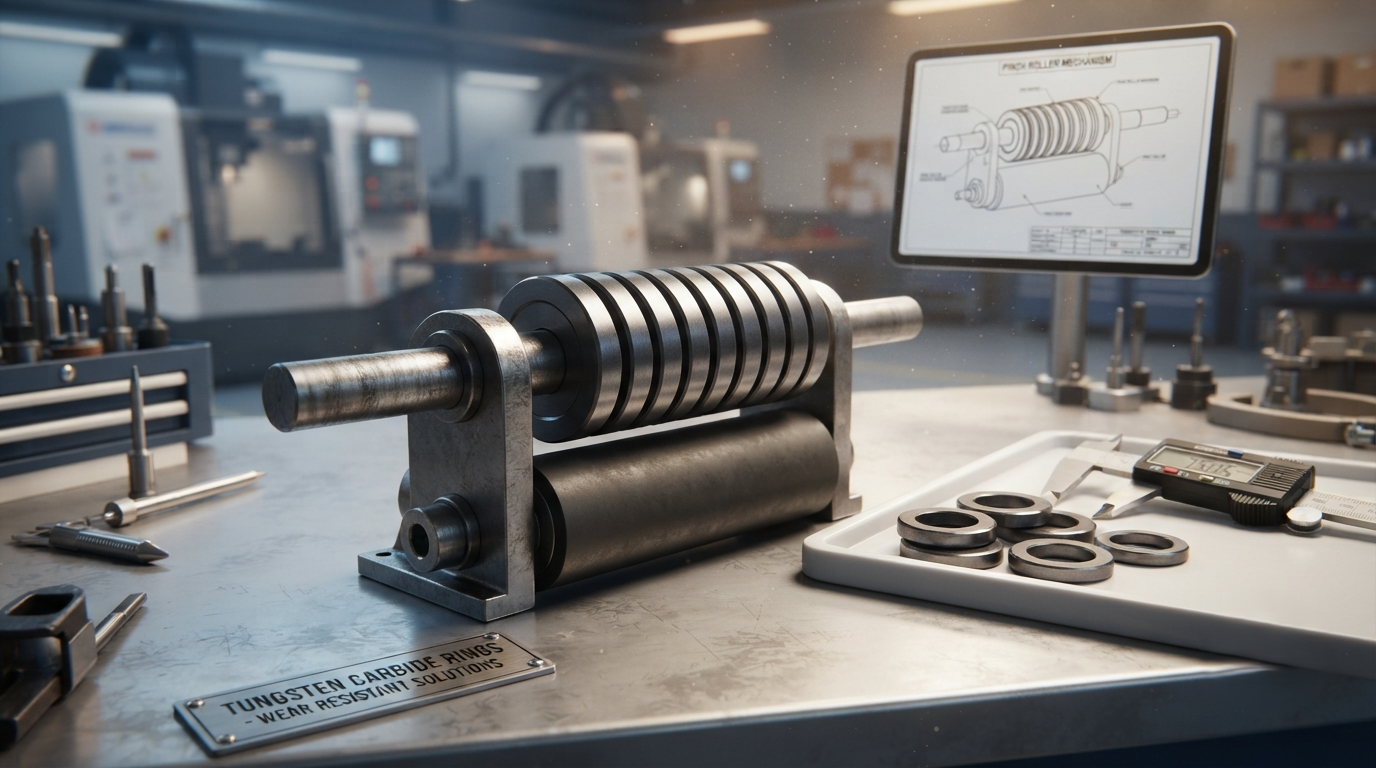
Tungsten Carbide Rings help control product shape and dimensions, while the Pinch Roller helps control how material moves through the production line.
Tungsten Carbide Rings are mainly used in rolling applications where high wear resistance is required.
They are produced from cemented carbide, a composite material made using hard tungsten carbide particles combined with a metallic binder.
This material structure gives carbide rings several important characteristics.
These include:
This is especially useful in finishing and sizing applications where even a small amount of roll wear can affect final product dimensions.
During rolling, steel passes between rotating rolls or rings.
The groove profile inside the ring shapes the steel into the required diameter or section.
The process sounds simple, but the contact conditions are severe.
The ring surface must resist:
If the groove wears unevenly, the finished product may lose dimensional accuracy.
This is one of the main reasons Tungsten Carbide Rings are preferred in high-wear rolling positions.
One common mistake is assuming that the hardest carbide grade will always provide the best performance.
That is not always true.
A very hard grade can provide excellent wear resistance, but it may be more sensitive to sudden mechanical shock.
A tougher grade may tolerate impact better, even if its wear resistance is slightly lower.
The correct carbide grade depends on several operating conditions, including:
The best solution is usually a balance between hardness and toughness.
Cooling is one of the most important factors affecting the life of Tungsten Carbide Rings.
When hot steel contacts the ring, the working surface heats up rapidly.
Cooling water then lowers the temperature.
This repeated heating and cooling creates thermal stress.
If the cooling system is not working correctly, microscopic cracks may begin to develop.
Over time, these cracks may become larger and cause:
Cooling nozzles, water pressure, flow rate, and water distribution should therefore be checked regularly.
A Pinch Roller performs a completely different job.
Instead of shaping the product, it helps control movement.
A typical pinch-roll system uses two rollers that contact the moving rod, bar, strip, or wire.
By applying controlled pressure, the rollers create enough friction to grip the product.
This allows the system to control:
In high-speed production lines, this controlled movement is extremely important.
A Pinch Roller must work in coordination with the rest of the rolling line.
If the roller speed is too high, it may pull the material too aggressively.
This can create excessive tension.
If the speed is too low, the material may become loose or unstable.
Both situations can affect downstream processing.
For this reason, modern pinch-roll systems are often synchronized with production-line speed.
Stable synchronization helps improve:
Pressure must also be carefully controlled.
If pressure is too low, the product may slip between the rollers.
This can create unstable speed and poor material control.
If pressure is too high, different problems can appear.
These may include:
The ideal setting applies only enough pressure to achieve reliable traction.
| Feature | Tungsten Carbide Rings | Pinch Roller |
| Main purpose | Shape and size material | Control material movement |
| Major advantage | Wear resistance | Stable gripping |
| Main concern | Groove wear | Slippage |
| Controls | Dimensions and profile | Speed and tension |
| Typical issue | Cracks or chipping | Bearing or surface wear |
| Critical factor | Grade selection | Pressure and synchronization |
| Maintenance focus | Cooling and groove condition | Alignment and roller condition |
Even though their functions are different, both components contribute to the same goal: reliable and efficient production.
Some common causes of carbide-ring failure include:
Operators should regularly inspect ring surfaces for small cracks and abnormal wear patterns.
Early detection can prevent larger failures.
A Pinch Roller may develop problems because of:
Regular inspection of these areas can help prevent sudden production interruptions.
Before selecting Tungsten Carbide Rings, the mill operator should provide complete operating information.
Important factors include:
Selecting only by price or hardness can lead to poor performance.
Application-based selection is much more effective.
For a Pinch Roller, selection should consider both mechanical and process requirements.
Important factors include:
The roller should provide enough grip without damaging the product.
Good maintenance can significantly increase component life.
For Tungsten Carbide Rings:
For the Pinch Roller:
Consistent maintenance is usually more cost-effective than dealing with unexpected breakdowns.
They are used in rolling mills to shape and size material while providing high wear resistance.
It grips and controls material movement, speed, and tension.
It offers high hardness and strong resistance to abrasive wear.
Yes. Thermal stress, impact, poor cooling, or incorrect mounting can lead to cracking.
Slippage may occur because of low pressure, worn surfaces, or speed mismatch.
No. Toughness is also important, especially in applications with impact or thermal shock.
Cooling controls temperature and helps reduce thermal fatigue.
Yes. Too much pressure can cause marks or deformation.
Correct alignment, pressure control, bearing maintenance, and surface inspection can improve service life.
Proper grade selection, cooling, mounting, and regular inspection can significantly improve performance.