


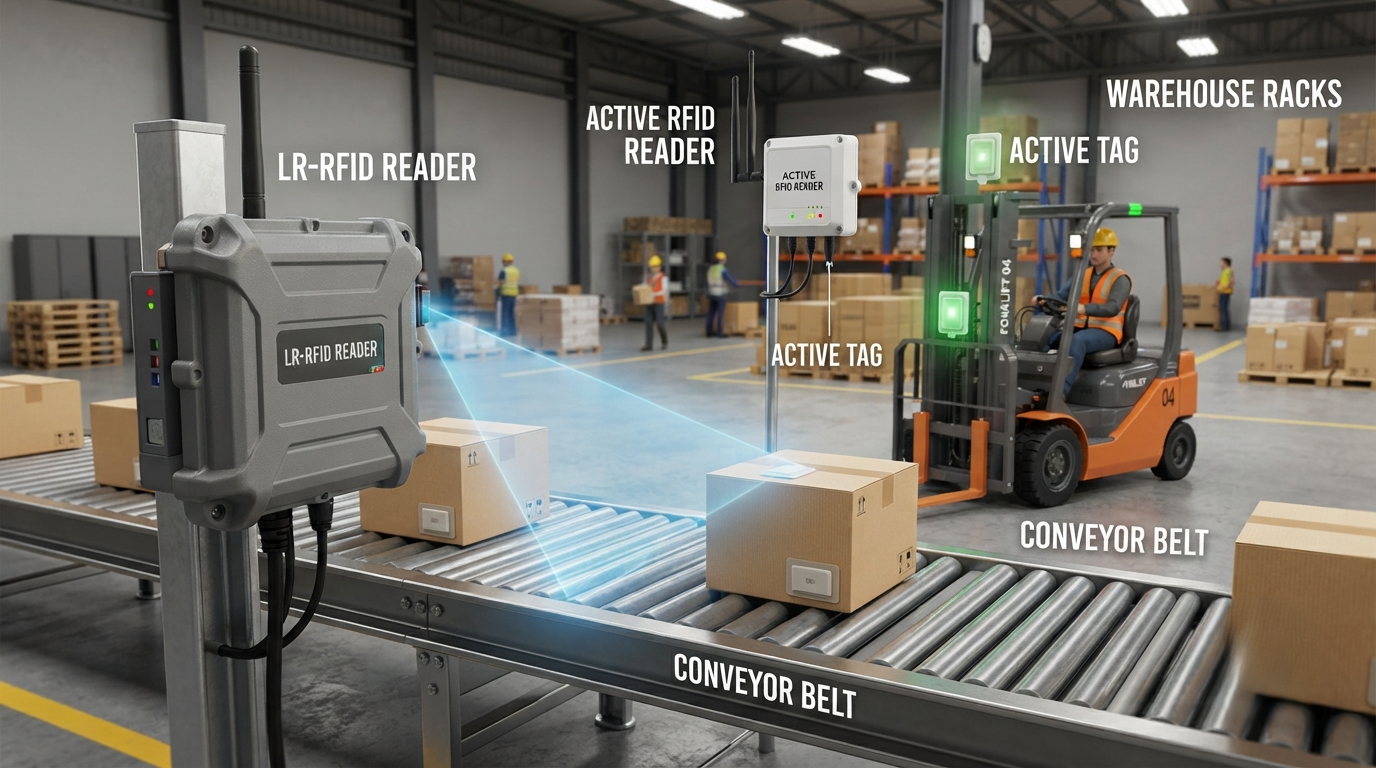
Businesses are rapidly moving toward automated identification systems to improve security, inventory accuracy, vehicle management, and asset visibility. RFID technology has become one of the most effective tools for these applications because it can identify tagged objects without requiring direct contact or line-of-sight scanning.
Among modern RFID solutions, the Long Range RFID Reader and Active RFID Reader are widely used when organizations need reliable identification across larger areas. Although both technologies support long-distance communication, they operate differently and are suited to different tracking environments.
Understanding their functions, benefits, and applications can help businesses select the right RFID infrastructure for their operations.
A Long Range RFID Reader is designed to communicate with RFID tags from a significantly greater distance than conventional proximity readers.
Most long-range RFID systems use UHF technology, allowing readers to detect passive tags attached to vehicles, pallets, cartons, assets, or equipment.
Unlike barcode systems, RFID does not require employees to manually position a scanner in front of each item.
A properly configured reader can automatically capture information when tagged objects enter or leave a predefined detection zone.
Common applications include:
Reading performance depends on antenna configuration, environmental conditions, tag orientation, frequency, and reader power.
An Active RFID Reader communicates with active RFID tags that contain their own internal battery.
Because the tag has an independent power source, it can transmit signals across greater distances compared with most passive RFID systems.
Active RFID is commonly selected when organizations need frequent communication, wider coverage, or real-time asset location.
Instead of waiting for a strong reader signal to power the tag, an active tag can periodically broadcast information.
This makes active technology useful for tracking mobile equipment, employees, vehicles, containers, medical assets, and high-value machinery.
Businesses should understand the difference between these technologies before selecting a system.
| Factor | Long Range RFID Reader | Active RFID Reader |
| Tag technology | Usually passive UHF | Battery-powered active tags |
| Tag cost | Generally lower | Generally higher |
| Maintenance | Very low | Battery replacement may be required |
| Reading distance | Long | Longer and highly flexible |
| Large-volume tagging | Excellent | Less cost-effective |
| Real-time tracking | Limited | Highly suitable |
| Common use | Inventory and access | Asset and personnel tracking |
Both technologies provide excellent automation capabilities, but the right choice depends on the use case.
A Long Range RFID Reader can significantly improve identification speed in busy operational environments.
Warehouse teams, for example, can automatically record pallet movements when goods pass through loading areas.
Businesses can gain several benefits.
RFID systems can identify tags automatically while objects are moving.
This reduces repetitive manual scanning.
Automatic RFID identification can reduce employee workload and help speed up warehouse, manufacturing, and logistics processes.
Multiple compatible RFID tags can be detected within the same reading area.
This capability is useful when tracking large quantities of products.
Automating identification can reduce incorrect manual data entry and missed barcode scans.
An Active RFID Reader provides stronger functionality for applications where organizations need continuous or frequent tracking.
Major benefits include:
For example, a manufacturing company can track important tools or machines across different production areas.
If an asset enters an unauthorized zone, the system can generate an alert.
Vehicle access control is one of the most popular uses of long-range RFID.
A passive tag can be attached to a vehicle windshield.
When the vehicle approaches the entrance, the Long Range RFID Reader detects the tag and verifies the vehicle information.
If authorization is confirmed, the software can automatically activate the gate.
This can make vehicle entry faster while reducing the need for access cards or manual verification.
Such systems can be used in:
Warehouses need accurate information about the movement of goods.
RFID can help businesses identify pallets, containers, cartons, and other inventory during receiving, storage, picking, and dispatch.
Readers installed near warehouse doors can automatically record tagged goods entering or leaving an area.
An Active RFID Reader may also be deployed to track reusable containers, forklifts, specialized equipment, or expensive mobile assets.
The collected information can be sent to warehouse management software for real-time operational visibility.
Choosing RFID technology should not be based only on maximum reading range.
Businesses should consider several operational factors:
A professional site survey can help determine suitable reader locations and antenna configurations.
RFID performance can vary depending on the environment.
Metal surfaces, liquids, walls, nearby equipment, tag placement, and radio interference may affect results.
Organizations should first test RFID technology in their actual operating environment.
Start with a pilot project and monitor reading accuracy before expanding the deployment.
Reader power should also be configured carefully.
Increasing power unnecessarily can create overlapping reading zones or detect unwanted tags.
The goal should be accurate identification within controlled areas rather than simply achieving maximum distance.
It identifies compatible RFID tags from a greater distance and automatically sends tag information to connected software.
It is commonly used for real-time asset, equipment, personnel, container, and vehicle tracking.
Yes. Active RFID tags normally contain internal batteries that power their transmissions.
Yes. Long-range UHF RFID is widely used for automated vehicle identification and parking access.
No. RFID uses radio communication and generally does not require direct line of sight.
Yes. Suitable RFID systems can identify multiple tags within the same reading zone.
Yes. It is especially useful for tracking valuable mobile assets and equipment.
Yes. RFID platforms can connect with ERP, WMS, access control, and custom applications through APIs or middleware.
Passive long-range RFID is typically more economical when thousands of tags are required.
The decision should consider range, asset value, tracking frequency, environment, software requirements, and total cost.