


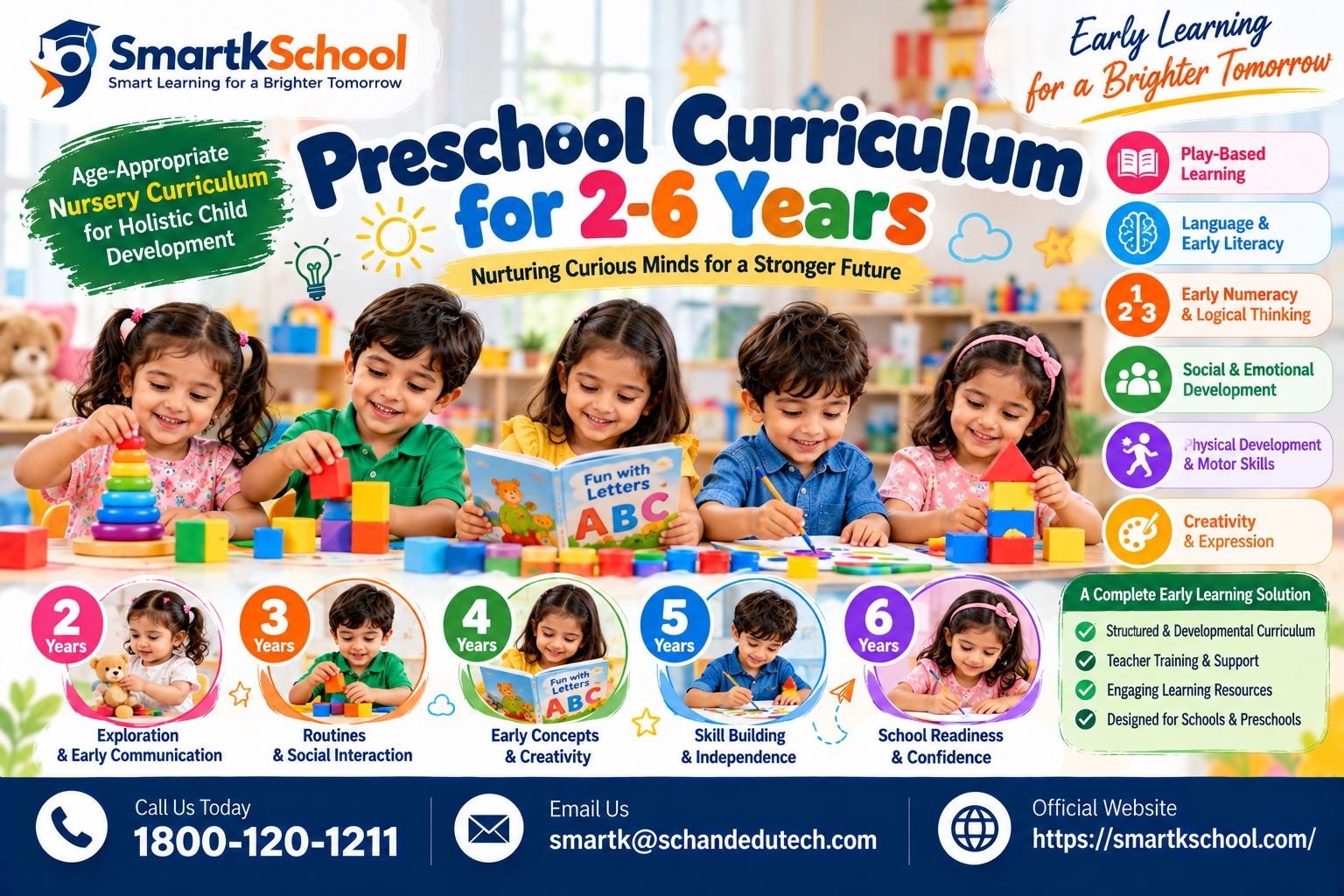
Early childhood education is entering a more development-focused phase as preschools and educational institutions recognize the importance of age-appropriate learning experiences. A well-structured preschool curriculum for 2-6 years helps young children develop communication abilities, emotional confidence, creativity, physical coordination, and foundational academic skills through meaningful activities.
For schools, designing an effective early learning program means understanding how children’s developmental needs change between toddlerhood and the beginning of formal education. A thoughtfully planned nursery curriculum combines playful exploration with guided learning, allowing children to build essential abilities without unnecessary academic pressure.
The growing emphasis on holistic education highlights the need for flexible teaching methods, engaging classroom environments, and structured developmental goals.
Children between two and six years of age experience significant developmental changes. During these formative years, they begin expanding their vocabulary, understanding relationships, strengthening motor skills, and developing greater independence.
An effective preschool curriculum for 2-6 years recognizes these differences and introduces learning opportunities suitable for each developmental stage.
Instead of expecting every child to achieve identical milestones at the same time, educators can create environments that encourage individual progress.
This philosophy places curiosity, confidence, and emotional security at the center of early childhood education.
A preschool curriculum for children aged two to six is a structured educational framework that supports cognitive, language, physical, social, emotional, and creative development.
It includes learning objectives, age-appropriate activities, teaching strategies, classroom routines, and developmental assessment methods.
Rather than relying exclusively on textbooks, effective preschool programs incorporate storytelling, sensory exploration, music, movement, creative activities, and interactive games.
The main objective is to prepare children for future learning while respecting their individual interests and developmental abilities.
Children require different learning experiences as they grow. A progressive curriculum helps educators introduce new concepts at appropriate stages.
At this stage, toddlers primarily learn through movement, observation, repetition, and sensory experiences.
Activities may include identifying familiar objects, singing action songs, exploring textures, playing with large blocks, and listening to simple stories.
The emphasis remains on communication, coordination, security, and discovery.
A structured nursery curriculum introduces more opportunities for group participation, vocabulary development, and creative expression.
Children can explore colors, shapes, counting through objects, picture recognition, storytelling, and simple cooperative games.
Teachers also encourage independence through manageable classroom routines.
Children begin exploring early literacy, numerical relationships, sequencing, and problem-solving.
Activities such as sound games, pattern recognition, artwork, puzzles, and role-playing encourage broader cognitive development.
Learning experiences increasingly support communication, logical thinking, self-management, and familiarity with formal classroom routines.
Children may explore letter-sound relationships, meaningful counting, storytelling, collaborative projects, and age-appropriate writing readiness.
These age ranges provide general guidance rather than rigid developmental expectations.
A balanced nursery curriculum should create opportunities for children to develop across several interconnected learning areas.
Language Development: Conversations, storytelling, rhymes, and picture books encourage vocabulary growth and listening skills.
Early Numeracy: Sorting, matching, comparing quantities, and identifying patterns introduce mathematical understanding.
Physical Development: Outdoor movement, drawing, clay modeling, and manipulative activities support gross and fine motor coordination.
Social-Emotional Learning: Group games, cooperative activities, and guided conversations encourage empathy, confidence, and emotional expression.
Creative Exploration: Painting, music, imaginative play, and craft activities provide opportunities for self-expression.
Environmental Awareness: Nature walks, gardening, and everyday observations help children understand their surroundings.
Together, these experiences encourage learning through active participation.
Play is a natural and meaningful learning process during early childhood.
Through building blocks, children explore size, balance, and spatial relationships. Through pretend play, they practice language, imagination, and social communication.
A well-designed preschool curriculum for 2-6 years integrates play into educational planning instead of treating it as a separate recreational activity.
Play-based teaching also provides educators with opportunities to observe children’s interests, problem-solving approaches, and emerging abilities.
Successful curriculum implementation requires more than distributing activity books and lesson plans.
Schools should establish clear developmental objectives while allowing teachers to adapt classroom experiences.
Important implementation practices include:
Teachers should also receive practical guidance on age-appropriate instruction, classroom interaction, and positive behavior support.
Children benefit when classroom learning connects naturally with everyday family experiences.
Parents can support educational development through shared reading, conversations, music, imaginative games, and outdoor exploration.
Schools can strengthen this connection by sharing simple activity suggestions and developmental observations.
A successful curriculum should encourage partnership rather than impose unrealistic academic expectations on families.
School readiness is not limited to alphabet recognition, counting, or handwriting.
It also involves confidence, independence, communication, curiosity, and the ability to participate in group activities.
An appropriate nursery curriculum gradually develops these skills through consistent routines, guided exploration, and positive relationships.
Children who experience supportive early learning environments can develop greater familiarity with classroom expectations while maintaining enthusiasm for discovery.
It is an age-appropriate educational framework designed to support language, cognitive, physical, emotional, social, and creative development through interactive activities.
It should include storytelling, sensory activities, foundational numeracy, language development, music, movement, creative expression, and social interaction.
Play encourages curiosity, problem-solving, imagination, communication, and active participation in learning experiences.
Learning should emphasize sensory exploration, communication, movement, familiar objects, simple routines, and secure social interactions.
Nursery programs generally emphasize exploration and early developmental experiences, while kindergarten gradually introduces more structured foundational learning and school readiness activities.
It introduces early literacy through stories, sounds, picture recognition, drawing, and age-appropriate pre-writing activities.
Teachers can use observations, learning portfolios, classroom activities, and developmental records rather than relying on formal examinations.
Parents can encourage learning through storytelling, meaningful conversations, creative play, simple counting games, and outdoor activities.
An effective curriculum balances developmental goals, creative activities, play-based experiences, inclusion, and flexible teaching methods.
It supports communication, independence, social confidence, foundational literacy, early numeracy, and familiarity with classroom routines.
Industry: Early Childhood Education & Preschool Curriculum Solutions
Location: New Delhi, India
Toll-Free Number: 1800-120-1211
Email: smartk@schandedutech.com
Official Website: https://smartkschool.com/