


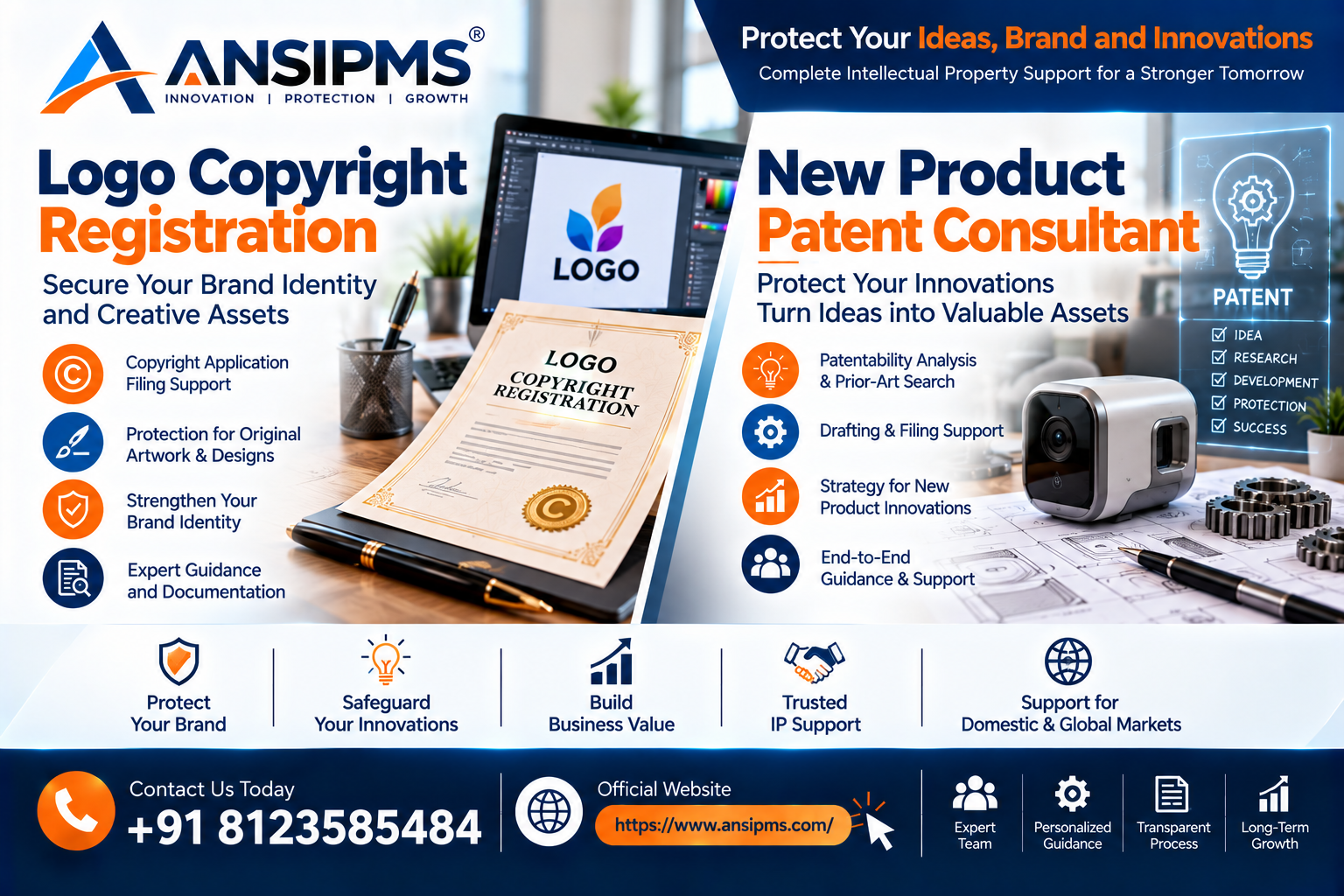
As Indian startups, manufacturers, entrepreneurs, and technology companies introduce innovative products and distinctive brand identities, protecting intellectual property has become an important business consideration. The growing interest in Logo Copyright Registration reflects the need to safeguard original creative designs, while demand for a New Product Patent Consultant highlights the importance of protecting technical inventions before commercial launch.
From emerging consumer brands to engineering companies developing advanced products, intellectual property protection can help businesses manage ownership concerns, reduce infringement risks, and establish stronger commercialization strategies.
Understanding the differences between copyright, trademarks, and patents is essential for businesses planning to protect both their brand identity and technological innovations.
A company’s logo is often one of its most recognizable business assets. It communicates brand identity, supports customer recognition, and contributes to marketing consistency.
Businesses invest in graphic design, typography, illustrations, and visual concepts to develop distinctive logos.
However, creating or using a logo does not automatically mean every aspect of the brand is protected under all intellectual property laws.
Logo Copyright Registration provides a voluntary mechanism for recording eligible original artistic works under India’s copyright framework.
Copyright generally arises automatically when qualifying original artwork is created. Registration is not mandatory for copyright to exist, although a registration certificate can provide useful documentary evidence.
Businesses should also examine trademark protection, which serves a different legal purpose.
Logo Copyright Registration is the process of applying to register eligible original logo artwork with the relevant copyright authority in India.
The Copyright Act, 1957, provides protection for qualifying original artistic works.
A logo may include illustrations, graphical designs, stylized lettering, or other artistic elements.
Copyright generally protects the original expression embodied in the artwork rather than an abstract business idea.
Registration may help businesses document ownership claims and establish an official record of the submitted work.
However, copyright registration does not automatically prove that a logo is unique in the marketplace or that its commercial use cannot infringe another party’s trademark.
Launching a new product often involves investments in research, prototype development, engineering, and manufacturing.
Businesses may create innovative mechanisms, technical improvements, manufacturing processes, or functional technologies.
A qualified New Product Patent Consultant can help inventors evaluate whether these developments may qualify for patent protection.
Professional patent-related support may include:
In India, patents are governed by the Patents Act, 1970, and applicable rules.
Patent protection is available only for inventions satisfying relevant legal requirements, and filing an application does not guarantee approval.
Businesses should identify which legal protection is appropriate for each asset.
| Protection type | Primary purpose |
| Copyright | Protects qualifying original creative expression, including artistic logo designs |
| Patent | Protects eligible technical inventions |
| Trademark | Protects distinctive identifiers used to distinguish commercial goods or services |
| Registered design | Protects qualifying visual features of articles |
A single business may benefit from several forms of intellectual property protection.
For example, an innovative electronic product may involve patentable technology, an original company logo, and a distinctive product brand.
Each requires separate legal consideration.
Businesses considering copyright registration should first confirm ownership and originality.
Identify who created the logo and review relevant employment, commissioning, or assignment agreements.
Ownership can depend on the circumstances and applicable law.
Maintain suitable copies of the original design and supporting information.
Where logo artwork is used or capable of being used in relation to goods or services, additional trademark-related documentation may be required.
Complete the prescribed copyright registration application and provide applicable supporting documents and fees.
The application may involve examination, objections, or requests for additional information.
Successful registration creates an official record but does not eliminate every possible ownership or infringement dispute.
A New Product Patent Consultant can help businesses understand the technical and legal stages of patent filing.
A typical process includes invention disclosure, prior-art analysis, patentability review, specification preparation, application filing, examination, and responses to objections.
An invention generally must demonstrate novelty, inventive step, and industrial applicability while complying with statutory exclusions.
Public disclosure before filing can affect patentability, subject to limited legal exceptions.
Early planning helps businesses consider appropriate filing decisions before presenting inventions at trade shows, publishing technical details, or sharing information without confidentiality safeguards.
Businesses sometimes confuse ownership of a logo design with trademark registration or assume that every innovative product qualifies for a patent.
Other common mistakes include using third-party artwork without clear rights, overlooking employee or contractor agreements, publicly revealing inventions prematurely, and filing incomplete patent specifications.
Companies should also understand that patents are territorial and that an Indian patent does not automatically provide worldwide protection.
Seeking appropriate advice before commercialization can help identify preventable legal risks.
Businesses should assess professional qualifications, technical understanding, experience, confidentiality practices, and transparency regarding fees.
For patents, clients should verify whether the relevant work will be handled by an appropriately qualified advocate or registered patent agent.
For creative assets, companies should clarify whether they require copyright registration, trademark protection, or both.
A suitable adviser should explain available legal options without promising guaranteed registration or approval.
It is the voluntary registration of eligible original logo artwork under India’s copyright registration framework.
No. Copyright generally arises automatically in qualifying original artistic works, although registration can provide documentary benefits.
A consultant helps inventors assess patentability, understand filing requirements, and plan appropriate protection for qualifying technical inventions.
Yes. An eligible logo may receive copyright protection for its artistic expression and trademark protection for its commercial identification function.
No. The invention must satisfy statutory patentability requirements, including novelty, inventive step, industrial applicability, and exclusions.
Ownership depends on applicable law, contractual terms, and the circumstances of creation. Written ownership arrangements are advisable.
The general patent term is 20 years from the applicable filing date, subject to statutory requirements and maintenance obligations.
Yes. Eligible startups can seek appropriate intellectual property protection for qualifying creative works and inventions.
Costs vary depending on official fees, applicant category, professional services, and procedural complexity.
No. The scope and enforceability of rights depend on applicable law, ownership, validity, and the circumstances of any dispute.
Industry: Patent, Copyright, Trademark & Intellectual Property Services
Service Region: India
Contact Number: +91 8123585484
Email: info@ansipms.com
Official Website: https://www.ansipms.com/