


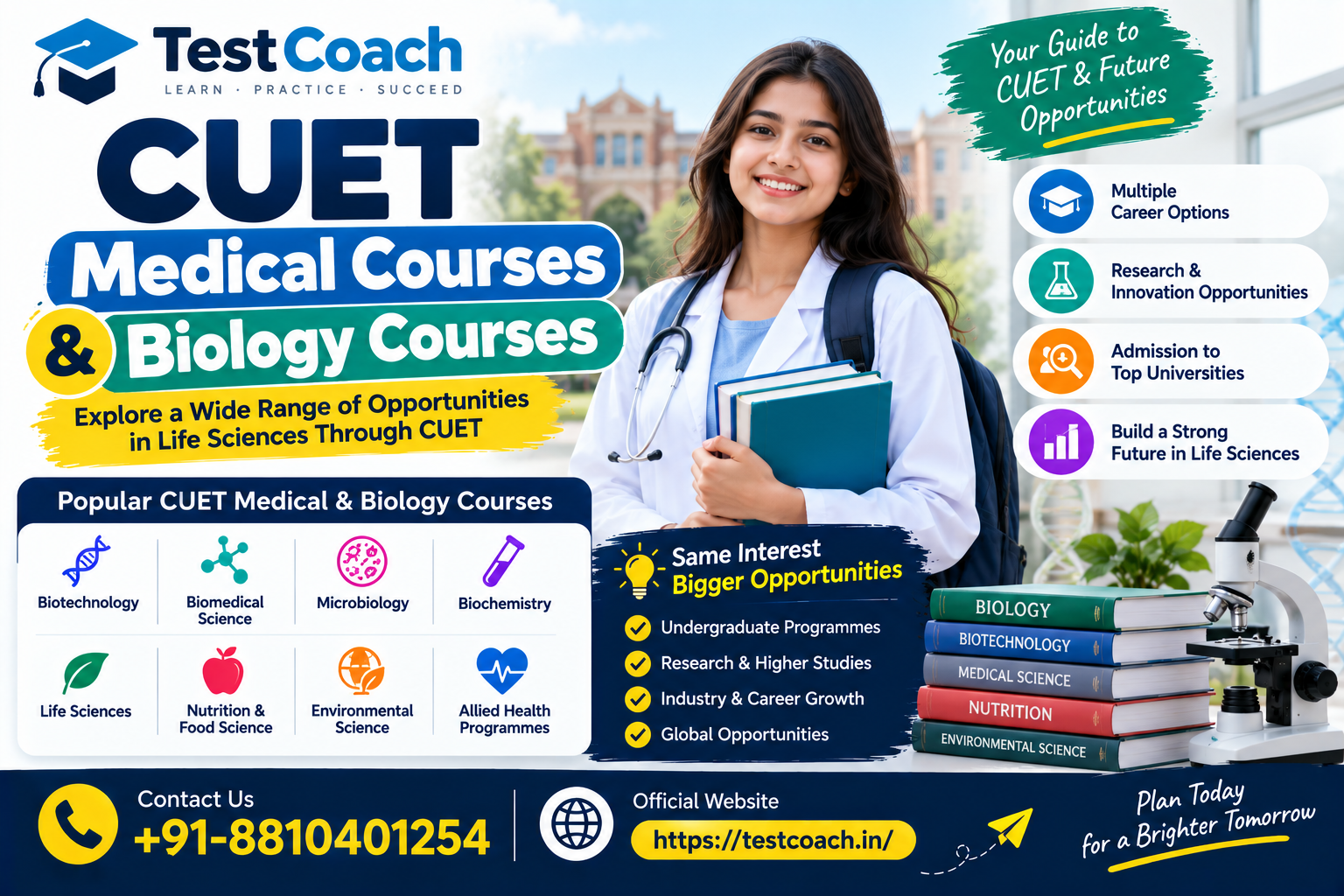
As students explore higher education opportunities in healthcare, biological sciences, and research, interest in CUET Medical Courses continues to grow. Many Class 12 science students are looking beyond conventional medical degrees and considering undergraduate programs in biotechnology, microbiology, biomedical science, and other biology-related disciplines.
The Common University Entrance Test (CUET) provides an admission pathway to selected undergraduate programs offered by participating universities. For students with a biology background, understanding the available CUET Biology Courses, eligibility requirements, and career opportunities can help them make informed academic decisions.
Education guidance professionals emphasize the importance of distinguishing CUET-based science admissions from professional medical admissions, which may follow different entrance examination requirements.
Biology students have several educational pathways beyond traditional medical practice.
Advances in biotechnology, healthcare research, diagnostics, environmental science, and pharmaceutical development have created diverse areas of scientific study.
CUET Medical Courses is a commonly searched term among students exploring healthcare-related undergraduate education. However, CUET primarily offers admission opportunities to eligible programs at participating universities, rather than serving as a replacement for medical entrance examinations.
For example, MBBS, BDS, and several AYUSH undergraduate degrees generally require NEET-UG qualification.
Meanwhile, selected biological science programs may accept CUET scores, depending on university admission policies.
Students should therefore examine program requirements before selecting entrance examination subjects.
CUET Medical Courses generally refers to undergraduate programs related to biological sciences, biomedical research, and selected healthcare disciplines for which participating universities may consider CUET scores.
These programs can provide foundational knowledge relevant to laboratory research, healthcare technology, pharmaceuticals, and scientific innovation.
However, admission routes vary significantly between universities. Not every healthcare-related degree accepts CUET.
Students should verify the admission method for their preferred program.
Students who completed Class 12 with Biology may consider several undergraduate academic disciplines.
Biotechnology combines biological science with technological applications.
Students explore genetics, microbiology, molecular biology, and biotechnology principles relevant to research and industrial applications.
Microbiology focuses on microorganisms and their biological activities.
The field is relevant to laboratory science, food testing, pharmaceutical research, and environmental analysis.
Biochemistry examines chemical processes within living organisms.
Students study biological molecules, metabolic pathways, enzymes, and cellular processes.
Biomedical science explores biological processes associated with human health and disease.
The program can provide foundations for further study in biomedical research and related scientific disciplines.
Zoology examines animal biology, while botany focuses on plant science.
Both subjects support opportunities for advanced academic study and research.
Life sciences programs often combine multiple biological disciplines, helping students develop broad scientific knowledge.
These CUET Biology Courses represent possible academic choices, not a confirmed list of CUET-accepting programs at every university.
Understanding the distinction between these entrance examinations is essential.
| CUET UG | NEET UG |
| Used for selected undergraduate programs at participating universities | Used for admission to MBBS, BDS, and specified medical programs |
| Covers multiple academic disciplines | Focuses on medical entrance eligibility |
| Subject requirements depend on university programs | Examination subjects follow the prescribed medical entrance syllabus |
| May support admission to biological science programs | Required for designated professional medical degrees |
Students planning to become doctors should carefully review NEET requirements.
Those interested in biology, biotechnology, laboratory science, or research can explore suitable CUET-based undergraduate options.
Eligibility depends on the selected university and undergraduate program.
Students generally need to complete Class 12 or an equivalent qualifying examination from a recognized board.
Many biology-related programs require relevant science subjects, which may include Physics, Chemistry, and Biology.
However, subject combinations, minimum marks, and additional conditions differ.
Before applying, candidates should review:
Selecting appropriate examination subjects is important because an incorrect combination may affect eligibility.
Effective preparation begins with understanding the prescribed examination syllabus.
Students should strengthen fundamental concepts and practice questions consistently.
Important learning areas may include genetics, human physiology, ecology, reproduction, biotechnology, and cell biology, depending on the applicable syllabus.
Previous examination papers can help candidates understand question formats and identify areas requiring further revision.
Timed practice supports question-solving efficiency and examination familiarity.
Students should analyze incorrect answers, revisit difficult concepts, and monitor improvement.
A balanced study schedule can help students prepare without relying exclusively on memorization.
Biology-based education offers pathways into multiple scientific and professional fields.
Depending on qualifications and specialization, graduates may explore opportunities in:
Many research-oriented and regulated professional roles require additional qualifications, training, or licensing.
Students should evaluate educational progression and employment requirements before selecting a course.
Selecting among CUET Medical Courses requires careful consideration of academic interests and career goals.
Students interested in genetics may prefer biotechnology, while those fascinated by microorganisms may consider microbiology.
Candidates interested in broader biological concepts can explore life sciences, zoology, or botany.
University curriculum, laboratory facilities, admission requirements, fees, and opportunities for advanced study should also influence the final decision.
They generally refer to biology, biomedical science, and selected healthcare-related undergraduate programs that may accept CUET scores at participating universities.
No. MBBS admissions in India require NEET-UG qualification under the applicable admission framework.
Possible options include biotechnology, microbiology, biochemistry, biomedical science, zoology, botany, and life sciences, subject to university availability.
Requirements vary by program. Many biology-related degrees require Biology or specified science subject combinations.
Yes. Students with Physics, Chemistry, and Biology can apply for eligible CUET undergraduate programs, subject to examination and university requirements.
The examinations serve different purposes. Their difficulty cannot be compared directly because the syllabuses, assessment objectives, and admission competition differ.
Yes, where a participating university offers biotechnology admission through CUET and the candidate meets the eligibility conditions.
Graduates may explore laboratory, research-support, pharmaceutical, and quality-testing fields, depending on their qualifications.
Admission routes vary by institution. Some programs may use CUET, NEET, or other selection processes, so university-specific requirements must be checked.
Students should follow the official syllabus, strengthen biological concepts, practice previous questions, and review mock-test performance.
Industry: Education, Competitive Examination Preparation & Admission Guidance
Location: India
Contact Number: +91-8810401254
Email: support@testcoach.in
Official Website: https://testcoach.in/