


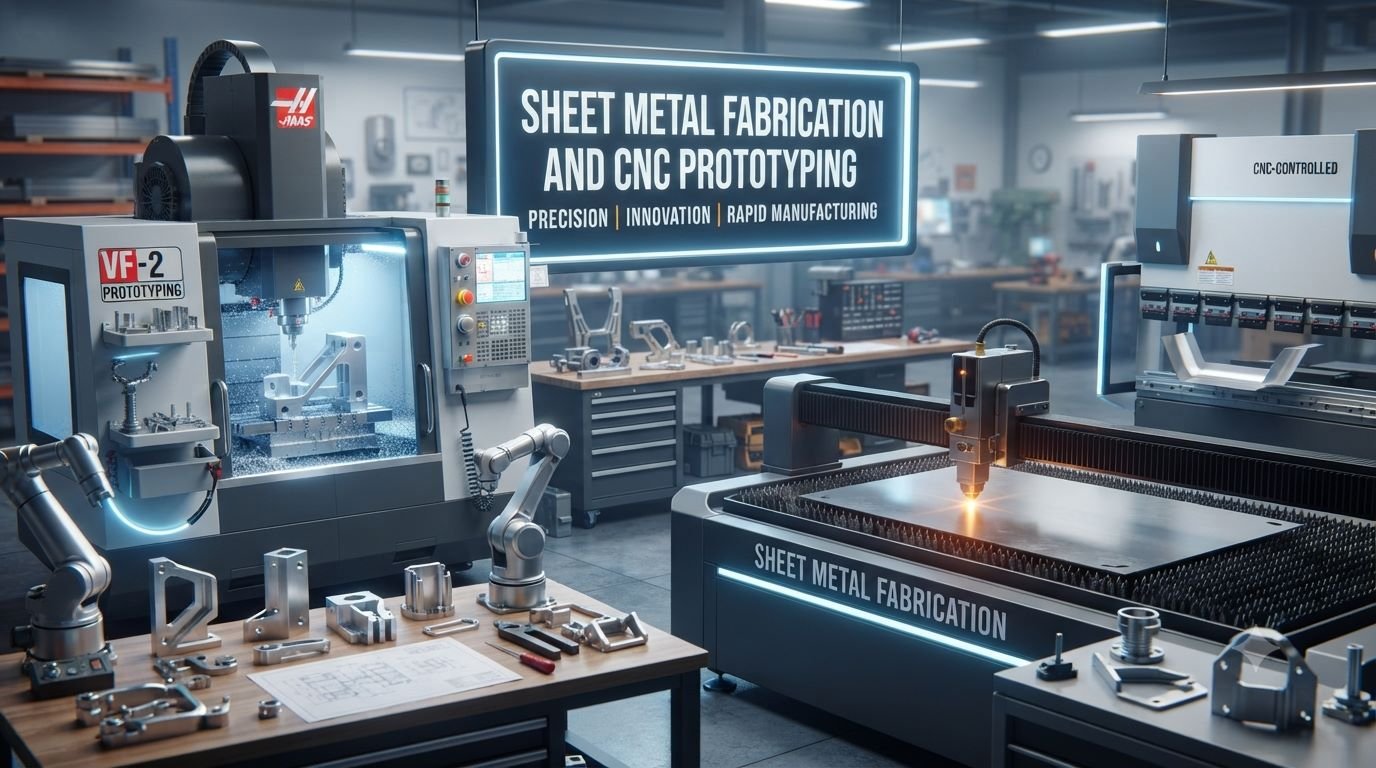
Bringing a new product from an engineering drawing to a functional physical component is rarely a single-step process. Designers must consider materials, tolerances, geometry, assembly, production costs and the practical limitations of manufacturing equipment. Two technologies that address many of these challenges are sheet metal fabrication and CNC prototyping.
Both methods have established roles in modern manufacturing, but their real value becomes clear when they are selected according to the specific requirements of a component. From industrial equipment and electronics to robotics and automotive systems, manufacturers can use these technologies to develop prototypes, validate designs and prepare products for scalable production.
Sheet metal fabrication involves transforming flat sheets of metal into functional components through a combination of cutting, bending, forming, joining and finishing processes.
Instead of removing large amounts of material from a solid block, manufacturers can create lightweight yet structurally useful components from relatively thin sheets.
The process is widely used for:
Aluminium, stainless steel, mild steel, galvanised steel, copper and brass are among the materials commonly considered.
Traditional fabrication depended heavily on manual operations. Today, CAD/CAM software and CNC-controlled machinery allow manufacturers to achieve greater consistency across many production tasks.
Laser cutting, for example, can produce detailed profiles directly from digital design data. CNC press brakes can subsequently bend those profiles into three-dimensional components.
However, accurate equipment does not remove the need for good engineering.
Manufacturers must consider:
A design that ignores these factors may look correct digitally but become difficult to manufacture consistently.
CNC prototyping is a subtractive manufacturing process in which computer-controlled equipment removes material from solid stock to create a prototype.
CNC milling machines and lathes can manufacture features such as pockets, holes, threads, slots, bores and complex profiles.
Materials may include:
One of the key advantages of CNC prototyping is the ability to manufacture a prototype from materials that may closely resemble those intended for the final component.
Advanced CAD software can simulate many aspects of product development, but physical testing remains important.
A digital assembly may show two components fitting correctly. In reality, machining tolerances, fastener accessibility, material behaviour or assembly sequence may reveal a problem.
A CNC-machined prototype allows engineers to evaluate:
If an issue appears, the design can be modified before larger quantities are produced.
This is one reason CNC prototyping is valuable during iterative product development.
Understanding the difference between the two methods makes process selection easier.
| Factor | Sheet Metal Fabrication | CNC Prototyping |
| Starting material | Flat metal sheet | Solid stock |
| Main technique | Cutting and forming | Material removal |
| Best suited for | Panels, frames, brackets | Detailed solid parts |
| Thin-wall components | Excellent | Often less efficient |
| Complex 3D geometry | Moderate | Excellent |
| Prototypes | Suitable | Highly suitable |
| Typical machines | Laser cutter, press brake | CNC mill, lathe |
| Material options | Mainly metals | Metals and plastics |
Neither process should automatically replace the other. The ideal manufacturing method depends on component geometry, performance requirements and production quantity.
Consider the development of an automated industrial machine.
Its exterior guarding, electrical cabinet and structural panels may be ideal candidates for sheet metal fabrication. Inside the machine, however, precision bearing blocks, mounting plates, shafts or mechanical interfaces may require CNC machining.
This combination appears across industries including:
The important principle is simple: select the process according to the component rather than designing every component around one manufacturing technology.
Design for Manufacturability, commonly known as DFM, examines how efficiently a component can be produced.
A designer may create a technically functional component that is unnecessarily complicated to manufacture.
For example, a fabricated bracket could contain an impractical bend close to a hole. A CNC component might contain a very deep pocket that requires specialised tooling.
Useful considerations include:
Designers should evaluate:
Specifying extremely tight tolerances everywhere can increase machining and inspection requirements.
Close tolerances should be reserved for features where precision directly affects fit, alignment, movement, sealing or another critical function.
Manufacturing efficiency is strongly connected to material choice.
Aluminium offers low weight and good machinability for many applications. Stainless steel provides corrosion resistance and is useful for products exposed to demanding environments.
Mild steel remains popular for structural applications where strength and economical production are important.
Before finalising a material, consider:
The cheapest material per kilogram is not necessarily the most economical material to manufacture.
Manufacturing does not end when a machine completes the component.
Dimensional inspection helps confirm whether the finished part meets its engineering requirements.
Tools can include callipers, micrometers, height gauges, thread gauges, optical measurement systems and coordinate measuring machines.
For sheet metal fabrication, inspection may focus on dimensions, hole positions, bend angles, flatness and assembly.
For CNC prototyping, critical dimensions, bores, threads and geometric features may require verification.
These measurements can provide useful information when the prototype is refined for future production.
Choosing a supplier purely on unit price can overlook important engineering considerations.
A capable manufacturing partner should understand both drawings and the practical requirements behind them.
Before choosing a supplier, evaluate:
A supplier capable of supporting both prototypes and subsequent production can also reduce the need to transfer technical knowledge between multiple manufacturers.
It is the process of manufacturing components from metal sheets through cutting, bending, forming, joining and finishing.
It uses computer-controlled machining equipment to create physical prototype components from digital CAD designs.
Panels, brackets, cabinets, machine covers, enclosures, chassis and frames are common applications.
Yes. CNC prototypes can be produced from many engineering-grade metals and plastics for practical evaluation.
Yes. Aluminium is widely used for fabricated and CNC-machined components.
Sheet metal fabrication is generally more practical for thin-walled enclosures and cabinets.
CNC prototyping is usually better suited to components requiring detailed three-dimensional machined features.
DFM stands for Design for Manufacturability and focuses on making components practical and efficient to produce.
They can increase machining time, inspection requirements and overall manufacturing complexity.
Yes. Many industrial products use fabricated structures alongside CNC-machined precision components.
https://newsgrow.blogspot.com/2026/08/rapid-injection-molding-and-china-rapid.html
https://newsgrow.blogspot.com/2026/08/aluminum-prototype-and-sheet-metal.html
https://newsgrow.blogspot.com/2026/08/deep-information-about-sheet-metal.html