


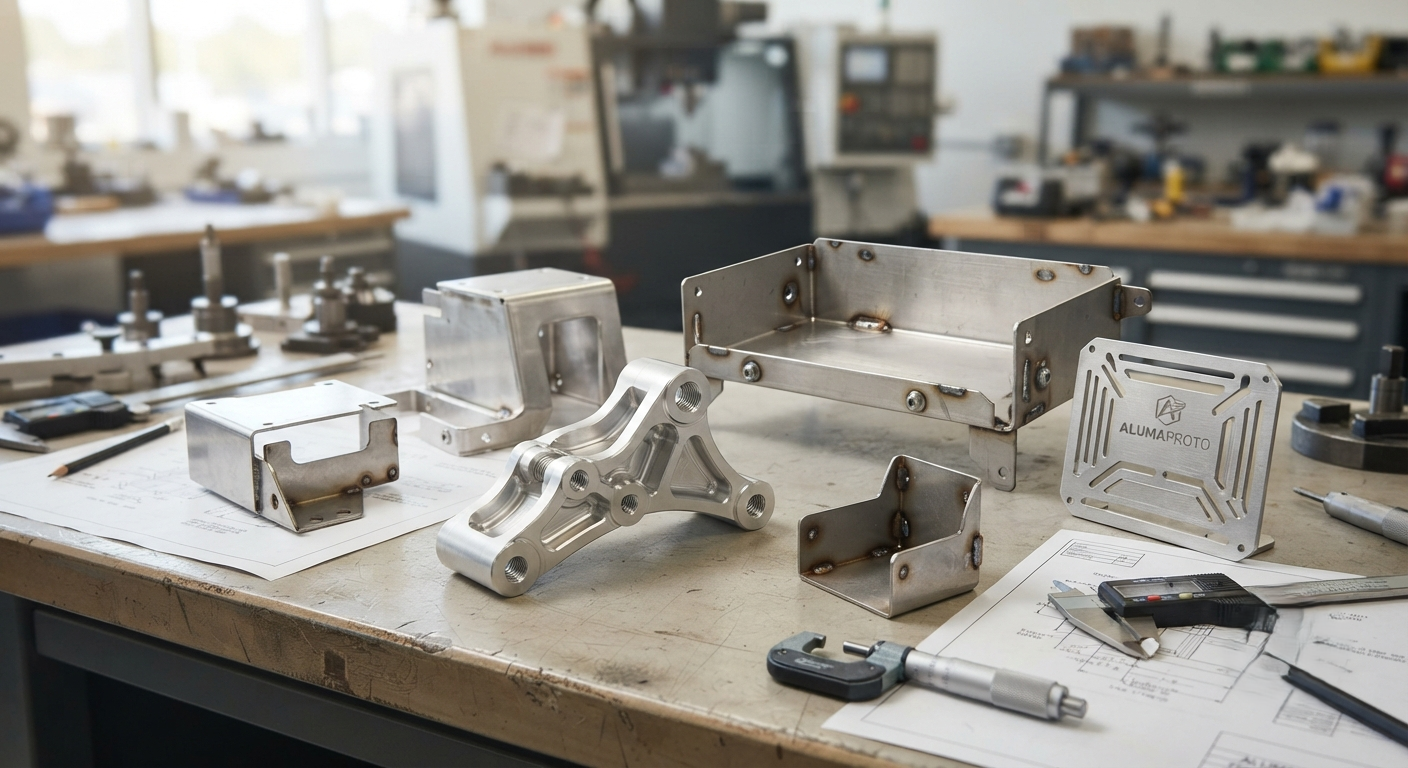
When a new product moves from a CAD model to a physical part, the prototype needs to do more than simply look like the final design. It should help engineers validate dimensions, assembly, functionality, manufacturability and, where necessary, real-world performance.
An aluminum prototype is often an excellent choice for this stage because aluminium combines low weight, good machinability, useful mechanical properties and a professional finished appearance. For products made from formed metal, sheet metal prototyping can provide an equally practical way to evaluate brackets, housings, enclosures, panels and structural components before production.
Whether you are developing an industrial component, electronics enclosure, automotive part, medical device housing or consumer product, selecting the right prototyping method can save time and reduce costly design changes later.
What Is an Aluminum Prototype?
An aluminum prototype is a trial component or assembly manufactured from an aluminium alloy to evaluate a product design before full-scale production.
Depending on the application, an aluminium prototype may be produced using:
The appropriate process depends on the geometry, tolerances, quantity, material requirements, surface finish and intended purpose of the prototype.
For example, a machined aluminium prototype may be suitable when dimensional accuracy and complex three-dimensional geometry are important. A sheet metal prototype can be more appropriate for a folded enclosure or mounting bracket.
Why Use Aluminium for Prototyping?
Aluminium is widely used for prototypes because it offers a useful balance between manufacturability, weight and performance.
1. Lightweight Construction
Aluminium is considerably lighter than many commonly used engineering metals. This can be valuable when the final product needs to minimise weight.
Industries such as automotive, aerospace, robotics, electronics and industrial equipment may use aluminium components where weight reduction is an important design consideration.
2. Good Machinability
Many aluminium alloys can be efficiently machined using CNC milling and turning equipment. This makes aluminium suitable for prototypes with detailed features, holes, pockets, threads and complex surfaces.
A CNC aluminium prototype can also provide a physical representation that is much closer to a machined production component than some rapid-prototyping alternatives.
3. Useful Strength-to-Weight Characteristics
The appropriate aluminium alloy can provide useful mechanical performance without adding unnecessary weight.
However, aluminium alloys differ significantly in their strength, hardness, machinability and corrosion characteristics. Material selection should therefore be based on the application’s actual requirements rather than simply choosing “aluminium”.
4. Professional Appearance
Machined or finished aluminium prototypes can have a clean, production-oriented appearance.
Depending on the requirements, the prototype may receive finishing such as:
This can be particularly useful for prototypes that will be demonstrated to customers, investors or internal stakeholders.
5. Suitable for Functional Testing
A prototype made from an appropriate aluminium alloy can be used for more than visual inspection.
Depending on the design and testing requirements, engineers can evaluate:
The prototype material should still be selected according to the test objective. A prototype is not automatically equivalent to a production-certified component.
What Is Sheet Metal Prototyping?
Sheet metal prototyping is the process of producing prototype parts from flat sheets of metal by cutting, bending, forming and assembling them into the required shape.
For aluminium sheet metal prototypes, a typical workflow may include:
Sheet metal prototyping is particularly useful for products that will ultimately be manufactured from folded or formed sheet.
Aluminium Prototype vs Sheet Metal Prototype
The terms are related, but they describe different things.
Aluminium prototype refers primarily to the material used for the prototype.
Sheet metal prototype refers primarily to the manufacturing approach and the form of the material.
Therefore, an aluminium prototype can be manufactured through CNC machining, while an aluminium sheet metal prototype can be cut and bent from sheet.
The right option depends on the final component design.
| Requirement | CNC Aluminium Prototype | Sheet Metal Prototype |
| Complex 3D geometry | Excellent | Limited |
| Flat panels | Possible but may be inefficient | Excellent |
| Enclosures | Suitable for machined designs | Highly suitable |
| Brackets | Suitable | Highly suitable |
| Internal pockets | Excellent | Generally unsuitable |
| Folded features | Limited | Excellent |
| Tight machined tolerances | Suitable | Depends on process |
| Lightweight structures | Suitable | Often highly suitable |
| Production simulation | Good for machined parts | Good for formed sheet parts |
How Is an Aluminium Prototype Made?
The manufacturing process varies according to the prototype’s design.
Step 1: Design Review
The process begins with a CAD model, engineering drawing or other design information.
The manufacturer may review:
A design review can identify manufacturing problems before production begins.
Step 2: Material Selection
Different aluminium grades provide different properties.
For CNC prototypes, commonly considered grades can include 6061 and 7075, depending on the application and required properties. For sheet metal work, the selected grade also needs to be suitable for cutting, bending and forming.
Material choice should consider the final application rather than simply selecting the strongest available alloy.
Step 3: Manufacturing
The selected process is then used to manufacture the prototype.
For a CNC aluminium part, this may involve milling, turning, drilling and finishing.
For sheet metal prototyping, the process may involve laser cutting followed by CNC bending and assembly.
Step 4: Finishing
The prototype can be finished according to its intended use.
A prototype used only for dimensional testing may require minimal finishing, while a customer-facing prototype may need a more refined appearance.
Step 5: Inspection
The completed part should be checked against the relevant drawings, CAD data or agreed specifications.
Critical dimensions may require more detailed inspection depending on the project’s tolerance requirements.
When Should You Choose CNC Aluminium Prototyping?
CNC machining is particularly useful when the prototype requires complex geometry or a high degree of dimensional control.
Consider CNC aluminium prototyping when you need:
For example, a robotics company developing a new actuator housing may choose CNC machining because the housing requires mounting holes, bearing seats, internal pockets and accurately positioned interfaces.
When Is Sheet Metal Prototyping the Better Choice?
Sheet metal prototyping makes more sense when the intended product is manufactured from formed sheet.
Typical applications include:
A sheet metal prototype can also reveal practical problems that may not be obvious in a CAD model, such as bend clearances, assembly access, fastener placement and interference between folded sections.
What Should You Consider Before Ordering an Aluminum Prototype?
Before requesting a prototype, prepare as much technical information as possible.
Material
Specify the required aluminium alloy where the material is critical to performance.
If you are unsure, discuss the application with the manufacturer rather than selecting a grade based only on price.
Dimensions and Tolerances
Not every dimension needs the same tolerance.
Identify critical dimensions and functional interfaces clearly. This helps avoid unnecessary manufacturing costs associated with holding very tight tolerances on non-critical features.
Quantity
Prototype requirements can range from a single part to a small batch.
The required quantity can influence the most economical production method.
Surface Finish
State whether the prototype needs:
Testing Requirements
Explain how the prototype will be used.
A visual prototype, assembly prototype and functional test component may have very different material and manufacturing requirements.
How Much Does an Aluminum Prototype Cost?
There is no single price for an aluminium prototype because cost depends on the design and manufacturing requirements.
Key cost factors include:
For this reason, requesting a quotation based on the CAD file and technical requirements is generally more reliable than relying on a generic per-part price.
A well-prepared RFQ should ideally include the CAD model, drawing, material specification, quantity, tolerance requirements and finishing requirements.
How to Reduce Aluminium Prototype Costs Without Sacrificing Quality
Prototype development does not have to mean choosing the cheapest possible manufacturing process.
Instead, focus on eliminating unnecessary complexity.
Simplify Non-Critical Features
Avoid unnecessarily complicated pockets, tiny features or extremely tight tolerances where they provide no functional benefit.
Identify Critical Tolerances
Tell the manufacturer which dimensions are genuinely important.
This allows engineering effort and inspection resources to be focused where they matter.
Choose the Right Process
A simple folded enclosure does not necessarily need to be machined from a solid aluminium block.
Likewise, a complex mechanical housing may be inefficient to manufacture from sheet metal.
Order the Right Quantity
If several prototype iterations are expected, discuss batch pricing and manufacturing strategy with the supplier.
Common Applications of Aluminium Prototypes
Aluminium prototypes are used across a wide range of industries.
Automotive
Prototypes can be used for brackets, housings, fixtures, interior components and other development parts.
Electronics
Machined aluminium housings and sheet metal enclosures can be used to test PCB fit, connectors, thermal considerations and assembly.
Robotics
Robotic frames, brackets, actuator mounts and mechanical housings may benefit from lightweight aluminium construction.
Industrial Equipment
Engineers can prototype machine components, guards, control enclosures and mounting systems before committing to production.
Aerospace and Engineering
Where weight and engineering performance are important, aluminium can be considered for appropriate prototype components.
The exact alloy, manufacturing process and inspection requirements should always be determined by the application’s engineering specifications.
What Information Should You Send to a Prototype Manufacturer?
A good prototype quotation starts with clear technical information.
Where available, provide:
If a design is still being developed, say so. An experienced manufacturer may be able to identify design-for-manufacturing issues before production.
Aluminium Prototyping and Design for Manufacturing
One of the biggest advantages of working with an experienced prototype manufacturer is the opportunity to identify manufacturing issues early.
For example, a CNC-machined aluminium component may contain deep narrow pockets that are difficult or expensive to machine. A sheet metal component may have bends positioned too close to holes or edges.
These problems can often be addressed during design rather than after a prototype has already been produced.
This is where design for manufacturing (DFM) becomes valuable. The objective is not simply to make the prototype cheaper; it is to make the design practical, repeatable and suitable for the intended production process.
Aluminium Prototype FAQs
What is an aluminium prototype?
An aluminium prototype is a trial component manufactured from an aluminium alloy to test a product design before production. It can be CNC machined, fabricated from sheet metal or produced using another suitable manufacturing method.
Is aluminium good for prototypes?
Yes, aluminium can be an effective prototype material when its properties are appropriate for the application. It is lightweight, machinable and available in multiple grades and finishes.
What is sheet metal prototyping?
Sheet metal prototyping is the production of trial components from metal sheet using processes such as cutting, bending, forming and joining.
Is CNC machining better than sheet metal prototyping?
Neither process is universally better. CNC machining is generally more suitable for complex solid components, while sheet metal fabrication is often more efficient for panels, brackets, enclosures and folded structures.
Can aluminium sheet be used for prototypes?
Yes. Aluminium sheet can be cut, bent, drilled, formed and assembled to create functional prototypes for suitable applications.
How do I choose an aluminium alloy?
Choose the alloy based on the required mechanical properties, machinability, corrosion resistance, forming requirements, finish and intended application. When the material specification is critical, consult an experienced engineer or manufacturer.
Can an aluminium prototype be used for functional testing?
It can be, provided the material, manufacturing process and prototype design are appropriate for the intended test. A prototype should not automatically be treated as a production-certified component.
Choosing a Local Aluminium Prototyping Partner
If you are searching for aluminium prototype services locally, don’t compare suppliers on price alone.
Look for a manufacturer that can demonstrate:
A local supplier can also be useful when rapid communication, prototype revisions, inspection or physical meetings are important.
Before placing an order, ask whether the supplier can manufacture both the prototype and eventual production parts if the design moves forward. Having a clear transition from prototype to low-volume production can simplify the development process.