


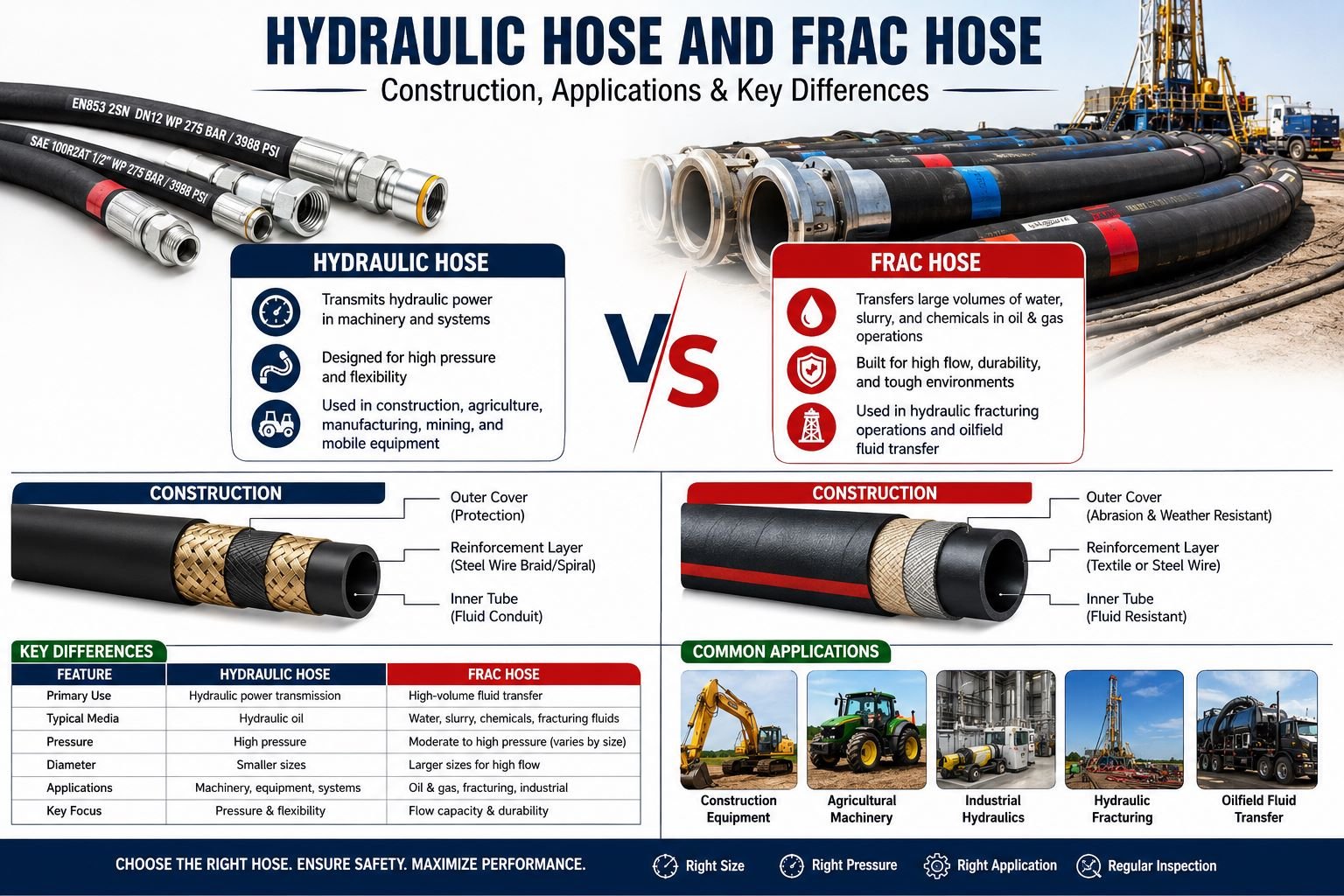
When industrial equipment loses hydraulic pressure or an oilfield fluid-transfer operation is interrupted, attention usually turns to pumps, valves or major machinery. Yet the problem can sometimes originate from a far less noticeable component—the hose.
A Hydraulic Hose is expected to transport pressurised fluid while repeatedly bending and moving with machinery. A frac hose, meanwhile, may be required to transfer substantial volumes of fluid in challenging oilfield environments.
Both products demonstrate an important principle in industrial engineering: a hose is not simply a flexible tube. It is an engineered component whose performance depends on how well its construction matches the application.
For equipment owners, engineers and purchasing teams, knowing what to look for before buying can make a significant difference.
Hydraulic power is used whenever machinery needs controlled force and movement. Excavators use it to move their booms and buckets. Cranes rely on hydraulic systems for lifting functions. Manufacturing equipment uses hydraulic power for pressing, clamping and positioning.
The Hydraulic Hose connects different parts of these systems while allowing movement.
A typical hydraulic circuit includes a pump, valves, actuators, fluid reservoir and connecting lines. When pressurised fluid reaches a hydraulic cylinder, the cylinder converts that energy into linear movement.
The hose therefore has two jobs: safely contain the hydraulic fluid within its specified operating limits and remain flexible enough for the equipment to function.
Cut open a typical Hydraulic Hose, and its engineering becomes easier to understand.
The first layer is the inner tube. It carries the hydraulic fluid and must be compatible with that media.
The second is reinforcement. Textile braid, steel-wire braid or spiral-wire reinforcement may be used depending on the pressure and application requirements.
The third is the outer cover, which protects the reinforcement from external influences.
These layers face different challenges.
The inner tube deals with fluid and temperature. Reinforcement handles mechanical forces created by pressure. The cover deals with abrasion, oil, moisture, weather and physical contact.
This is why two hoses that look almost identical externally can have very different performance characteristics.
Move from a construction site to an oilfield and the fluid-transfer challenge changes considerably.
Hydraulic fracturing involves complex fluid-handling operations. Water and prepared fracturing fluids may need to move between storage equipment, blending units, pumping systems and other parts of the site.
This is where an appropriately specified frac hose can play an important role.
Depending on the individual product and application, it may be intended for transferring water, slurry, chemical mixtures or other compatible oilfield fluids.
Flow capacity often becomes particularly important because some applications involve substantial transfer volumes.
A hose that performs well in a controlled factory environment may face completely different challenges at a wellsite.
Consider what can happen during normal field use. A frac hose may be moved repeatedly, exposed to sunlight, positioned across rough ground or operated around mud and dust. The transferred media itself may contain chemicals or abrasive solids.
A suitable product may therefore require a combination of:
There is no single specification that automatically makes a hose suitable for every fracturing operation.
A quick comparison makes their roles clearer.
| Question | Hydraulic Hose | Frac Hose |
| What is its main job? | Transfer hydraulic power fluid | Transfer oilfield process fluids |
| Where is it commonly installed? | Mobile and industrial machinery | Hydraulic fracturing sites |
| What might it carry? | Hydraulic oil and compatible media | Water, slurry and compatible frac fluids |
| What movement occurs? | Repeated machine movement | Handling and repositioning |
| What is a major concern? | Pressure, heat and flexibility | Flow, abrasion and media |
| What determines selection? | Complete hydraulic circuit requirements | Complete transfer application |
The takeaway is important: hose selection begins with understanding what the hose actually needs to do.
It is tempting to compare hoses by one number: pressure.
But pressure is only one part of the specification.
Suppose a Hydraulic Hose has more than enough pressure capacity but is incompatible with the hydraulic fluid. It is still the wrong hose.
Likewise, a frac hose may meet the required pressure but have insufficient internal diameter for the desired flow.
Buyers should also understand the difference between working pressure and burst pressure.
Working pressure relates to intended operating conditions. Burst pressure is associated with destructive testing and should never be interpreted as a recommended everyday operating limit.
Think about drinking through a very narrow straw. Moving the same amount of liquid becomes more difficult.
Industrial fluid systems involve far more complex engineering, but internal diameter similarly affects fluid velocity and pressure loss.
If a Hydraulic Hose is undersized, fluid velocity may become excessive. Increased pressure drop and heat generation can follow.
In high-volume frac applications, insufficient hose diameter can limit transfer performance.
Engineers therefore evaluate:
Matching the connector does not necessarily mean the hose itself is correctly sized.
External damage is easy to see. Internal deterioration is more difficult.
If the inner tube is incompatible with the transferred media, the material can potentially soften, swell, harden or crack over time.
A Hydraulic Hose should therefore be selected with the exact hydraulic fluid in mind.
For a frac hose, operators should identify more than just the base fluid. Chemical additives and suspended solids can change the application’s compatibility and abrasion requirements.
A good supplier will normally want to know what is actually passing through the hose before recommending a product.
Another overlooked issue is temperature.
There are two sources to consider.
The first is internal: how hot is the fluid?
The second is external: how hot or cold is the hose’s working environment?
A Hydraulic Hose positioned close to an engine, exhaust system or industrial heat source can face external thermal stress.
A frac hose may operate outdoors under changing weather conditions.
Selecting a hose within the manufacturer’s specified temperature range is therefore an important part of application matching.
Sometimes the correct hose is purchased but installed incorrectly.
Imagine a hydraulic line forced into a tight bend directly behind its fitting. Every machine cycle places additional stress on that same area.
Or consider a hose that continuously rubs against a metal bracket. The outer cover may gradually wear away.
Good installation should minimise:
Minimum bend radius should always be respected.
A Hydraulic Hose should be able to move naturally with the equipment rather than fighting against its installation.
A hose assembly consists of more than hose.
Fittings and couplings must be compatible with its construction, dimensions, pressure and intended service.
This is particularly important for crimped Hydraulic Hose assemblies. Correct crimping should follow the manufacturer’s specified assembly procedures.
For frac hose, coupling selection must likewise reflect pressure, media and field requirements.
Mixing components simply because they physically fit can be a poor approach when compatibility has not been confirmed.
Routine visual inspection can identify many developing issues before a complete failure occurs.
Look along the entire hose, not just near the fittings.
Warning signs include:
High-pressure hydraulic leaks require particular caution. Appropriate maintenance and safety procedures should always be followed.
Inspection frequency should reflect application severity and manufacturer recommendations.
Replacing an existing hose with exactly the same specification may seem straightforward. But if the previous hose failed prematurely, simply repeating the same choice may reproduce the same problem.
Before ordering a new Hydraulic Hose, ask why replacement is necessary.
Was there excessive abrasion?
Was the hose installed too close to a heat source?
Was the bend too tight?
Was the fluid compatible?
Was the hose properly sized?
Finding the cause of deterioration can be more valuable than simply replacing the component.
Before requesting a hose quotation, collect the following information:
For frac hose applications, also explain whether abrasive solids are present and how frequently the hose will be moved.
These details allow suppliers to recommend according to the application rather than assumptions.
It provides flexibility where equipment movement, vibration or installation geometry makes rigid piping unsuitable.
Depending on its specification, it may transfer water, slurry, chemical mixtures and compatible fluids used in oilfield operations.
No. The terms describe hoses intended for different applications, although both may handle fluids under pressure.
Determine the system’s operating requirements and select according to manufacturer specifications and applicable engineering requirements.
Not automatically. The correct diameter depends on flow, pressure loss, fluid characteristics and system design.
Possible causes include ageing, heat, environmental exposure, excessive bending and unsuitable operating conditions.
Only when its materials are compatible with the specific chemical mixture being transferred.
It describes how tightly a hose can be bent according to its specified design limits.
Fluid temperature, excessive velocity, nearby heat sources and system conditions can contribute to hose temperature.
Any repair or replacement should follow manufacturer-approved methods and appropriate safety procedures.
Read more – https://newsgrow.blogspot.com/2026/08/hydraulic-hose-manufacturer-and.html
https://newsgrow.blogspot.com/2026/08/hydraulic-hose-and-frac-hose-deep.html