


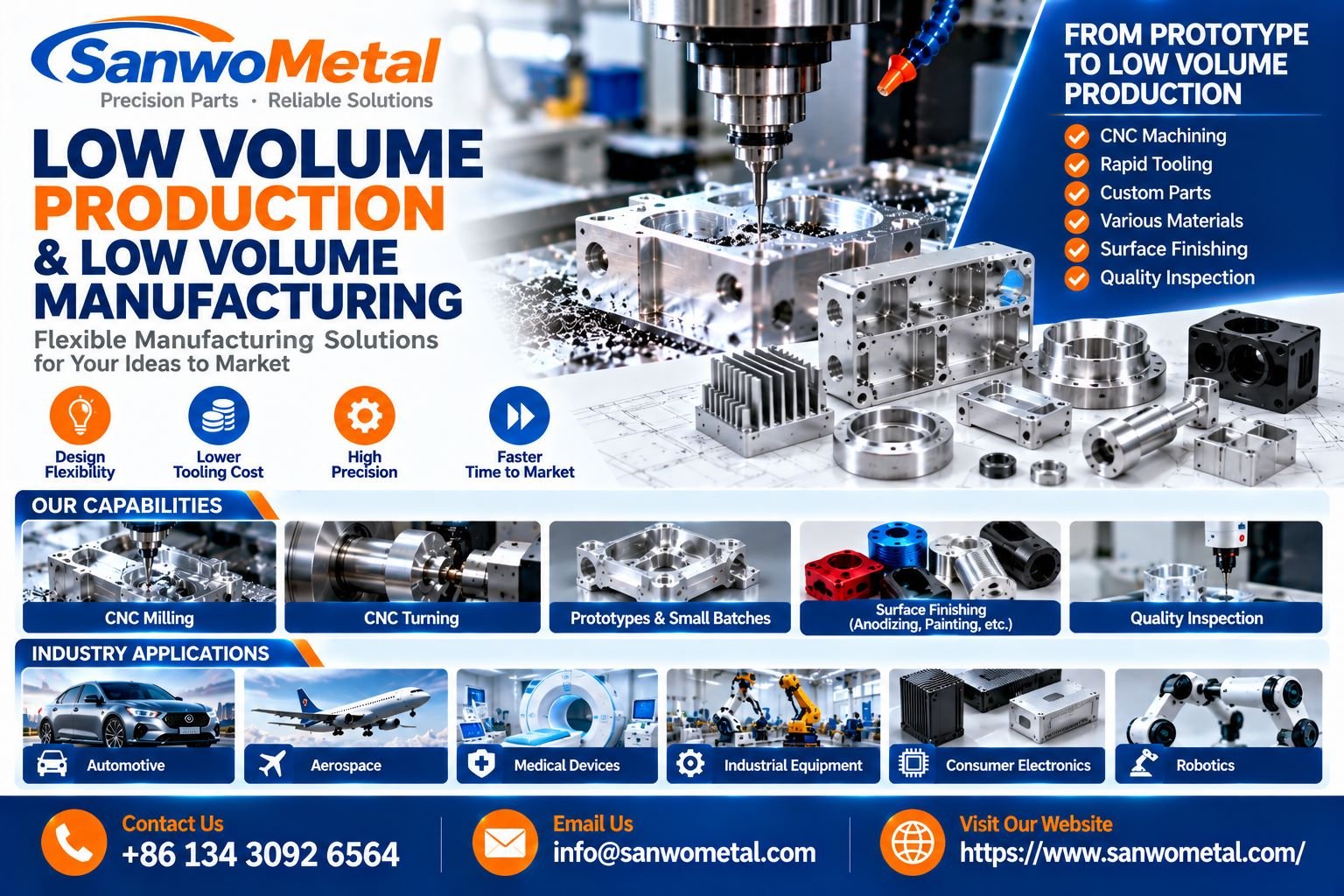
As companies move toward faster product launches, customized designs, reduced inventory, and lower upfront investment, low volume production and low volume manufacturing are becoming increasingly important across automotive, aerospace, robotics, medical devices, electronics, industrial equipment, and consumer products.
Traditional mass production remains valuable for large, stable demand, but many modern businesses need greater flexibility. Smaller production runs allow engineering teams to test markets, refine products, respond to changing requirements, and avoid committing too early to expensive tooling or excessive inventory.
low volume production refers to manufacturing a relatively small number of parts or finished products compared with conventional mass production.
There is no universal quantity range. Depending on the industry and product, low-volume production may involve:
The key characteristic is flexibility rather than a fixed number.
Low-volume production is particularly useful when demand is uncertain, designs may still change, or products are intended for specialized markets.
low volume manufacturing is the broader manufacturing strategy used to produce smaller batches efficiently while maintaining production-grade quality.
It can involve several manufacturing technologies, including:
The most suitable process depends on part geometry, material, quantity, tolerance, finish, and budget.
Several market trends are driving demand for low volume production.
Companies are launching new products more frequently and cannot always justify long tooling schedules.
Customers increasingly expect product variations, sizes, colors, and specialized configurations.
Smaller batches can help businesses avoid holding excessive stock.
Manufacturers can test demand before scaling production.
Engineering changes can often be introduced more easily between batches.
This flexibility makes low-volume approaches attractive to startups as well as established manufacturers.
One of the most valuable uses of low-volume manufacturing is the transition from prototype to mass production.
A typical development path may include:
This phased approach reduces the risk of investing heavily in an unproven design.
It also allows businesses to collect feedback from real users before production quantities increase.
CNC machining is one of the most common methods for low volume manufacturing because it does not require expensive dedicated molds.
CNC processes can include:
Materials may include:
CNC machining is particularly useful for precision components, complex parts, engineering prototypes, and small production batches.
When plastic parts are required in larger low-volume quantities, rapid tooling can be a practical option.
Instead of investing immediately in expensive long-life tooling, manufacturers may use lower-cost molds designed for shorter production runs.
This can provide:
Rapid tooling can help bridge the gap between prototypes and full-scale injection molding.
Launching a new product always involves uncertainty.
A company may not know:
low volume production allows companies to manufacture enough units for meaningful testing without committing to large inventory.
This approach is especially valuable for new consumer products, specialist equipment, and rapidly evolving technology markets.
High-volume manufacturing processes often require substantial tooling costs.
Examples include:
For lower quantities, these investments may be difficult to justify.
low volume manufacturing can reduce upfront cost by using CNC machining, simplified tooling, or flexible production methods.
This can improve cash flow during early product development.
Engineering changes are common during the early stages of product development.
A part may need changes to:
Large-scale production makes changes more expensive because tooling and inventory may already exist.
Low-volume batches allow companies to introduce revisions between production runs with less disruption.
Automotive companies use low volume production for:
CNC machining and other flexible manufacturing processes make it possible to produce accurate parts before high-volume production begins.
Low-volume methods are also useful for motorsport and custom vehicle applications.
Aerospace manufacturing often involves relatively small quantities combined with demanding quality requirements.
Low-volume parts may include:
Because aerospace designs can be highly specialized, low volume manufacturing provides an efficient way to produce complex components without mass-production tooling.
Medical product developers often require small production quantities during testing and validation.
Applications may include:
Low-volume production gives engineering teams the flexibility to refine designs before larger quantities are required.
Quality control and material traceability can be particularly important in medical applications.
Robotics companies frequently develop specialized machines in relatively small quantities.
Low-volume components can include:
Industrial equipment manufacturers may also use low volume production for specialized machinery and replacement components.
These applications often benefit from CNC machining because designs can be updated quickly.
Consumer electronics companies may use low-volume manufacturing for:
Producing smaller batches allows product teams to evaluate fit, appearance, thermal performance, and customer response before scaling.
This can be especially valuable in markets where designs change quickly.
Material choice affects strength, appearance, cost, weight, and machinability.
Common options include:
Lightweight and easy to machine.
Strong and corrosion resistant.
Useful for housings and functional mechanical parts.
Suitable for specialized electrical and mechanical applications.
Using production-grade materials during low volume manufacturing can help ensure that testing accurately reflects final product performance.
Low-volume parts can receive many of the same finishes used in higher-volume production.
Options may include:
Surface finishing can improve:
Finishing requirements should be specified early because they may affect dimensions and lead time.
Smaller quantities do not mean lower quality requirements.
Inspection methods may include:
Manufacturers may also provide dimensional reports for critical parts.
Clear drawings, tolerances, and specifications help ensure that production results meet expectations.
The two approaches serve different goals.
Low volume production typically offers:
Mass production typically offers:
The correct approach depends on demand, product maturity, and business strategy.
Many successful products begin with low-volume manufacturing and scale gradually.
Companies should evaluate suppliers based on more than price.
Important considerations include:
A supplier that supports both prototypes and production can make the transition between stages easier.
low volume production is the manufacturing of relatively small quantities of parts or products compared with traditional mass production.
low volume manufacturing is a flexible manufacturing approach designed to produce smaller batches efficiently using processes such as CNC machining, rapid tooling, molding, and fabrication.
There is no fixed number. Depending on the product, it may range from dozens to several thousand units.
It can reduce inventory risk, tooling investment, and development time while allowing easier design changes.
Yes. CNC machining is widely used because it offers precision without requiring dedicated molds.
Yes. Parts can often be manufactured from the same materials intended for final production.
Yes. It allows startups to test products and demand without committing to large inventories.
Yes. Flexible manufacturing processes make design updates easier than traditional high-volume tooling.
Yes. Anodizing, coating, polishing, painting, and other finishing options may be available.
Manufacturers commonly require CAD files, drawings, material specifications, quantity, tolerances, and surface-finish requirements.
Low Volume Manufacturing Enquiries
Contact: +86 134 3092 6564
Email: info@sanwometal.com
Official Website: https://www.sanwometal.com/