


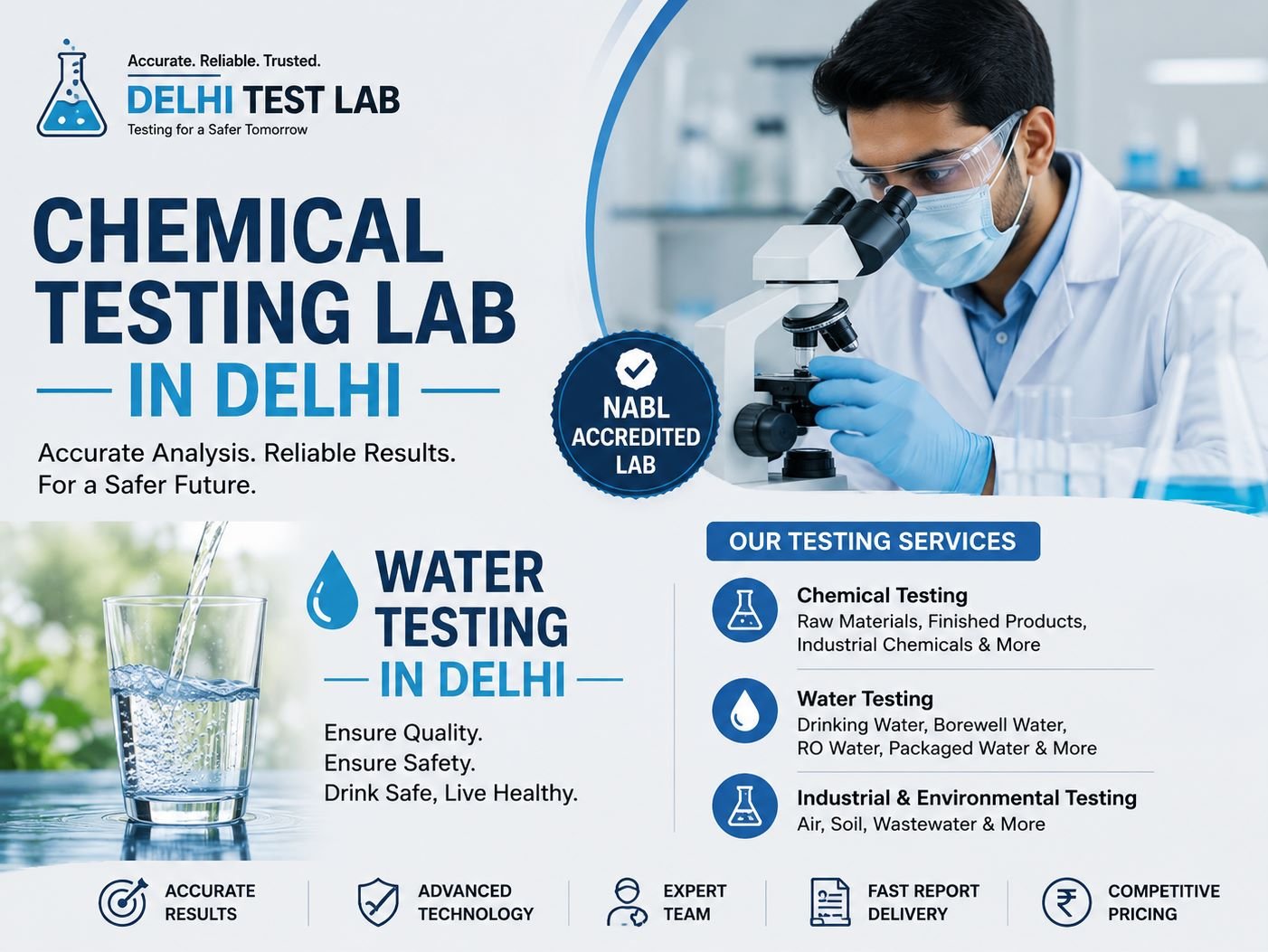
The need for reliable chemical and water analysis is gaining greater attention across Delhi as industries, residential communities, commercial establishments and institutions place increased emphasis on quality monitoring. From checking groundwater characteristics to verifying industrial raw materials, laboratory testing is becoming an important source of scientific data for everyday and commercial decisions.
The changing landscape has increased interest in finding a reliable chemical testing lab in Delhi, particularly among manufacturers and businesses seeking measurable information about materials used in their operations. At the same time, water testing in Delhi continues to attract attention as people become more aware that the appearance of water alone cannot provide a complete picture of its quality.
Experts in laboratory analysis point out that the value of testing depends not simply on conducting more tests, but on selecting the right parameters for the right sample.
Water reaching a household, office or industrial facility can have a very different journey depending on its source.
Some users depend on municipal supplies, while others may use groundwater, borewells, tankers or treated water. Storage tanks, internal plumbing and treatment equipment can add further variables.
As a result, water from two locations within the same city should not automatically be expected to have identical characteristics.
Professional water testing in Delhi can provide a clearer picture by examining selected physical, chemical and microbiological parameters.
One of the biggest challenges surrounding water quality is that many important characteristics are invisible.
A sample may appear clean and colourless while containing different concentrations of dissolved substances. Microbiological characteristics also cannot be reliably determined simply through visual examination.
Laboratory analysis can evaluate parameters such as:
The appropriate combination depends on the source of the water and how it will be used.
The widespread use of handheld TDS meters has made consumers more interested in monitoring water. However, laboratory professionals caution against interpreting a single TDS reading as a complete water-quality assessment.
TDS represents the overall level of dissolved solids. It does not individually identify every substance contributing to that measurement.
| Method | Information Available |
| Visual Inspection | Colour and visible particles |
| TDS Meter | Approximate dissolved solids |
| pH Testing | Acidic or alkaline characteristics |
| Chemical Analysis | Selected individual chemical parameters |
| Microbiological Analysis | Selected microbial indicators |
| Comprehensive Laboratory Testing | Multiple parameters based on testing objective |
This distinction is one reason professional water testing in Delhi remains relevant even when basic household testing devices are available.
The conversation around testing extends well beyond water.
Delhi and surrounding industrial areas support businesses involved in manufacturing, engineering, construction, food processing, chemicals, consumer products and numerous other sectors.
For these organisations, consistency in raw materials can be critical.
A chemical testing lab in Delhi can analyse selected characteristics of materials to help organisations determine whether they meet specified requirements.
Testing may cover:
Actual capabilities differ between laboratories, making it important to confirm testing scope before submitting a sample.
Consider a manufacturer that has used the same type of raw material for several years.
A new batch arrives and looks completely normal. However, operators begin noticing changes during production.
Possible causes could involve equipment, process conditions, storage or the material itself.
Laboratory analysis allows the chemical characteristics of the material to be examined as one part of the investigation.
For this reason, organisations may approach a chemical testing lab in Delhi not only for compliance requirements but also for:
Testing provides evidence that can be combined with other production and quality-control information.
Groundwater characteristics are influenced by geological and environmental conditions and can differ from one location to another.
Users relying on borewell water may therefore consider testing for relevant parameters rather than judging suitability from appearance alone.
Water testing in Delhi for borewell samples may include hardness, TDS, pH, nitrate, fluoride, chloride, iron and other parameters depending on the intended application.
Testing can be useful when a new borewell begins operating or when noticeable changes occur in the water.
Water testing is not restricted to individual households or industrial plants.
A range of facilities may have reasons to monitor water characteristics, including:
Large buildings may receive water from one source, store it in tanks and distribute it through extensive internal plumbing.
Understanding where to collect a representative sample is therefore an important part of meaningful testing.
Testing equipment may be sophisticated, but the final result still depends on the sample submitted.
For example, using a contaminated bottle can introduce substances that were not originally present in the water.
Similarly, testing water collected from an unsuitable location may produce a technically accurate result that does not represent the source being investigated.
Laboratories may recommend:
Special instructions may apply when microbiological parameters are being analysed.
Experts also highlight the importance of understanding the intended application.
Testing can include relevant physical, chemical and microbiological parameters.
Parameters are selected according to manufacturing and process requirements.
Testing may focus more heavily on characteristics relevant to deposits, scaling and system operation.
Analysis can help compare characteristics before and after treatment.
Different parameters may be required to evaluate treatment processes or specified environmental requirements.
A person seeking water testing in Delhi should therefore describe the source and intended use before choosing a testing package.
As demand for testing increases, customers should also understand how to evaluate laboratory services.
When selecting a chemical testing lab in Delhi, several questions are worth asking.
Laboratories specialise in different areas. Capability should always be confirmed.
The analytical method should be suitable for the sample and testing objective.
For applications requiring accredited results, users should check whether the specific parameter and method fall within the laboratory’s current accreditation scope.
Sample quantity, container type, preservation and transportation requirements should be established before collection.
Laboratory testing provides measurable information about samples that cannot always be determined through visual or physical inspection.
Depending on its facilities, a laboratory can analyse chemicals, water, metals, soil, coatings, construction materials and other industrial samples.
Yes. Appearance alone cannot identify every chemical or microbiological characteristic.
No. TDS provides information about overall dissolved solids but does not provide a complete chemical or microbiological profile.
Yes. Borewell and groundwater samples are commonly submitted for water testing in Delhi.
Yes. Chemical analysis can form part of an organisation’s incoming-material quality-control process.
Yes. Laboratories with relevant capabilities may test industrial effluent, ETP water and STP water.
Frequency depends on the source, intended use, previous results, operational requirements and applicable standards or regulations.
An unsuitable or contaminated container can potentially influence the sample and compromise the usefulness of the results.
They should consider technical capability, relevant test methods, accreditation scope where necessary, sampling guidance and reporting quality.
https://newsgrow.blogspot.com/2026/08/chemical-testing-lab-in-delhi-and-water.html