


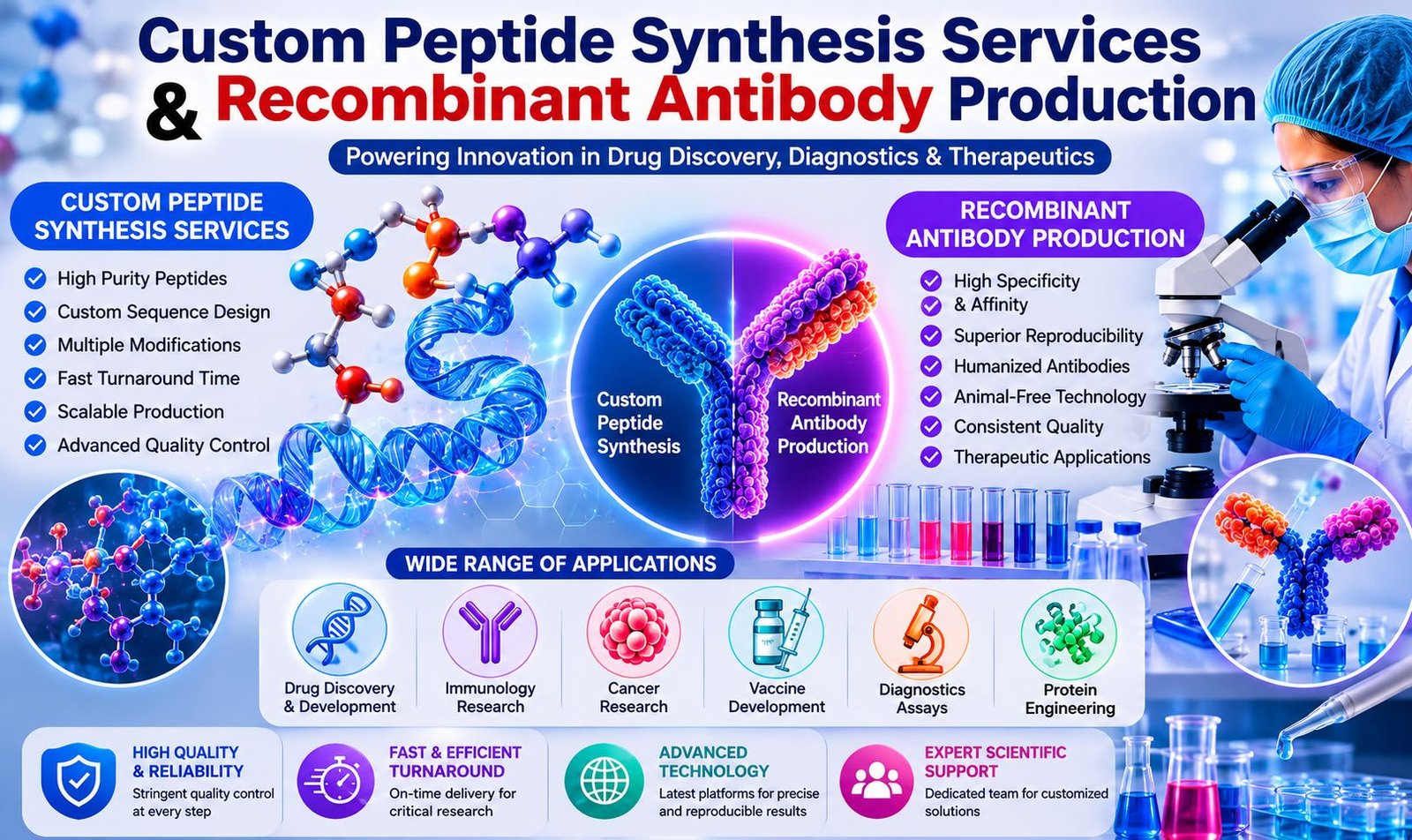
Biotechnology increasingly depends on highly precise research tools capable of supporting drug discovery, diagnostics, immunology, proteomics, and molecular biology. Two technologies playing an especially important role are custom peptide synthesis services and recombinant antibody production. Although they involve different biological molecules, both help researchers develop highly specific reagents for studying proteins, identifying biomarkers, validating therapeutic targets, and designing new diagnostic approaches.
As life-science research becomes more specialized, laboratories are moving away from generic reagents toward customized molecules designed around specific experimental objectives. Understanding how peptides and recombinant antibodies are produced can therefore help research teams select the right development strategy.
Custom peptide synthesis services provide researchers with peptides manufactured according to a specified amino-acid sequence, purity level, quantity, modification, or labeling requirement.
Peptides are short chains of amino acids connected through peptide bonds. Because researchers can define their exact sequences, synthetic peptides can reproduce selected regions of proteins or function as specialized molecular tools.
They are widely used in:
A customized peptide allows scientists to investigate a targeted biological region without necessarily producing an entire protein.
One of the most widely used manufacturing approaches is solid-phase peptide synthesis, commonly known as SPPS.
A typical peptide synthesis workflow includes:
High-performance liquid chromatography is commonly used for purification, while analytical techniques such as mass spectrometry can help confirm molecular mass and identity.
Peptide length, amino-acid composition, hydrophobicity, charge, modifications, and structural characteristics may affect synthesis difficulty, solubility, stability, and final yield.
For this reason, sequence evaluation before manufacturing can be an important part of a successful peptide project.
An important advantage of custom peptide synthesis services is the ability to incorporate specialized modifications according to experimental requirements.
Common possibilities include:
Researchers may also request different purity specifications depending on whether peptides will be used for screening, analytical experiments, immunization, or other research applications.
Recombinant antibody production uses engineered DNA sequences and controlled expression systems to manufacture antibody molecules or antibody fragments.
Instead of relying exclusively on antibody production within immunized animals or traditional hybridoma systems, recombinant approaches allow researchers to work with defined antibody sequences.
The genetic sequence encoding the desired antibody can be introduced into an appropriate expression host, allowing cells to produce the antibody under controlled laboratory conditions.
The production process can differ according to antibody format, host system, scale, and research application.
A general workflow includes:
Mammalian cells are frequently used when researchers require complex antibody structures and biologically relevant post-translational processing.
Other expression platforms may also be appropriate depending on the antibody format.
Researchers can produce several formats, including:
This flexibility supports diverse research and development objectives.
Both technologies provide precise molecular tools, but their applications differ.
| Feature | Custom Peptides | Recombinant Antibodies |
| Main molecule | Amino-acid sequence | Engineered antibody protein |
| Typical purpose | Protein-region studies | Target recognition |
| Customization | Sequence and modifications | Sequence and antibody format |
| Common applications | Assays, immunogens, screening | Detection, diagnostics, research |
| Production method | Chemical synthesis | Biological expression |
In many research programs, these technologies are complementary rather than competing alternatives.
An especially useful application combines custom peptide synthesis services with recombinant antibody production.
Researchers may first identify a protein region that could serve as an antigen. A synthetic peptide corresponding to that region can then be prepared and used during antibody research, screening, or validation.
The resulting antibody may later be converted into a recombinant format for sequence-defined manufacturing and further characterization.
This creates a research workflow connecting peptide design, antigen development, antibody discovery, and recombinant expression.
Quality can strongly influence experimental reproducibility. Researchers evaluating peptide or antibody providers should consider:
Price should therefore be considered together with technical capability, quality requirements, and project complexity.
It is the laboratory manufacturing of a peptide according to a researcher-defined amino-acid sequence and specification.
They can support protein studies, antibody research, assay development, screening, biomarker research, and many other laboratory applications.
Yes. Depending on technical feasibility, peptides can include labels, terminal modifications, conjugates, phosphorylation, and other specialized features.
Purity depends on synthesis efficiency, sequence complexity, purification strategy, and the requested product specification.
It is an antibody produced through an engineered genetic sequence expressed in a suitable biological system.
Defined sequences can support reproducibility, engineering flexibility, consistent production, and development of specialized antibody formats.
Mammalian cell systems are widely used, although bacterial, yeast, insect, and other expression platforms may be suitable for certain formats.
Yes. Researchers may modify antibody sequences, formats, binding characteristics, or fusion components depending on project objectives.
Yes. Carefully designed peptides can serve as defined antigens or screening reagents during antibody research.
Yes. Peptide-based antigen design and recombinant antibody technologies can form complementary stages within the same research program.