


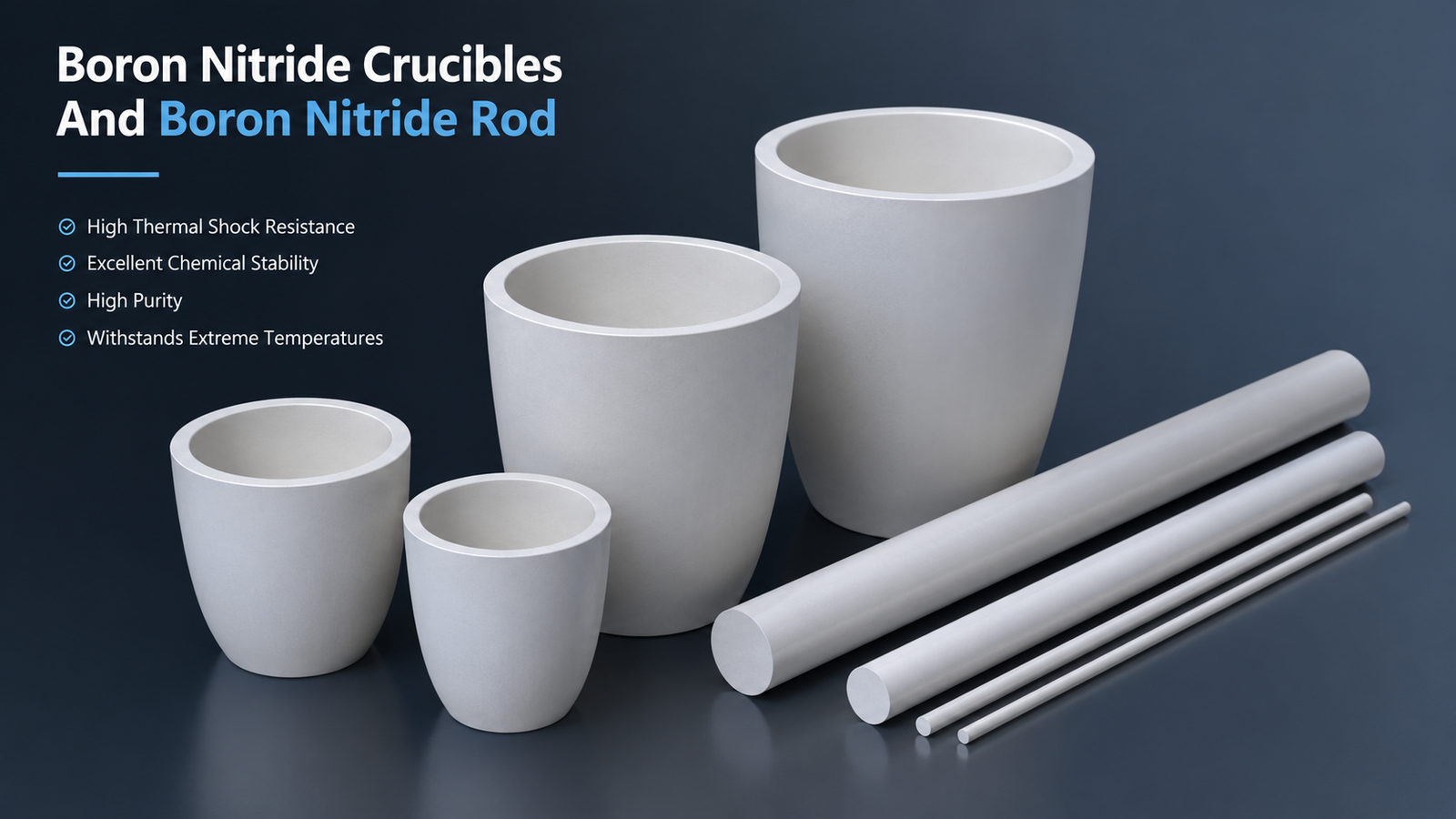
High-temperature equipment often fails for reasons that go beyond temperature itself. A component may survive intense heat but struggle with rapid thermal cycling, electrical isolation, chemical contact, dimensional stability, or contamination requirements. For engineers, choosing the right material therefore involves balancing several properties rather than focusing on a single temperature rating.
This is one reason Boron Nitride Crucibles and Boron Nitride Rod are widely considered for specialised thermal and electrical applications. Boron nitride offers a distinctive combination of heat resistance, electrical insulation, thermal-shock performance, low friction, and machinability.
Understanding where these properties matter can make it easier to decide whether boron nitride is suitable for a particular industrial process.
Materials behave differently as operating temperatures increase. Thermal expansion can change component dimensions, repeated heating and cooling can generate internal stress, and contact with molten substances may create chemical reactions.
An industrial component may therefore need to satisfy several requirements simultaneously:
Conventional materials can perform some of these functions well. The advantage of boron nitride is its ability to combine several useful characteristics within one technical ceramic.
The performance of a thermal process can depend heavily on the container holding the processed material.
Boron Nitride Crucibles are engineered ceramic containers used in specialised heating, melting, evaporation, and materials-processing operations. They are especially interesting when the contents must be processed under controlled conditions.
The thermal properties of BN help crucibles tolerate demanding temperature environments, while its non-wetting behaviour with various compatible materials can reduce unwanted adhesion.
For purity-sensitive applications, appropriate high-purity grades can also help engineers manage contamination risks.
Consider a laboratory performing repeated high-temperature experiments. A conventional crucible may experience thermal stress every time it moves through a heating and cooling cycle.
Another process may involve a molten substance that strongly adheres to the container surface.
These are situations where Boron Nitride Crucibles may offer practical advantages.
Typical applications include:
The exact application should always be checked against the properties of the selected BN grade.
A different challenge appears when engineers need a ceramic component with an unusual shape.
A standard insulator, spacer, or sleeve may not fit specialised equipment. Manufacturing an entirely new ceramic part can also become difficult when the material requires complicated grinding processes.
Boron Nitride Rod offers an alternative.
It is supplied as cylindrical ceramic stock that can be machined into application-specific parts. This gives designers greater flexibility when developing prototypes, modifying existing equipment, or producing specialised low-volume components.
Depending on dimensions and material grade, BN rod can be transformed into a variety of engineering components.
Common examples include:
A major advantage is that engineers can start with Boron Nitride Rod and machine only the geometry required for the application.
Advanced ceramics are sometimes avoided because producing complicated shapes can be challenging.
Suitable boron nitride grades are different because they offer comparatively good machinability. Detailed features such as holes, grooves, slots, and profiles can be produced using appropriate machining practices.
Important considerations include:
Good machinability does not eliminate ceramic behaviour. Boron nitride can still be damaged by excessive force, particularly around thin walls, sharp corners, and delicate features.
| Selection Factor | Boron Nitride Crucibles | Boron Nitride Rod |
| Intended purpose | Processing materials | Manufacturing components |
| Basic geometry | Container | Cylindrical bar |
| Typical function | Holding molten/heated material | Structural or insulating part |
| Key advantage | Thermal-process compatibility | Design flexibility |
| Common output | Ready-to-use vessel | Machined custom component |
| Applications | Melting, research, evaporation | Nozzles, sleeves, insulators |
The choice is generally straightforward: crucibles are primarily intended for containment, while rods provide material for customised component manufacturing.
Selecting the correct grade can be more important than simply selecting the correct dimensions.
Before purchasing, consider these five questions.
Specify both normal and peak operating temperatures.
Performance may differ between air, vacuum, and inert environments.
Chemical compatibility should be assessed for molten metals, chemicals, or other process materials.
Boron nitride can be particularly valuable where thermal performance and electrical isolation are needed together.
Provide drawings, dimensions, tolerances, and surface requirements when requesting customised components.
They combine specialised thermal properties with electrical insulation, thermal-shock resistance, and useful non-wetting characteristics.
It is primarily used as machinable ceramic stock for custom technical components.
Suitable BN materials provide good thermal-shock resistance, making them useful where temperature changes occur frequently.
Hexagonal boron nitride is generally recognised as an electrically insulating ceramic.
Yes. Suitable grades can be machined with holes, grooves, slots, and other features.
They can be used in laboratories, vacuum systems, metallurgy, semiconductor processes, and advanced material development.
BN can be compatible with selected molten materials, but compatibility should be confirmed for each specific application.
A ceramic’s usable temperature and performance can change depending on whether it operates in air, vacuum, or an inert atmosphere.
Not necessarily. The best grade depends on purity requirements, mechanical needs, environment, machinability, and cost considerations.
Yes. Rods and other BN stock forms can be machined according to engineering drawings and specified tolerances.
Read more – https://newsgrow.blogspot.com/2026/09/boron-nitride-crucibles-and-boron.html