


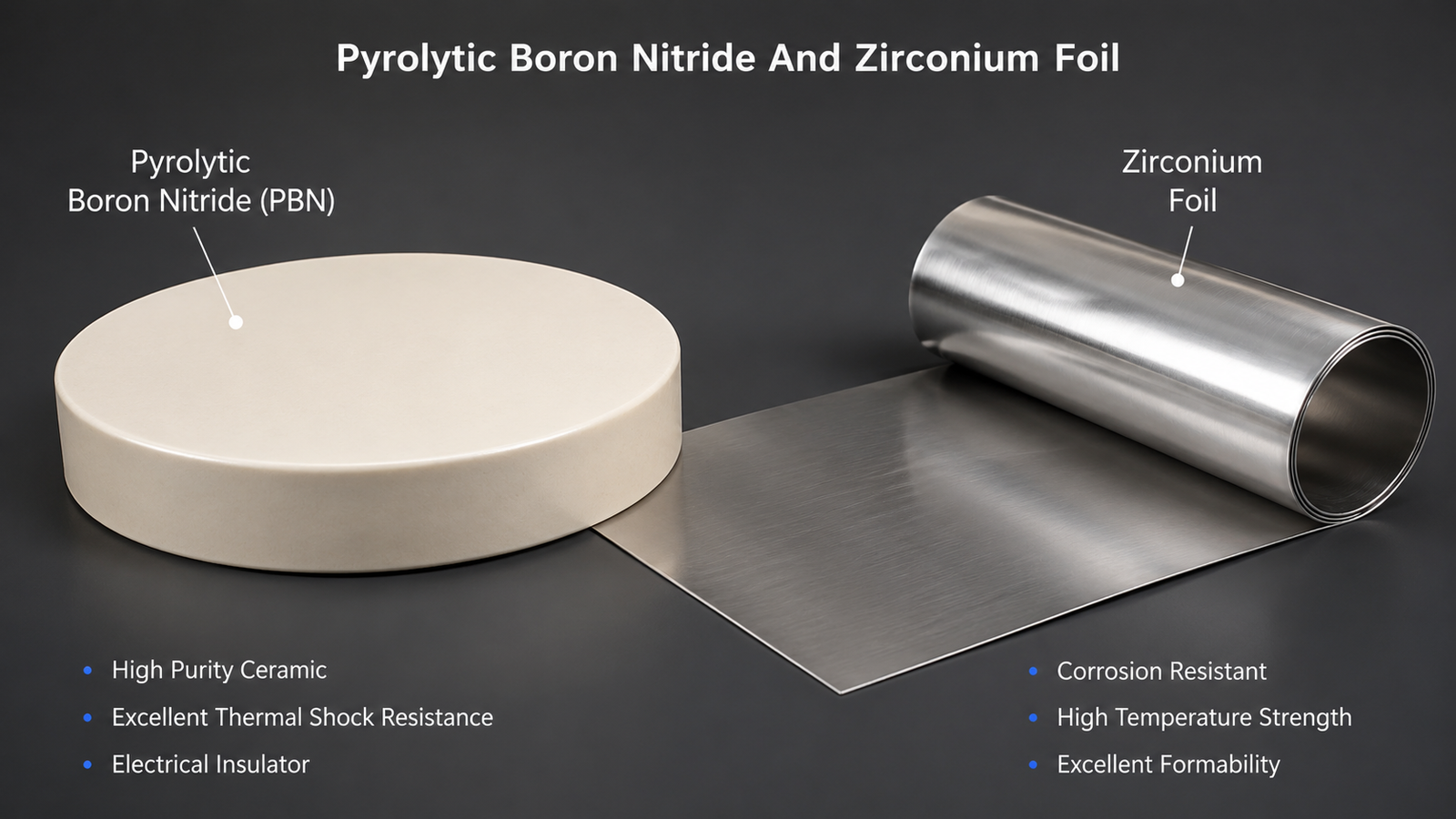
The continued development of semiconductor manufacturing, vacuum technology, nuclear research and high-temperature processing is increasing industry interest in specialised materials capable of operating under demanding conditions. Among these, Pyrolytic Boron Nitride and Zirconium Foil are gaining relevance for their distinctive thermal, electrical and chemical characteristics.
As industrial processes become more precise, manufacturers and research organisations increasingly require materials selected for specific operating environments rather than general-purpose performance. High purity, corrosion resistance, electrical behaviour, thermal management and dimensional accuracy are now critical considerations across many advanced applications.
Pyrolytic Boron Nitride, commonly referred to as PBN, is an advanced ceramic typically manufactured using chemical vapour deposition.
Unlike many conventional ceramic manufacturing processes, this production method can create highly pure boron nitride without traditional ceramic binders. This characteristic makes PBN particularly relevant to applications where contamination control is important.
Semiconductor processing is a notable example.
Materials used in semiconductor production may need to withstand elevated temperatures while maintaining purity and electrical insulation. PBN provides a combination of characteristics that can address these specialised requirements.
A significant characteristic of Pyrolytic Boron Nitride is its anisotropic thermal behaviour.
Because PBN possesses a layered structure, heat transfer varies according to material direction. Engineers can consider this directional behaviour when designing components requiring controlled thermal management.
Other important PBN characteristics include:
These characteristics support its use across sophisticated manufacturing and research environments.
Demand for advanced semiconductor materials continues to create applications for high-purity processing components.
Pyrolytic Boron Nitride can be considered for:
Crystal growth is particularly demanding because interactions between the processed material and its container must be carefully controlled.
Selecting an appropriate PBN specification can help address requirements involving purity, thermal stability and electrical insulation.
Alongside advanced ceramics, Zirconium Foil continues to serve important functions in materials research and specialised engineering.
Zirconium is a metallic element recognised for strong corrosion resistance in many environments. It also possesses a relatively high melting temperature and comparatively low neutron absorption.
When produced in thin foil form, zirconium becomes particularly useful where researchers require controlled thickness and a defined metallic surface.
Applications can range from surface science and oxidation research to nuclear-material studies and high-temperature experimentation.
The thin geometry of Zirconium Foil makes it particularly useful for experiments focused on material surfaces and interactions.
Potential applications include:
Researchers can expose zirconium foil to controlled environments and evaluate how temperature, gases or chemical substances affect its surface and underlying structure.
As a result, thickness, composition, purity and surface finish may all become important specification criteria.
While both materials support advanced technologies, they should not be viewed as direct substitutes.
| Property | Pyrolytic Boron Nitride | Zirconium Foil |
| Material category | Advanced ceramic | Metal |
| Electrical behaviour | Insulating | Conductive |
| Key advantage | Purity and thermal functionality | Corrosion-resistant metallic performance |
| Typical format | Crucibles and engineered components | Thin foil and sheet |
| Semiconductor relevance | Significant | Specialised |
| Nuclear research | Specialised applications | Important applications |
| Surface research | Application dependent | Highly relevant |
| Thermal behaviour | Direction dependent | Metallic heat transfer |
The correct material ultimately depends on the technical function required within the system.
The expanding use of advanced materials is also placing greater importance on detailed procurement specifications.
For Pyrolytic Boron Nitride, purchasers may need to define purity, component dimensions, thickness, thermal orientation, operating environment and manufacturing tolerances.
For Zirconium Foil, requirements may include foil thickness, dimensions, purity, grade, surface finish, temper and chemical composition.
Engineers should evaluate the complete operating environment before making a final selection.
Key considerations include temperature, electrical requirements, chemical exposure, vacuum conditions, mechanical loading and contamination limits.
1. What is Pyrolytic Boron Nitride?
PBN is an advanced boron nitride ceramic generally manufactured through chemical vapour deposition.
2. Why is PBN important for semiconductor manufacturing?
Its high purity, electrical insulation and specialised thermal behaviour make it useful in contamination-sensitive processes.
3. Is Pyrolytic Boron Nitride electrically insulating?
Yes. PBN is recognised for excellent electrical insulation.
4. What makes PBN thermally unusual?
Its layered structure produces anisotropic thermal conductivity, meaning heat transfer depends strongly on direction.
5. What is Zirconium Foil?
It is zirconium metal manufactured into a thin foil for specialised research and engineering applications.
6. Is Zirconium Foil corrosion resistant?
Zirconium provides strong corrosion resistance in many suitable environments.
7. Why is zirconium relevant to nuclear technology?
Its relatively low neutron absorption is an important reason zirconium-based materials are used in nuclear applications.
8. Can Zirconium Foil be used in surface research?
Yes. Its controlled thin geometry makes it suitable for oxidation, corrosion, diffusion and surface-science studies.
9. Are PBN and Zirconium Foil interchangeable?
No. PBN is an electrically insulating ceramic, whereas zirconium foil is a conductive metallic material.
10. What specifications should buyers consider?
Purity, dimensions, thickness, surface condition, temperature, chemical environment and application requirements should be clearly established.
Read more – https://newsgrow.blogspot.com/2026/09/boron-nitride-crucibles-and-boron.html
https://newsgrow.blogspot.com/2026/09/pyrolytic-boron-nitride-and-zirconium.html