


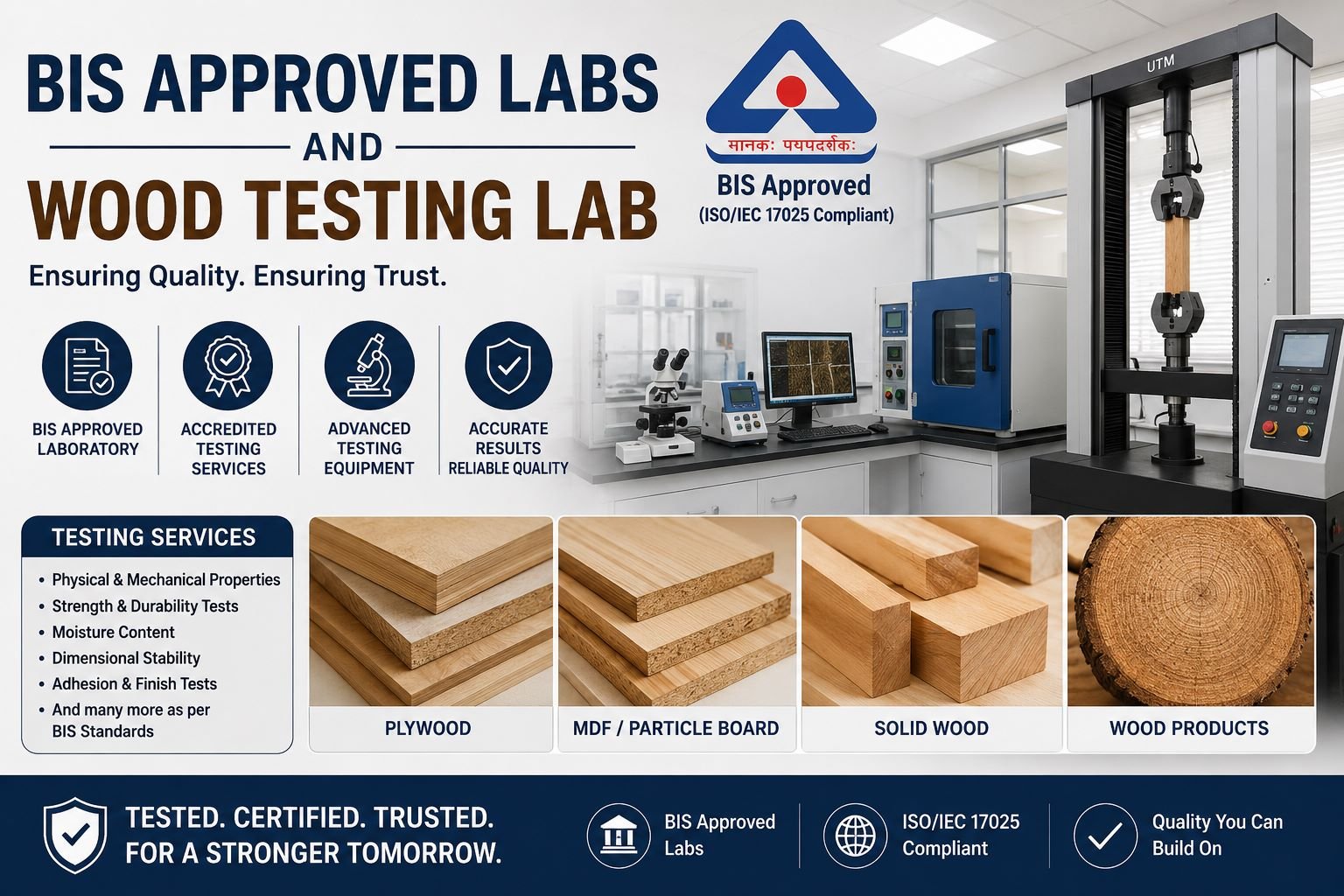
A piece of timber can travel through several stages before becoming a finished door, plywood sheet, furniture component, flooring panel or construction product. At every stage, material quality can influence the final result. Excess moisture may affect dimensions, variations in density can indicate inconsistency, and inadequate mechanical performance can make a product unsuitable for its intended application.
This is why professional laboratory evaluation has become an important part of wood quality management.
BIS approved Labs and an experienced Wood Testing lab help manufacturers, suppliers and buyers obtain measurable information about timber and wood-based products. Instead of judging quality only through colour, finish or visual appearance, laboratory testing allows important characteristics to be evaluated using defined methods.
Wood is a natural material, and natural materials are rarely identical.
Two timber samples from the same species can show different characteristics because of growing conditions, moisture, grain orientation, drying, storage and processing.
The possibility of variation becomes even greater when wood is converted into manufactured products.
Plywood, for example, involves veneers and bonding. Particle board is produced from wood particles, while fibreboard has a different structure and manufacturing process.
As a result, quality evaluation needs to consider the actual product rather than treating every wooden material in the same way.
Indian Standards establish specifications and testing methods for various products. When a wood-based product is subject to a relevant standard or conformity requirement, appropriate laboratory testing may be necessary.
Businesses often search for BIS approved Labs when looking for such testing services.
However, there is an important detail that manufacturers should understand: laboratory capability and recognition can be product- and standard-specific.
A facility testing one category of plywood or board may not necessarily cover another product.
Before submitting samples, businesses should identify:
This simple verification can prevent choosing a laboratory that does not cover the required tests.
A Wood Testing lab uses controlled procedures and appropriate equipment to evaluate specified characteristics of wood.
The process normally starts with sample identification. Depending on the test method, specimens may then require preparation, measurement or conditioning before actual testing begins.
Laboratory personnel perform the specified tests, record observations and prepare a report containing relevant results.
Depending on laboratory facilities and scope, testing may cover:
The required parameters vary between these products.
Moisture is one of the most important characteristics associated with wood.
Because wood can exchange moisture with its surroundings, changes in environmental conditions can influence dimensions and behaviour.
For manufacturers, moisture evaluation can help determine whether raw material or finished products meet specified requirements.
Moisture-related information may be particularly useful when investigating problems such as dimensional variation, movement or inconsistent processing behaviour.
A professional Wood Testing lab can evaluate moisture content according to the applicable test procedure.
Density is another useful physical property.
When manufacturers receive wood materials from multiple suppliers, density measurements can contribute to comparisons between representative samples.
For manufactured boards, density and its consistency can also provide useful information when assessing production quality.
However, density should not be interpreted in isolation. The relevant product standard and other performance characteristics should also be considered.
One of the most common questions buyers ask is: “Is this wood strong enough?”
There is no universal answer because different applications place different demands on a product.
A decorative panel does not experience the same loading conditions as a structural component.
Depending on the applicable specification, mechanical testing may evaluate:
Suppose two batches of wooden components look identical.
Visual inspection might suggest that both are suitable. Mechanical evaluation, however, could reveal meaningful performance differences.
Laboratory data gives manufacturers a more objective basis for deciding whether further investigation or corrective action is required.
Plywood is not simply a thick piece of natural wood.
It consists of multiple veneers assembled and bonded to create a panel. Therefore, its quality is influenced by several factors associated with both raw materials and manufacturing.
Depending on the applicable specification, testing may consider:
The same principle applies to particle board, fibreboard and other engineered wood products.
This is why businesses should avoid requesting generic “wood testing” without first identifying the exact product.
| Requirement | Suitable Testing Approach |
| Applicable BIS conformity requirement | Verify relevant BIS approved Labs or recognised facility |
| Raw timber evaluation | Competent Wood Testing lab |
| Production monitoring | Routine laboratory testing |
| Supplier comparison | Comparable material testing |
| Product development | Performance and specification testing |
| Customer complaint investigation | Targeted laboratory evaluation |
| Finished-product verification | Relevant product testing |
Understanding the objective before approaching a laboratory makes the testing process more efficient.
Price is often an important factor when selecting timber or board suppliers, but purchasing decisions based entirely on cost can create quality risks.
Testing can add another layer of information.
For example, a manufacturer considering three raw-material suppliers can establish relevant specifications and evaluate representative samples using consistent methods.
Results can then form part of a wider supplier-assessment process alongside:
A Wood Testing lab therefore has a potential role in both quality assurance and procurement.
Good testing starts before the sample reaches the laboratory.
Ask these questions first:
This point deserves special attention when selecting BIS approved Labs.
Do not assume that general laboratory recognition means every test is covered. Verify the relevant product, standard and parameters before submitting material.
Testing provides measurable information about material characteristics that cannot always be reliably evaluated through visual inspection.
A Wood Testing lab evaluates specified physical, mechanical, dimensional and other properties of timber and wood-based materials.
The term BIS approved Labs is commonly used when referring to laboratories associated with BIS-related testing. Their current recognition and scope should be verified for the required product.
Yes. Relevant characteristics of timber can be evaluated according to applicable testing methods.
Yes. Plywood can be evaluated for specified physical, mechanical, dimensional and bonding-related characteristics.
Moisture can influence dimensions and performance, making it an important parameter for many wood applications.
Yes. Different mechanical tests can evaluate how wood responds to forces such as bending, compression, tension or shear.
No. A laboratory can provide wood testing without necessarily being recognised by BIS for the required product or standard.
Yes. Comparable testing can provide objective information that supports supplier evaluation.
Start by identifying the exact product, intended application and applicable standard or specification.
https://newsgrow.blogspot.com/2026/08/chemical-testing-lab-in-delhi-and-water.html
https://newsgrow.blogspot.com/2026/08/bis-approved-labs-and-wood-testing-lab.html