


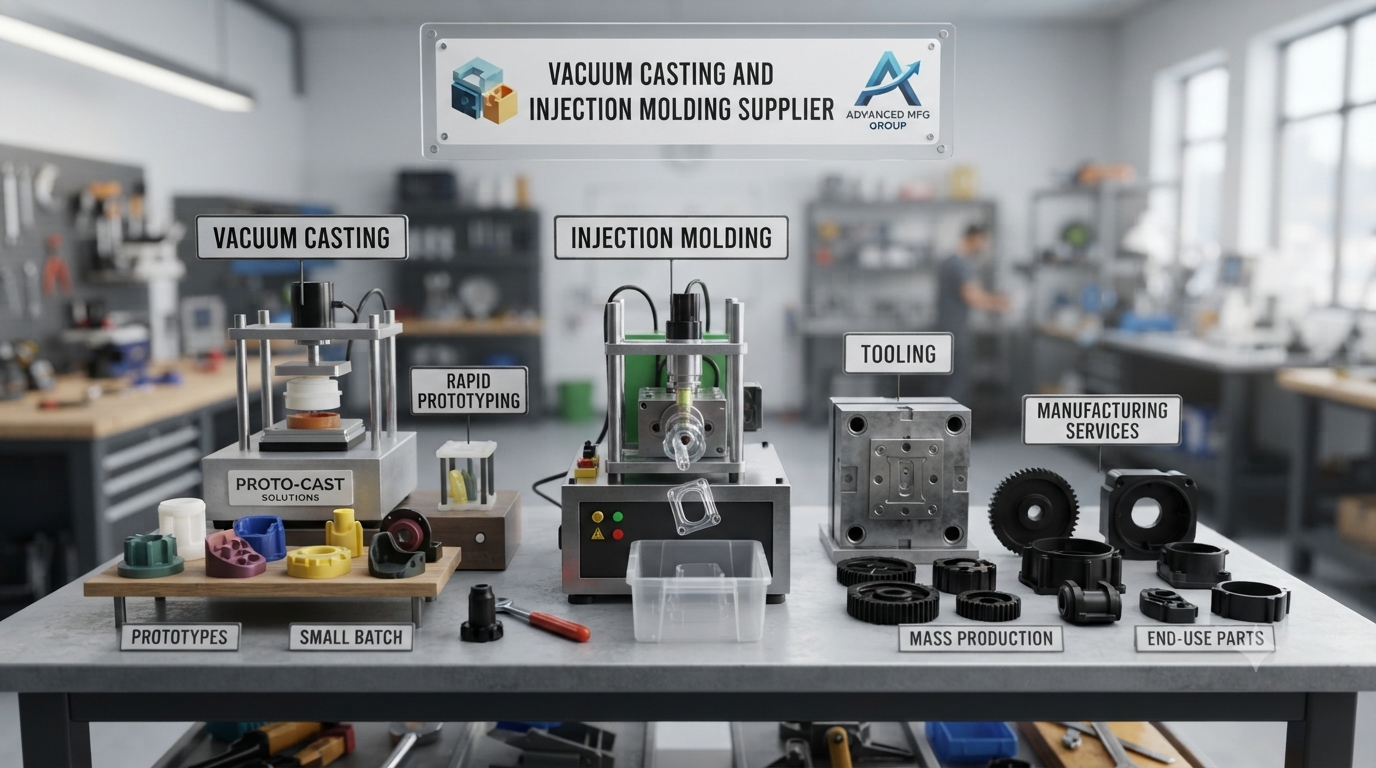
Manufacturing a new plastic product requires careful decisions at every stage, from initial prototyping to full-scale production. Two important areas in this journey are vacuum casting and selecting a professional injection molding supplier. While vacuum casting is commonly associated with prototypes and low-volume manufacturing, injection moulding is designed to deliver consistent parts when production requirements increase.
Understanding how these processes differ—and how they can work together—can help product designers, engineers and purchasing teams reduce unnecessary tooling risks, evaluate designs more effectively and select a manufacturing strategy suited to long-term production requirements.
Vacuum casting is a manufacturing technique used to reproduce plastic-like components in relatively small quantities. The process normally uses a silicone mould created from an accurately manufactured master pattern.
The master may be produced through CNC machining or high-resolution 3D printing. Liquid silicone is formed around the master and allowed to cure. After curing, the mould is opened and the original model is removed.
A polyurethane casting resin is then introduced into the silicone mould under vacuum conditions. The vacuum helps minimise trapped air and enables material to reproduce detailed features of the mould cavity.
Once cured, the component is removed and prepared for any necessary finishing.
Typical applications include:
The relatively flexible tooling approach makes vacuum casting particularly useful while a product is still being developed.
One of the biggest risks in manufacturing is approving expensive tooling before the design has been properly validated.
A CAD model can provide extensive technical information, but it cannot always reveal how a physical product will perform during real-world use.
For example, engineers may discover that:
Vacuum casting gives development teams an opportunity to produce multiple physical samples and investigate these concerns before permanent production tooling is completed.
This can be particularly valuable when a company requires more samples than conventional prototype development but is not yet ready for large-scale manufacturing.
Although exact production methods differ between manufacturers, a typical project follows several stages.
The process begins with an accurate master model. Its dimensions and surface condition are important because the silicone mould reproduces the master’s characteristics.
The master is positioned inside a moulding frame and surrounded by liquid silicone.
After curing, the mould is carefully separated and the master removed.
Polyurethane resin is selected according to the project’s visual and functional requirements.
Different formulations can provide varying levels of rigidity, flexibility and appearance.
The prepared material is introduced into the silicone mould under vacuum conditions to reduce trapped air and improve reproduction of detailed features.
Once cured, the component is removed from the mould.
Post-processing can include trimming, sanding, painting, polishing, texturing, printing and assembly.
Prototype manufacturing has limitations. When product demand grows and the design becomes stable, a business requires a manufacturing process capable of producing consistent parts efficiently.
An injection molding supplier uses precision metal tooling to manufacture thermoplastic components.
Plastic material is heated until it can flow and is then injected into a mould cavity under controlled conditions. The component cools and solidifies before being ejected.
The process repeats during production, making injection moulding particularly suitable for larger quantities.
An experienced injection molding supplier may provide:
Supplier capability can therefore influence much more than the final unit price.
Choosing between the two processes depends on several technical and commercial considerations.
| Factor | Vacuum Casting | Injection Moulding |
| Tooling | Silicone mould | Metal mould |
| Initial tooling requirement | Lower | Higher |
| Typical volume | Low | Medium to high |
| Design flexibility | High | Lower after tooling |
| Tool lifespan | Limited | Long |
| Materials | Casting resins | Production thermoplastics |
| Production automation | Limited | High |
| Repeatability | Good | Excellent |
| Prototype suitability | Excellent | Depends on tooling strategy |
| Mass production suitability | Limited | Excellent |
A company requiring only 20 or 50 components may find vacuum casting more practical, while a product expected to require thousands of components may justify injection mould tooling.
Vacuum casting and injection moulding do not have to compete for the same project.
They can represent different stages of one manufacturing programme.
A product development route may look like this:
Concept → CAD Design → Initial Prototype → Vacuum Casting → Testing → Design Revision → DFM → Tooling → Injection Moulding → Production
This approach provides an opportunity to identify physical design problems while changes remain easier to implement.
For example, if testing reveals that a mounting point needs repositioning, engineers can update the CAD model before permanent tooling is manufactured.
Before an injection molding supplier begins manufacturing a mould, the design should be reviewed for manufacturability.
Design for Manufacturing examines how product geometry may influence tooling and production.
Large variations in wall thickness can influence material flow, cooling and dimensional stability.
A suitable wall structure can support more consistent moulding.
Draft helps components release from the mould after cooling. Insufficient draft may create difficulties during ejection.
Undercuts can prevent a component from being removed through a straightforward mould-opening movement.
They may require sliders, lifters or other specialised mechanisms, potentially increasing tooling complexity.
Ribs can strengthen plastic components without making the entire wall excessively thick. Bosses commonly provide locations for screws and other assembly features.
Both should be designed carefully to support manufacturability.
Material selection is another area where an experienced injection molding supplier can provide valuable technical input.
Frequently used thermoplastics include:
Material selection should consider the component’s actual working environment.
Important factors include:
A plastic suitable for an indoor consumer product may not necessarily perform appropriately in an industrial or automotive environment.
Vacuum casting supports product development across numerous sectors.
Prototype interior components, control housings, trim parts and development models can be produced before final tooling.
Device housings, controllers, remote controls and smart-product enclosures can be evaluated for appearance and assembly.
Machine covers, control enclosures and specialised components may be tested before production.
Household products, accessories and lifestyle products frequently require physical samples for customer and design evaluation.
Prototype housings and equipment components can support engineering development, although final applications must meet relevant regulatory and material requirements.
Choosing the right injection molding supplier requires more than obtaining several quotations and selecting the cheapest.
Important factors include:
A supplier willing to identify potential design problems before tooling can provide significant value during product development.
Providing complete information helps manufacturers evaluate projects more accurately.
A typical enquiry should contain:
Companies should also explain whether the design is final or still under development.
This information can help the supplier determine whether vacuum casting, rapid tooling or full production tooling is the most suitable route.
Vacuum casting is commonly used for prototypes, functional samples, presentation models and small production batches.
It commonly uses polyurethane casting resins formulated to provide different physical and visual characteristics.
Generally, no. Silicone moulds have limited production life, so other processes become more suitable as quantities increase.
It allows physical evaluation and design refinement before significant investment is made in metal production tooling.
An injection molding supplier manufactures thermoplastic components using engineered moulds and controlled injection moulding processes.
Initial tooling can represent a significant investment, although production economics can improve considerably when larger quantities are required.
ABS, polypropylene, polycarbonate, nylon, POM, PMMA, TPU and many other thermoplastics can be processed.
DFM means Design for Manufacturing. It evaluates product geometry to identify potential manufacturing or tooling concerns.
Yes. Depending on requirements, parts can be painted, polished, textured, printed or assembled.
Evaluate engineering support, tooling expertise, material knowledge, quality control, capacity, communication and total manufacturing capability.
https://newsgrow.blogspot.com/2026/08/rapid-injection-molding-and-china-rapid.html
https://newsgrow.blogspot.com/2026/08/aluminum-prototype-and-sheet-metal.html
https://newsgrow.blogspot.com/2026/08/deep-information-about-sheet-metal.html
https://newsgrow.blogspot.com/2026/08/vacuum-casting-and-injection-molding.html