


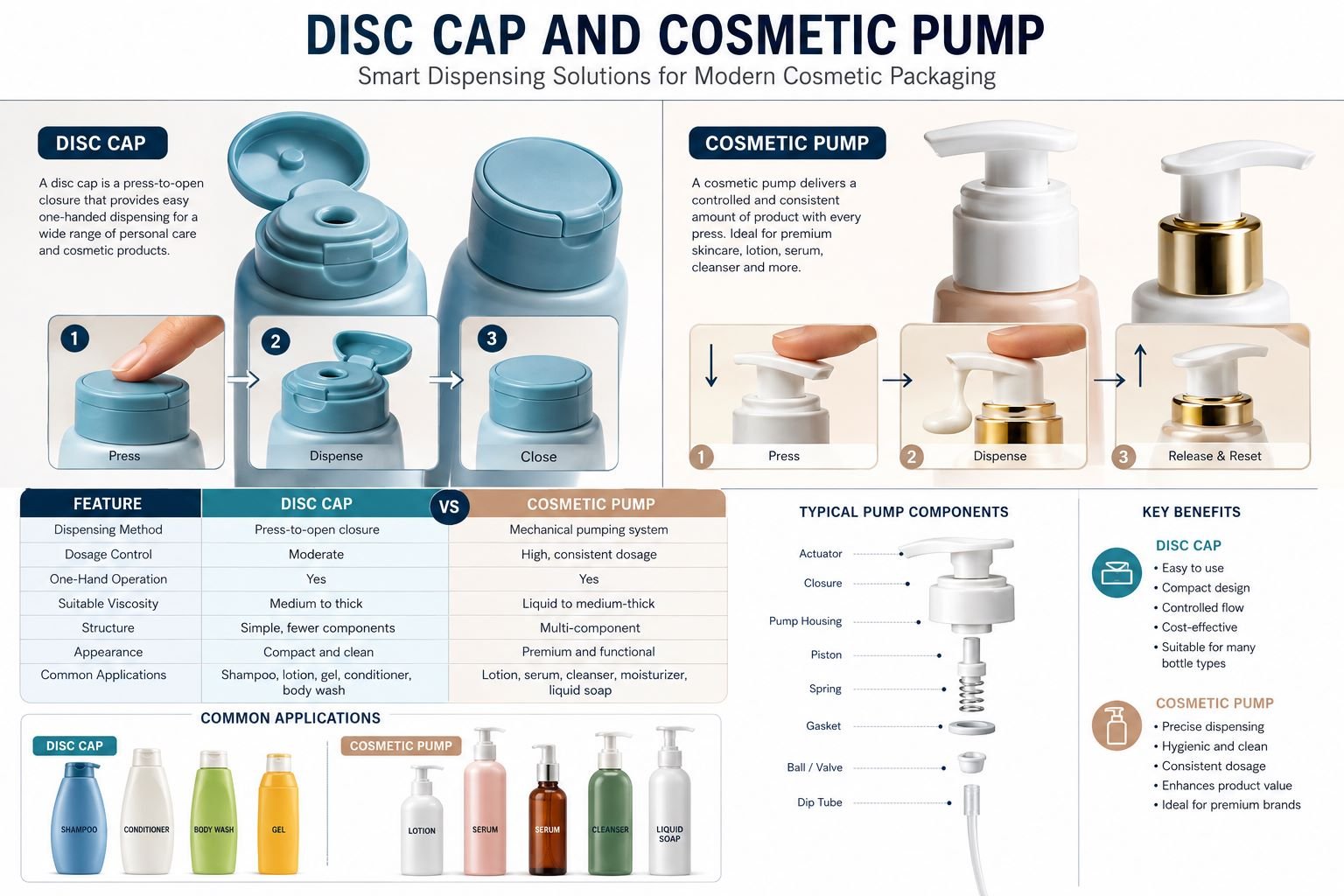
Packaging plays a major role in how cosmetic, personal care, skincare, and hygiene products are protected, dispensed, and experienced by consumers. Two widely used dispensing solutions are the disc cap and cosmetic pump. Although both perform the basic function of controlling product flow, their structures, dispensing mechanisms, product compatibility, and ideal applications are quite different.
Choosing the right closure is not simply a design decision. It affects dosage control, leakage prevention, product hygiene, manufacturing efficiency, transportation safety, shelf appeal, and customer satisfaction. Understanding how disc cap and cosmetic pump systems work helps brands select packaging that matches both the formulation and the intended consumer experience.
A disc cap is a dispensing closure commonly fitted to bottles containing shampoos, conditioners, lotions, body washes, gels, creams, oils, and other personal care formulations. It usually contains a circular top surface that operates through a press-to-open mechanism.
When one side of the disc is pressed downward, the opposite side rises and exposes the dispensing opening. After the required amount of product is released, pressing the raised section closes the opening again.
The mechanism is simple, compact, and convenient, which explains why disc closures are widely used across cosmetic and personal care packaging.
A typical disc closure may contain:
Manufacturers may modify these elements depending on bottle neck specifications, product viscosity, dispensing requirements, and packaging design.
The effectiveness of a disc cap comes from its simplicity. Consumers can usually open and close the package using one hand without completely removing the closure.
The controlled opening also helps reduce accidental over-dispensing compared with completely open bottle necks.
A cosmetic pump is a mechanical dispensing system designed to release a measured or controlled quantity of liquid, lotion, cream, serum, cleanser, or similar formulation when the actuator is pressed.
Pumps are particularly popular for premium skincare, haircare, body care, hand care, professional beauty, and hospitality products.
Unlike simple closures, a pump uses multiple internal components to draw the formulation through a dip tube and push it through the dispensing nozzle.
When the pump actuator is pressed, internal pressure changes move the product through the pumping chamber. After the actuator is released, the mechanism returns to its original position and draws another quantity of formulation into the chamber.
A standard pump system may include:
The exact internal construction varies depending on dosage, viscosity, bottle compatibility, and pump technology.
One major advantage of a cosmetic pump is consistent dosage. Brands can select pumps designed to dispense specific quantities with every complete stroke.
Consistent dosing is useful for products such as moisturizers, serums, cleansing lotions, liquid soaps, and professional cosmetic formulations where controlled consumption improves convenience.
Both dispensing systems have advantages, but they serve different packaging requirements.
| Feature | Disc Cap | Cosmetic Pump |
| Dispensing method | Press-open closure | Mechanical pumping |
| Structure | Relatively simple | Multi-component |
| Dosage control | Moderate | High |
| One-hand operation | Yes | Yes |
| Suitable viscosity | Medium to thick products | Liquid to medium-thick products |
| Packaging appearance | Compact | Premium and functional |
| Product protection | Good | Very good |
| Manufacturing complexity | Lower | Higher |
| Common applications | Shampoo, lotion, gel | Lotion, serum, cleanser |
| Consumer experience | Simple and convenient | Controlled and premium |
Packaging must be compatible with the formulation stored inside it. A closure that performs perfectly with shampoo may not work effectively with highly viscous cream.
For a disc cap, manufacturers commonly evaluate product thickness, flow behavior, opening diameter, squeeze pressure, and bottle flexibility.
For a cosmetic pump, testing may involve viscosity, dip-tube dimensions, suction performance, dosage output, priming speed, and chemical compatibility.
Testing the complete bottle, closure, formulation, and dispensing system together reduces the risk of poor dispensing performance.
Plastic materials such as polypropylene are commonly used in dispensing closures because they offer useful mechanical properties, chemical resistance, lightweight construction, and manufacturing flexibility.
Different components may require different material characteristics. A pump spring, gasket, actuator, closure, and internal housing can each perform a specific mechanical function.
Material selection should therefore consider formulation compatibility, recyclability goals, appearance, functionality, durability, and manufacturing requirements.
The disc cap is popular because it combines simple operation with economical packaging.
Major advantages include:
Because the cap stays attached to the bottle during normal use, consumers also avoid repeatedly removing and replacing a separate closure.
A cosmetic pump creates a more controlled dispensing experience and can strengthen the perceived value of the product.
Its important benefits include precise dispensing, reduced direct contact with the formulation, cleaner application, improved convenience, controlled consumption, and professional packaging aesthetics.
Pump packaging is especially effective where the product is used frequently and consumers expect repeatable quantities.
Packaging developers should evaluate several factors before making a final decision.
Consider:
For squeeze bottles containing shampoo or gel, a disc cap may offer excellent functionality. For lotions, cleansers, and premium skincare formulations, a cosmetic pump may provide better control and presentation.
Reliable dispensing packaging requires systematic testing before commercial production.
Leakage tests determine whether the closure remains secure during storage, transportation, and normal consumer use. Compatibility tests evaluate whether the formulation affects plastic components, seals, springs, or internal mechanisms.
Manufacturers may evaluate dosage consistency, opening force, pump priming, closure torque, actuator recovery, dip-tube performance, and repeated-use durability.
Long-term testing is valuable because cosmetic products may remain packaged for months before they are completely consumed. Packaging should continue functioning throughout the intended shelf life.
Sustainability is increasingly influencing cosmetic packaging development. Brands are exploring lightweight structures, recyclable materials, reduced component counts, refill systems, and mono-material packaging concepts.
Simple disc cap designs may offer advantages because they contain fewer components. Pump systems can be more complicated because conventional pumps may contain different plastics, springs, and other materials.
However, packaging technology is evolving toward improved recyclability and simplified pump constructions.
A disc cap is commonly used for shampoos, lotions, conditioners, gels, cleansers, and personal care products.
Pressing one side of the top disc raises the opposite side and reveals the dispensing opening.
A cosmetic pump is a mechanical dispensing system that releases controlled amounts of cosmetic or personal care formulations.
Lotions, moisturizers, cleansers, liquid soaps, serums, conditioners, and body care products commonly use pumps.
A disc cap generally has a simpler construction, making it suitable for cost-sensitive packaging projects.
Yes. Pumps can be engineered to provide relatively consistent output during each complete dispensing stroke.
Yes, provided the dispensing opening and bottle design are compatible with the formulation’s viscosity.
Yes. Their controlled dispensing and professional appearance make pumps popular in premium skincare and personal care packaging.
Brands should evaluate viscosity, dosage, packaging cost, user experience, bottle compatibility, branding, and transportation requirements.
Yes. Manufacturers may offer customized colors, sizes, finishes, actuator styles, closure designs, and dispensing specifications.
https://newsgrow.blogspot.com/2026/08/cream-jar-and-cosmetic-jar.html