


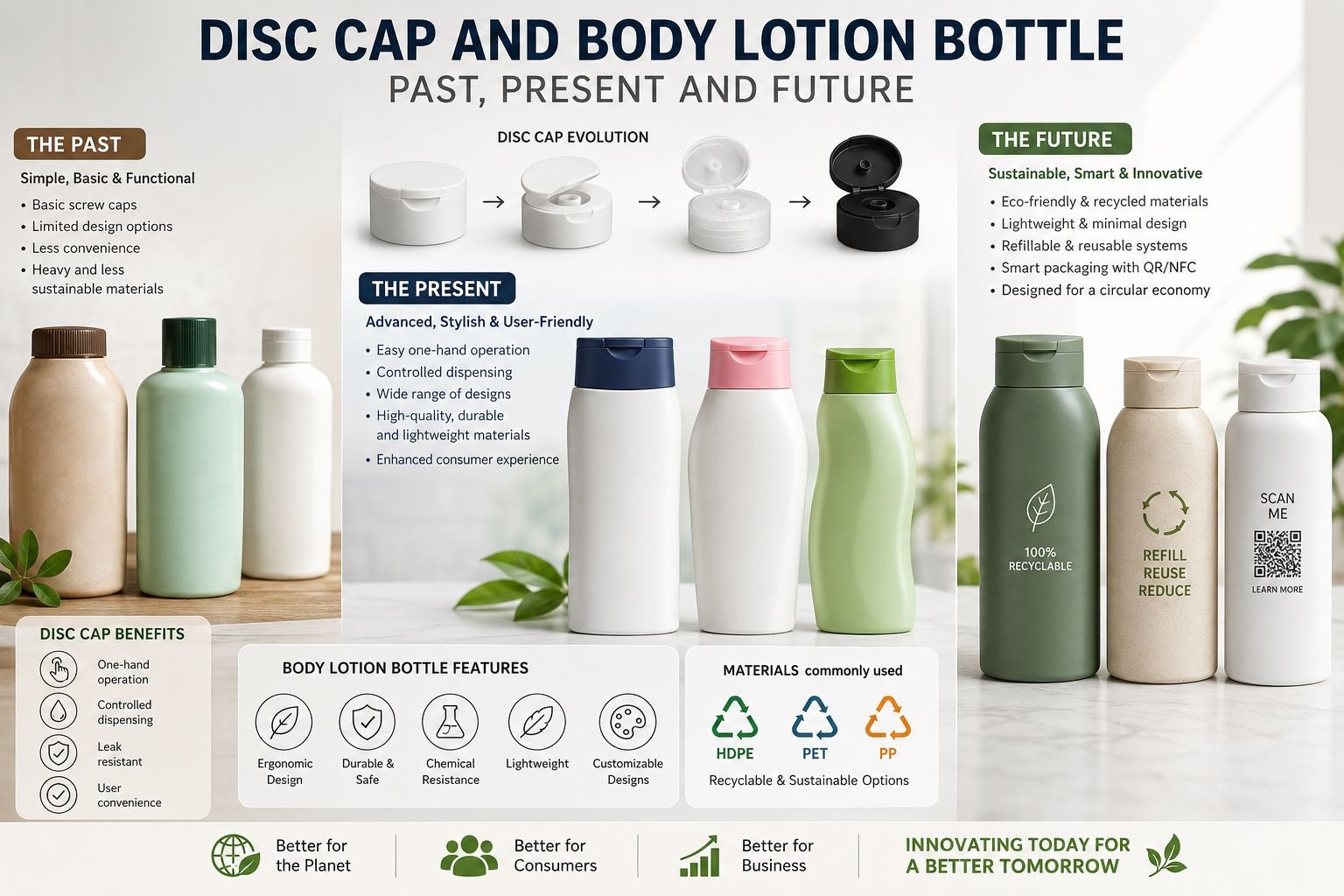
Packaging closures may look like a small component of a bottle, but they have a direct influence on dispensing control, product protection, convenience and the overall customer experience. For brands developing packaging for personal care, cosmetics, household products and other liquid formulations, selecting between a disc cap and a flip top cap requires more than simply comparing appearance.
The right closure should complement the product’s viscosity, bottle neck, intended dispensing method, consumer habits and brand positioning. Understanding these practical differences can help packaging buyers and product developers make a more informed sourcing decision.
A disc cap, commonly called a disc top cap, is a dispensing closure that uses a press-to-open mechanism. One side of the top disc is pressed down, causing the opposite side to rise and expose the dispensing orifice.
The user can then squeeze or tilt the bottle to dispense the required amount of product. Pressing the raised section again closes the opening.
This simple mechanism makes disc top closures particularly useful for products that consumers use frequently.
Typical applications include:
· Shampoo and conditioner
· Body lotion
· Hand and body wash
· Hair-care formulations
· Cosmetic liquids
· Personal-care products
· Selected household formulations
· Hotel and hospitality toiletries
A key advantage is that the closure remains attached to the bottle during use. There is no separate lid for the consumer to remove or misplace.
The mechanism is straightforward: press, dispense and close.
When pressure is applied to one side of the top disc, the dispensing side rises. The opening allows the formulation to flow out when the bottle is squeezed or tilted.
The design can provide controlled dispensing while maintaining a clean, streamlined appearance.
From a packaging development perspective, however, performance depends on several factors, including the size of the dispensing orifice, product viscosity, closure material, bottle flexibility and compatibility between the cap and bottle neck.
For example, a relatively thick body lotion may require a different dispensing configuration from a low-viscosity cleansing liquid.
A flip top cap is a hinged closure that opens by lifting or flipping a lid. The lid remains connected to the main closure and can be pressed back into position after dispensing.
These caps are widely used because consumers immediately understand how to operate them.
Common applications include personal-care bottles, shampoos, conditioners, lotions, hand sanitisers, cosmetic products and various household formulations.
Depending on the closure design and formulation, flip tops can accommodate different dispensing requirements and product viscosities.
Both closure types can provide convenient dispensing, but the user interaction is different.
| Factor | Disc Cap | Flip Top Cap |
| Opening mechanism | Press-to-open disc | Hinged lid |
| User action | Press the top section | Lift the lid |
| Lid remains attached | Yes | Yes |
| Dispensing control | Determined by orifice and product | Determined by opening and product |
| Visual character | Clean and streamlined | Familiar and functional |
| Typical uses | Lotions, shampoos, cosmetics | Shampoo, toiletries, lotions, household products |
| One-handed operation | Often convenient | Depends on closure design |
| Suitability | Depends on formulation and bottle | Depends on formulation and bottle |
Neither option is automatically better. The appropriate choice depends on how the packaged product will be stored, transported, displayed and used.
A disc top mechanism can make frequent product use straightforward. Consumers press the top, dispense the formulation and close the cap without removing a separate component.
This can be particularly useful for products kept on bathroom shelves, dressing tables or salon workstations.
A properly selected orifice can help regulate how much formulation leaves the bottle.
The ideal opening should be considered alongside viscosity. If an opening is too large for a thin formulation, dispensing may be excessive. If it is too small for a thick formulation, users may need to squeeze the bottle harder than expected.
Disc top closures are frequently selected for their relatively smooth profile. They can complement contemporary bottle designs and help maintain a neat overall presentation.
Manufacturers can develop disc top closures in different sizes, materials, finishes and dispensing configurations, making them relevant across numerous packaging projects.
Suggested internal link: Explore cosmetic packaging closures
Shampoo, conditioner, body lotion and cleansing formulations are natural candidates for dispensing closures.
For products used every day, ease of opening and closing can have a meaningful effect on customer experience.
Certain liquid and semi-liquid cosmetic formulations can use a disc cap where controlled dispensing and a streamlined bottle appearance are priorities.
Hair-care brands often need closures that work reliably with frequently handled bottles. Disc top designs can be considered for shampoos, conditioners and selected treatment formulations.
Hotels, resorts and travel-related businesses may use dispensing closures for toiletries such as shampoo, conditioner and body wash.
Depending on chemical compatibility and the intended application, disc top closures may also be considered for selected cleaning and household formulations.
Compatibility testing is especially important where the formulation contains ingredients that could interact with packaging materials.
Choosing a closure based only on diameter or appearance can lead to avoidable packaging problems. Buyers should evaluate the complete bottle-and-closure system.
The closure must match the bottle’s neck specification. Diameter alone does not guarantee compatibility because thread design and neck finish also matter.
Ask your packaging supplier to confirm the relevant specifications before placing a production order.
Think about how easily the formulation flows.
Low-viscosity liquids may require greater control, while thicker lotions or conditioners may need an opening that allows comfortable dispensing without excessive bottle pressure.
The dispensing hole influences product flow and consumer experience. Sampling and testing the actual formulation is more reliable than selecting an orifice based purely on visual judgement.
Closures are commonly manufactured using plastics such as polypropylene, but material choice should be confirmed for the specific application.
Compatibility should be evaluated against the product formulation, filling process, storage conditions and intended shelf life.
Before approving bulk production, test the bottle, closure and formulation together.
Useful checks can include:
· Opening and closing performance
· Leakage
· Dispensing behaviour
· Bottle squeezing force
· Closure fit
· Storage orientation
· Transport conditions
· Repeated consumer use
This is particularly important when developing packaging for commercial distribution.
A flip top cap can be a strong choice when a conventional hinged opening suits the consumer experience or product characteristics better.
For example, a brand may prefer a flip top when it wants a clearly visible opening action or when the closure’s dispensing geometry works particularly well with its formulation.
The decision should therefore be based on functional testing rather than assumptions about which closure is more premium or convenient.
Suggested internal link: View flip top cap options
Closure selection also contributes to the visual identity of a packaged product.
Depending on manufacturing capabilities and order requirements, buyers may consider options such as closure colour, surface finish, cap diameter, dispensing opening and other design details.
Colour matching can help create consistency between the bottle, label, closure and overall brand identity.
For example, a skincare range using several bottle sizes may use coordinated closures to maintain visual consistency across the collection.
Before requesting commercial quantities, provide the supplier with detailed packaging requirements rather than asking only for a price.
Important information can include the bottle neck specification, cap size, formulation type, product viscosity, required colour, expected quantity and intended market.
You can then ask whether samples are available for compatibility and leakage testing.
For larger projects, also discuss minimum order quantities, production lead times, packaging specifications and customisation requirements.
Suggested internal link: Request packaging closure samples
Unit price matters, especially when production volumes are high, but the lowest-priced closure may not necessarily deliver the best overall packaging outcome.
A poorly matched closure can potentially create dispensing difficulties, leakage concerns, packaging waste or customer dissatisfaction.
Commercial buyers should therefore consider overall value: compatibility, consistency, dispensing performance, appearance, supply reliability and cost.
A disc cap is a dispensing bottle closure that opens when one side of its top disc is pressed, exposing an opening for controlled product dispensing.
They are commonly considered for shampoos, conditioners, lotions, cosmetic liquids, body-care formulations and selected household products.
A disc top opens by pressing one side of a movable disc, while a flip top cap uses a hinged lid that is lifted to expose the dispensing opening.
Yes, they can be suitable for shampoo packaging when the closure, dispensing opening, bottle and shampoo viscosity are compatible.
They are frequently used for lotions and similar personal-care formulations, subject to viscosity and packaging compatibility.
Start with the bottle’s neck finish and closure specifications rather than diameter alone. Your bottle or closure supplier should confirm compatibility.
Customisation possibilities vary by manufacturer but may include colour, dimensions, finish and dispensing configurations.
Neither is universally better. The right option depends on product viscosity, dispensing behaviour, bottle design, user experience and packaging requirements.
For commercial packaging projects, testing samples with the actual bottle and formulation is strongly recommended before approving large quantities.
Provide the cap type, bottle neck specification, required size, colour, formulation, approximate order quantity and any customisation requirements.