


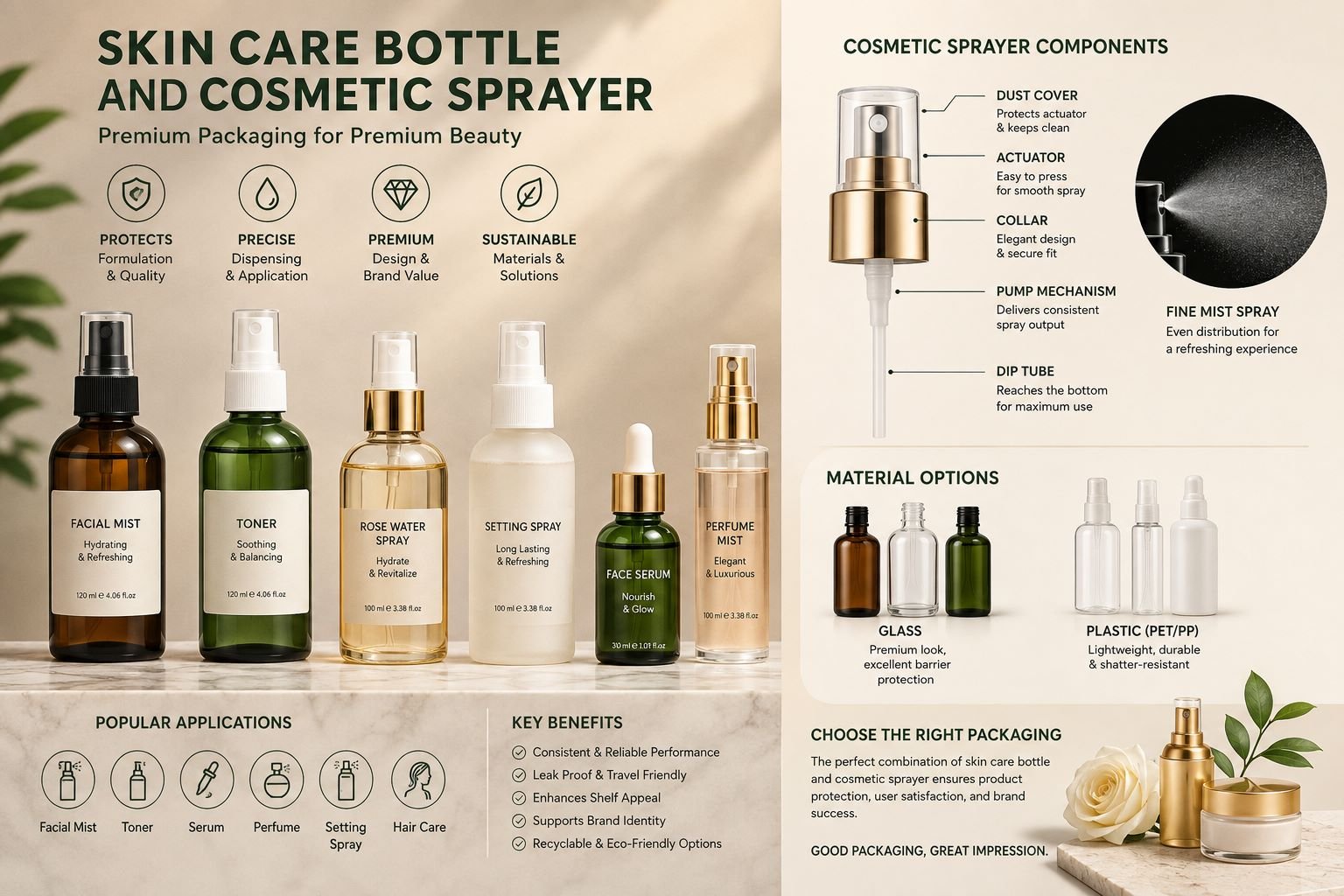
The global beauty packaging industry is witnessing a noticeable shift as skincare and cosmetic brands place greater emphasis on packaging performance, sustainability, and consumer convenience. Among the solutions receiving increased attention are the skin care bottle and cosmetic sprayer, two packaging components that are becoming increasingly sophisticated as brands compete to deliver better product experiences.
Industry developments indicate that packaging is moving beyond its traditional role of simply containing a formulation. Modern bottles and dispensing systems are being designed to protect sensitive ingredients, improve application, reduce product waste, strengthen visual identity, and address growing environmental expectations.
Beauty consumers increasingly interact with products through packaging before experiencing the formulation itself. Bottle shape, surface finish, pump operation, spray quality, portability, and dispensing accuracy can all influence the perceived quality of a cosmetic product.
This shift is encouraging brands to consider the skin care bottle during the early stages of product development.
Packaging developers must consider formulation viscosity, ingredient sensitivity, chemical compatibility, shelf-life expectations, transportation conditions, and consumer usage patterns before selecting a suitable container.
At the same time, dispensing systems are receiving similar attention. For facial mists and other sprayable cosmetics, a reliable cosmetic sprayer can determine whether application feels controlled and luxurious or uneven and inconvenient.
The growth of specialized serums, facial oils, essences, toners, moisturizers, and active skincare products has increased demand for bottles designed around specific formulations.
Glass continues to maintain a strong position in premium skincare because of its visual appeal and barrier characteristics. Plastic options such as PET, PETG, PE, and PP remain important because they can offer durability, lower transportation weight, and considerable design flexibility.
Choosing between plastic and glass is only the beginning.
Manufacturers must also evaluate:
For sensitive formulas, an ordinary transparent skin care bottle may not always provide the required protection. Brands may instead consider tinted, opaque, coated, or airless packaging depending on formulation stability.
Dispensing technology is also changing as consumers expect more refined application from facial mists, toners, setting sprays, body sprays, hair-care products, and fragrance products.
A cosmetic sprayer generally includes an actuator, nozzle, pump mechanism, closure, gasket, dip tube, and other internal components.
Small differences in these components can significantly change the final spray.
Manufacturers are focusing on producing finer droplets, wider and more consistent spray patterns, controlled dosage, smoother actuation, and reduced dripping.
Facial products particularly benefit from fine-mist dispensing.
Instead of releasing several large droplets onto one area, a well-engineered cosmetic sprayer distributes smaller droplets across a broader surface.
This can improve application while reducing the likelihood of excessive product being released in a single area.
Not every liquid behaves identically inside a sprayer. Viscosity, alcohol content, oils, suspended ingredients, and other formulation characteristics can affect pumping and atomization.
This makes formula-specific testing essential.
Packaging specialists increasingly emphasize that bottles and dispensing components should be evaluated as complete systems.
A high-quality skin care bottle combined with an incompatible closure can still create serious problems.
| Packaging Area | Key Requirement | Potential Problem |
| Bottle neck | Correct dimensions | Leakage |
| Sprayer closure | Accurate fit | Loose assembly |
| Gasket | Formula compatibility | Swelling or failure |
| Dip tube | Correct length | Product left inside |
| Nozzle | Suitable output | Uneven spraying |
| Bottle material | Formula resistance | Deformation |
Even small dimensional variations can affect sealing performance.
Brands are therefore encouraged to test the bottle, sprayer, formulation, decoration, and closure together before approving commercial production.
With cosmetics frequently transported across different climates and distribution networks, packaging must withstand conditions beyond normal room-temperature storage.
A product may encounter warehouse heat, transportation vibration, pressure variations, repeated handling, or prolonged retail storage.
Manufacturers and brands commonly evaluate packaging through several processes:
Testing a cosmetic sprayer over repeated actuations can also reveal whether spray performance remains consistent as the product level decreases.
Although technical performance is becoming more important, appearance remains a major factor in beauty packaging.
Brands are using decoration to transform standard containers into distinctive packaging.
Popular options include frosting, silk-screen printing, hot stamping, metallization, gradient coating, matte finishing, labeling, embossing, and customized color matching.
A premium skin care bottle may combine minimalist decoration with a coordinated pump, collar, or cap to create a consistent visual identity.
Established beauty companies may invest in proprietary bottle molds, while smaller brands can customize stock packaging through printing and surface treatments.
Stock packaging can reduce development costs and production timelines while still providing substantial branding opportunities.
Environmental considerations are becoming increasingly important across the cosmetics sector.
Packaging developers are exploring PCR plastics, lightweight containers, refillable formats, reusable glass bottles, recyclable components, and simplified material structures.
The objective is not merely to use less material but to improve packaging efficiency throughout its lifecycle.
Sustainable packaging must still protect the formulation.
Reducing plastic thickness too aggressively, for example, could weaken a skin care bottle and increase the possibility of damage during transportation.
Similarly, simplifying a cosmetic sprayer requires careful engineering because dispensing performance and sealing must remain reliable.
The challenge is therefore to balance environmental goals with product protection and consumer usability.
Another developing packaging priority is dosage control.
Consumers increasingly expect packaging that dispenses an appropriate amount without unnecessary waste. Controlled output can also help brands create more predictable usage experiences.
For spray-based products, the amount released with each actuation is especially important.
An effective cosmetic sprayer should maintain relatively consistent output throughout normal use rather than producing significantly different quantities with every press.
As packaging becomes more technically demanding, beauty companies are paying closer attention to supplier capabilities.
Brands increasingly evaluate manufacturing consistency, quality-control procedures, material expertise, customization options, mold precision, production capacity, minimum order quantities, and technical support.
Samples should ideally be tested using the final formulation rather than water alone.
A skin care bottle that performs successfully with one formulation may behave differently with another due to ingredient interactions.
A skin care bottle is packaging designed to store and protect skincare formulations such as serums, toners, lotions, oils, and essences.
Packaging influences product protection, usability, branding, dispensing accuracy, sustainability, and the consumer’s overall experience.
A cosmetic sprayer dispenses liquid formulations as droplets or fine mist for controlled and convenient application.
Facial mists, toners, setting sprays, perfumes, body sprays, hair products, and other low-viscosity cosmetics commonly use them.
Both have advantages. Selection should depend on formulation compatibility, positioning, weight, durability, sustainability goals, and required barrier protection.
High viscosity, dried formulation, particles, unsuitable nozzle design, or formula-pump incompatibility can contribute to clogging.
Fine-mist packaging uses a specialized dispensing mechanism to distribute small droplets relatively evenly across the application area.
Testing can identify interactions between the formula and packaging that could cause leakage, deformation, discoloration, or dispensing problems.
Yes. Brands can customize bottle colors, shapes, printing, coatings, labels, caps, collars, and surface finishes.
Brands and manufacturers are increasingly exploring recycled materials, refill systems, lightweight packaging, and designs intended to improve recyclability.
They should verify material compatibility, sealing, spray performance, durability, decoration quality, supplier consistency, and transportation resistance.
https://newsgrow.blogspot.com/2026/08/cream-jar-and-cosmetic-jar.html
https://gosarkarijobs.com/disc-cap-and-cosmetic-pump-a-deep-guide-to-modern-cosmetic-packaging/
https://newsgrow.blogspot.com/2026/08/disc-cap-and-cosmetic-pump-essential.html
https://tandtlawassociates.com/past-and-future-of-disc-cap-and-body-lotion-bottle-packaging/
https://newsgrow.blogspot.com/2026/08/disc-cap-and-body-lotion-bottle-designs.html
https://shopnets.com/why-flip-top-cap-and-cosmetic-sprayer-packaging-matters-more-than-ever/
https://newsgrow.blogspot.com/2026/08/the-packaging-detail-customers-notice.html