


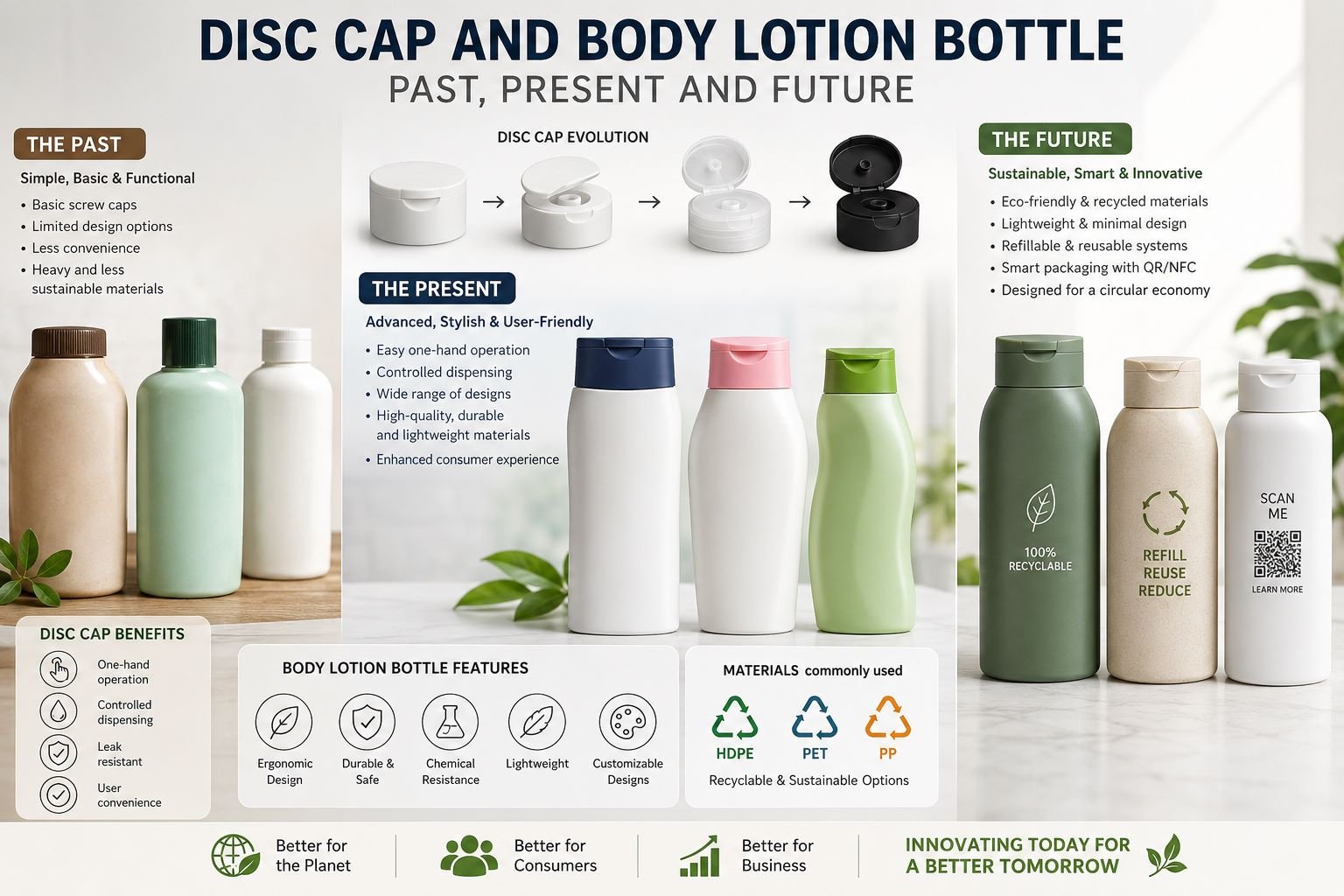
When consumers purchase a skincare product, the formula usually receives the most attention. Ingredients, fragrance, texture, and results matter—but packaging quietly shapes the entire experience. From carrying lotion while travelling to dispensing the right amount every morning, packaging determines how conveniently a product fits into everyday life.
Two components that have played an important role in this transformation are the disc cap and body lotion bottle. Their journey from simple functional packaging to modern, sustainability-focused solutions reflects the wider evolution of the beauty and personal care industry.
As brands search for packaging that is practical, attractive, efficient, and environmentally responsible, understanding this journey can help predict what comes next.
Earlier personal care packaging had a straightforward purpose: contain the formulation and prevent leakage.
Bottles were typically paired with conventional screw closures. Consumers needed to completely remove the cap, dispense the lotion, and replace the closure afterward.
Although functional, this system created everyday inconveniences. Caps could be misplaced, too much product could be dispensed, and repeatedly opening the entire bottle could make application less convenient.
Growing demand for user-friendly products encouraged packaging manufacturers to rethink closure design.
That demand eventually helped dispensing closures become an important part of personal care packaging.
The disc cap introduced an uncomplicated solution to a common packaging problem.
Its operating principle is simple. Pressing one side of the top causes the other side to lift, exposing a dispensing opening. Once the product has been used, pressing the raised section closes it again.
Consumers no longer need to remove the entire closure.
The design became attractive for personal care products because it offered:
As plastic molding technology became more advanced, manufacturers gained greater flexibility in producing closures with different dimensions, colors, finishes, and dispensing openings.
The evolution of the body lotion bottle followed a similar path.
Initially, the bottle was mainly a protective container. Over time, increasing competition in the skincare market changed its role.
Imagine walking through a personal care aisle where dozens of moisturizers offer similar benefits. Before reading every ingredient list, customers notice packaging.
Bottle shape, color, finish, label design, closure style, and overall appearance can communicate whether a product feels premium, natural, clinical, youthful, or environmentally conscious.
Manufacturers consequently introduced increasingly diverse bottle formats, including:
Packaging became an extension of the skincare brand rather than simply a container.
Pairing a disc cap with a squeezable body lotion bottle created an effective dispensing system.
The consumer presses the closure, squeezes the container, takes the required quantity, and closes the opening.
There are no separate closure components to manage.
This combination can work particularly well with lotions and similar formulations where controlled dispensing is important.
From a commercial perspective, a compact closure can also support efficient packaging, transportation, storage, and retail presentation.
The result is a system that balances functionality with relatively simple construction.
Material innovation helped transform cosmetic packaging.
HDPE, PET, and PP became widely used because each provides useful characteristics.
| Material | Typical Packaging Use | Main Advantage |
| HDPE | Lotion bottles | Durable and squeezable |
| PET | Cosmetic bottles | Clear and lightweight |
| PP | Closures | Flexible and durable |
| PCR Plastic | Sustainable formats | Reduces virgin material demand |
PP is frequently used in disc cap production because it can support reliable molding and repeated operation.
A body lotion bottle, meanwhile, may use HDPE when flexibility is important or PET when transparency and visual presentation are priorities.
The correct choice depends on formulation compatibility, bottle structure, appearance, manufacturing requirements, and intended use.
Beauty packaging expectations have changed significantly.
Consumers increasingly look beyond appearance and consider whether packaging is easy to use, portable, hygienic, recyclable, and appropriately designed.
For brands, this means packaging development must balance several priorities simultaneously:
The modern body lotion bottle must therefore perform both practical and marketing functions.
The disc cap remains relevant because it delivers a familiar dispensing experience without requiring an elaborate mechanism.
One of the biggest differences between the past and future of cosmetic packaging is sustainability.
Historically, packaging development often prioritized manufacturing efficiency, appearance, durability, and cost. These considerations remain important, but material consumption and recyclability have become increasingly significant.
Future packaging strategies may focus on:
This does not mean packaging can sacrifice performance.
A sustainable body lotion bottle still needs to protect its contents throughout storage, transportation, retail display, and consumer use.
A mature packaging format does not necessarily stop evolving.
Future disc cap development could focus heavily on material optimization.
Manufacturers may redesign internal structures to reduce plastic consumption while maintaining closure strength and reliable operation.
Another opportunity is dispensing optimization.
Different cosmetic formulations have different viscosities. A lightweight lotion does not behave like a thick moisturizing cream.
Closure manufacturers can optimize opening dimensions and structures according to formulation characteristics, providing better consumer control.
Closures designed with recycling considerations in mind may become increasingly valuable.
Compatible material systems and simplified packaging structures can help brands work toward more circular packaging strategies.
The future body lotion bottle may look simpler while becoming more technically sophisticated.
Lightweighting is likely to remain important. Manufacturers can attempt to reduce material usage through structural optimization while retaining necessary strength.
Greater use of post-consumer recycled material may also become common where technical, safety, regulatory, and aesthetic requirements allow it.
Refill systems could significantly change how customers purchase everyday skincare products.
Instead of replacing the entire body lotion bottle, consumers could keep the primary container and purchase refills.
For brands, this creates an opportunity to design a durable primary package that remains with customers longer.
The overall transformation can be summarized clearly.
| Past Packaging | Future Packaging |
| Basic containment | Consumer-focused experience |
| Heavy structures | Lightweight construction |
| Mostly virgin plastic | Increased recycled content |
| Single-use formats | Refill possibilities |
| Complex decoration | Purposeful minimalism |
| Static labels | Connected information |
| Convenience-focused | Convenience plus sustainability |
Future innovation will likely come from improving several small elements simultaneously rather than relying on one revolutionary packaging technology.
Tomorrow’s packaging may communicate with consumers in ways traditional containers never could.
QR codes and other digital technologies can connect a physical body lotion bottle to online information.
A simple scan could potentially provide access to:
This gives brands additional space for transparency without placing excessive information on the physical label.
Minimalist packaging is more than a visual trend.
Removing unnecessary components can potentially simplify packaging while creating a clean and premium appearance.
A streamlined disc cap combined with a thoughtfully designed bottle can create strong shelf appeal without excessive decorative materials.
For emerging skincare brands, this approach can be especially valuable because distinctive proportions, typography, finishes, and packaging architecture can establish identity without overly complicated designs.
A disc cap is a dispensing closure that opens by pressing one section of its top surface.
They provide convenient operation, controlled dispensing, compact construction, and an attached closure system.
Shampoo, conditioner, lotion, cleanser, shower gel, liquid soap, and similar products commonly use them.
Polypropylene is widely used because of its durability, flexibility, and molding characteristics.
Common options include HDPE and PET, while recycled materials are becoming increasingly important.
It can be suitable depending on the formulation, bottle design, compatibility testing, and dispensing requirements.
PCR packaging incorporates post-consumer recycled material recovered from previously used plastic products.
Yes. Brands can develop refill systems depending on hygiene, product stability, convenience, and packaging compatibility requirements.
Lightweighting can reduce raw-material requirements and transportation weight while preserving necessary packaging performance.
Future packaging will increasingly combine convenience, recyclability, recycled materials, lightweighting, refillability, and digital connectivity.
https://newsgrow.blogspot.com/2026/08/cream-jar-and-cosmetic-jar.html
https://gosarkarijobs.com/disc-cap-and-cosmetic-pump-a-deep-guide-to-modern-cosmetic-packaging/
https://newsgrow.blogspot.com/2026/08/disc-cap-and-cosmetic-pump-essential.html
https://tandtlawassociates.com/past-and-future-of-disc-cap-and-body-lotion-bottle-packaging/