


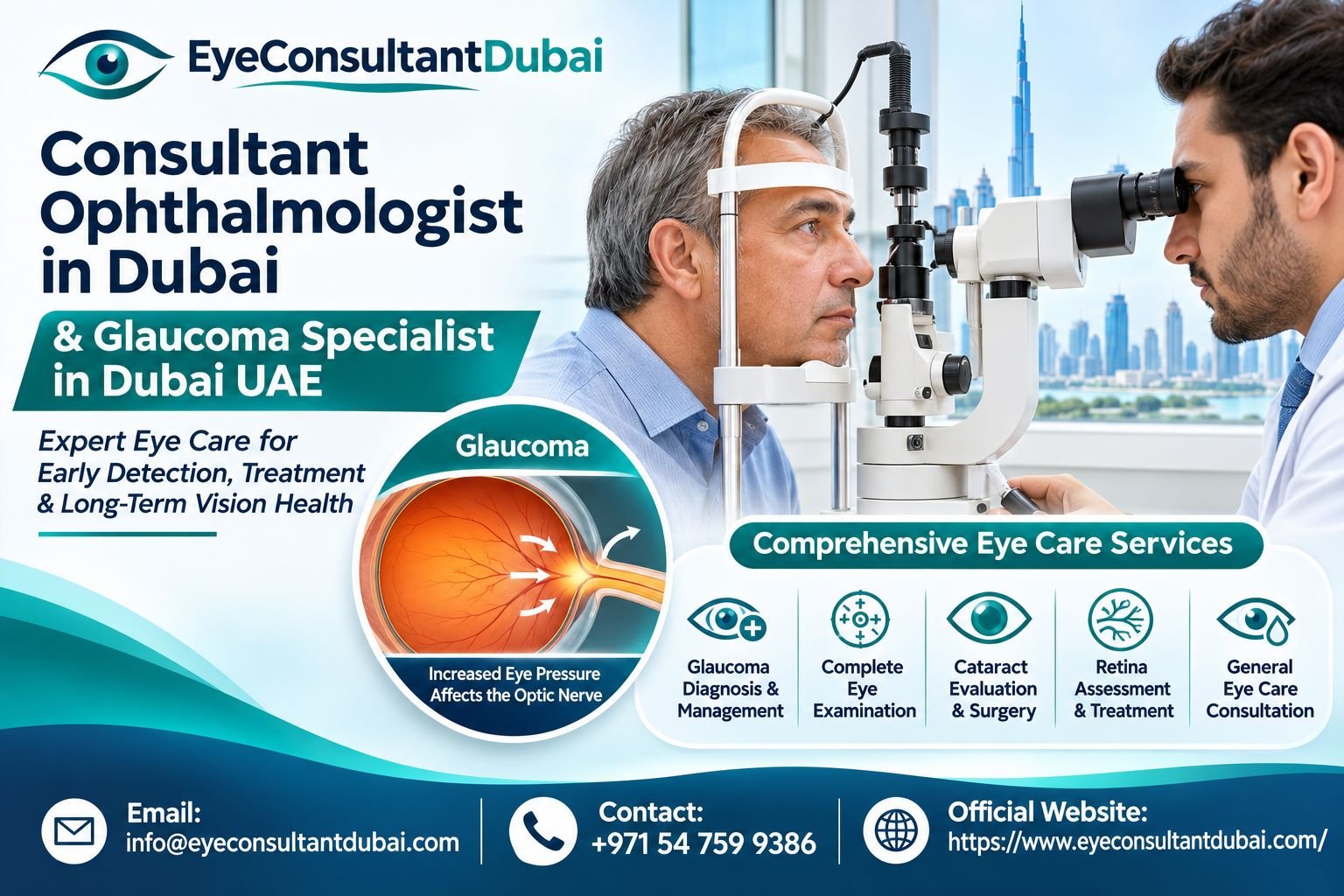
Maintaining healthy vision requires more than checking eyesight or updating prescription glasses. Certain eye conditions can develop gradually without obvious symptoms, making specialist examination essential for identifying potential threats to vision.
Glaucoma is one such condition. It affects the optic nerve and can cause permanent vision loss if appropriate treatment is not provided.
Consulting a qualified consultant ophthalmologist in dubai can help individuals understand their eye health, identify possible abnormalities, and receive personalised medical recommendations.
For people diagnosed with glaucoma or considered at increased risk, a glaucoma specialist in dubai uae can provide focused assessment and guidance on managing the condition.
The broader healthcare discussion highlights the importance of early detection, informed treatment decisions, and ongoing communication between patients and eye care professionals.
Glaucoma is a group of eye diseases characterised by progressive damage to the optic nerve, which transmits visual information from the eye to the brain.
The condition is frequently associated with elevated intraocular pressure, although glaucoma can also develop when eye pressure is within the statistically normal range.
In its common open-angle form, noticeable symptoms may not appear until significant visual damage has occurred.
Because vision loss caused by glaucoma is generally irreversible, detecting the condition before substantial damage occurs is particularly important.
A consultant ophthalmologist in dubai is a specialist medical doctor involved in diagnosing and managing conditions affecting the eyes.
Depending on their qualifications and clinical expertise, consultant ophthalmologists may evaluate cataracts, retinal disorders, corneal problems, glaucoma, and other ophthalmic conditions.
Their responsibilities can include comprehensive eye examinations, interpretation of diagnostic tests, treatment planning, and surgical management when appropriate.
Patients should verify a doctor’s professional licensing, specialist qualifications, and relevant clinical experience.
For complex eye conditions, referral to an ophthalmologist with additional expertise in a particular subspecialty may be appropriate.
A glaucoma specialist in dubai uae focuses on evaluating and managing glaucoma and related optic nerve conditions.
Specialist consultation may be recommended when an eye examination reveals increased intraocular pressure, suspicious optic nerve changes, or abnormal visual field results.
People with an established glaucoma diagnosis may also require specialist assessment if their condition is progressing despite treatment.
A family history of glaucoma can increase the importance of appropriate eye screening.
However, risk factors alone do not establish a diagnosis.
A comprehensive examination is necessary to determine whether glaucoma is present and what management is appropriate.
Glaucoma does not affect every patient in the same way.
Open-angle glaucoma is a common form that generally progresses gradually and may remain unnoticed.
Angle-closure glaucoma involves problems with the eye’s drainage angle. Sudden acute angle closure is a medical emergency that can cause severe eye pain, headache, blurred vision, nausea, and redness.
Normal-tension glaucoma involves characteristic optic nerve damage despite eye pressure readings within the usual statistical range.
Secondary glaucoma can develop in association with certain eye diseases, injuries, or medications.
Identifying the type of glaucoma helps an ophthalmologist select the most appropriate management approach.
Glaucoma assessment involves more than measuring eye pressure.
An ophthalmologist may recommend several investigations to evaluate the optic nerve and visual function.
No single result should automatically determine the diagnosis.
Some individuals have a greater likelihood of developing glaucoma.
Important risk considerations include family history, increasing age, certain eye characteristics, previous eye injury, and prolonged use of particular corticosteroid medications.
However, people without obvious risk factors can also develop glaucoma.
The appropriate examination approach depends on personal medical history and clinical findings.
An ophthalmologist may recommend additional investigations when suspicious changes are identified.
Individual risk assessment helps patients understand whether they require further evaluation or ongoing monitoring.
Glaucoma treatment generally aims to reduce eye pressure sufficiently to slow or prevent further optic nerve damage.
The treatment approach depends on glaucoma type, severity, pressure measurements, and other clinical factors.
Medicated eye drops may lower intraocular pressure by reducing fluid production or improving fluid drainage.
Selected glaucoma conditions may be managed using laser procedures intended to improve fluid outflow or address drainage-angle problems.
When appropriate, conventional glaucoma surgery or minimally invasive glaucoma procedures may be considered.
The choice of treatment requires specialist evaluation and informed consent.
Although treatment can help preserve remaining vision, it generally cannot restore optic nerve function already lost to glaucoma.
Glaucoma management requires active cooperation between patients and their medical teams.
Some individuals may not notice immediate changes after beginning treatment, particularly when their vision was previously unaffected.
However, prescribed medication may still be essential for controlling eye pressure.
Patients should follow their ophthalmologist’s instructions and discuss side effects or difficulties using eye drops.
They should not discontinue prescribed medication without medical guidance.
Regular assessments can help determine whether the selected treatment remains appropriate.
Successful glaucoma care involves more than achieving a particular eye pressure measurement.
Ophthalmologists may also assess optic nerve findings, visual field results, and functional vision.
Changes affecting mobility, driving, reading, or everyday activities may influence patient support requirements.
Effective communication helps patients understand their condition and raise concerns about treatment or visual difficulties.
This patient-centred approach supports informed participation in medical decisions.
Patients searching for specialist eye care should consider several important factors:
A suitable specialist should provide individualised recommendations rather than promising guaranteed outcomes.
1. What does a consultant ophthalmologist in Dubai treat?
A consultant ophthalmologist evaluates and manages eye diseases, including glaucoma, cataracts, retinal disorders, and other vision-related conditions, according to their expertise.
2. When should I consult a glaucoma specialist in Dubai UAE?
Specialist assessment may be appropriate when glaucoma is suspected, eye pressure is elevated, optic nerve changes are detected, or an existing condition requires further evaluation.
3. Can glaucoma develop without noticeable symptoms?
Yes. Open-angle glaucoma can progress without obvious symptoms, which makes appropriate eye examinations important.
4. Can glaucoma-related vision loss be reversed?
Vision loss caused by glaucoma is generally permanent. Treatment aims to protect the vision that remains by slowing or preventing further damage.
5. Does every glaucoma patient require surgery?
No. Treatment may involve prescription eye drops, laser procedures, surgery, or a combination, depending on the individual condition.
Department: Ophthalmology and Specialist Eye Care Enquiries
Enquiry Categories: Glaucoma Consultation, Eye Pressure Assessment, Optic Nerve Evaluation, Vision Screening, Ophthalmology Services, and Eye Health Awareness.
Contact: +971 54 759 9386
Email: info@eyeconsultantdubai.com
Official Website: https://www.eyeconsultantdubai.com/