


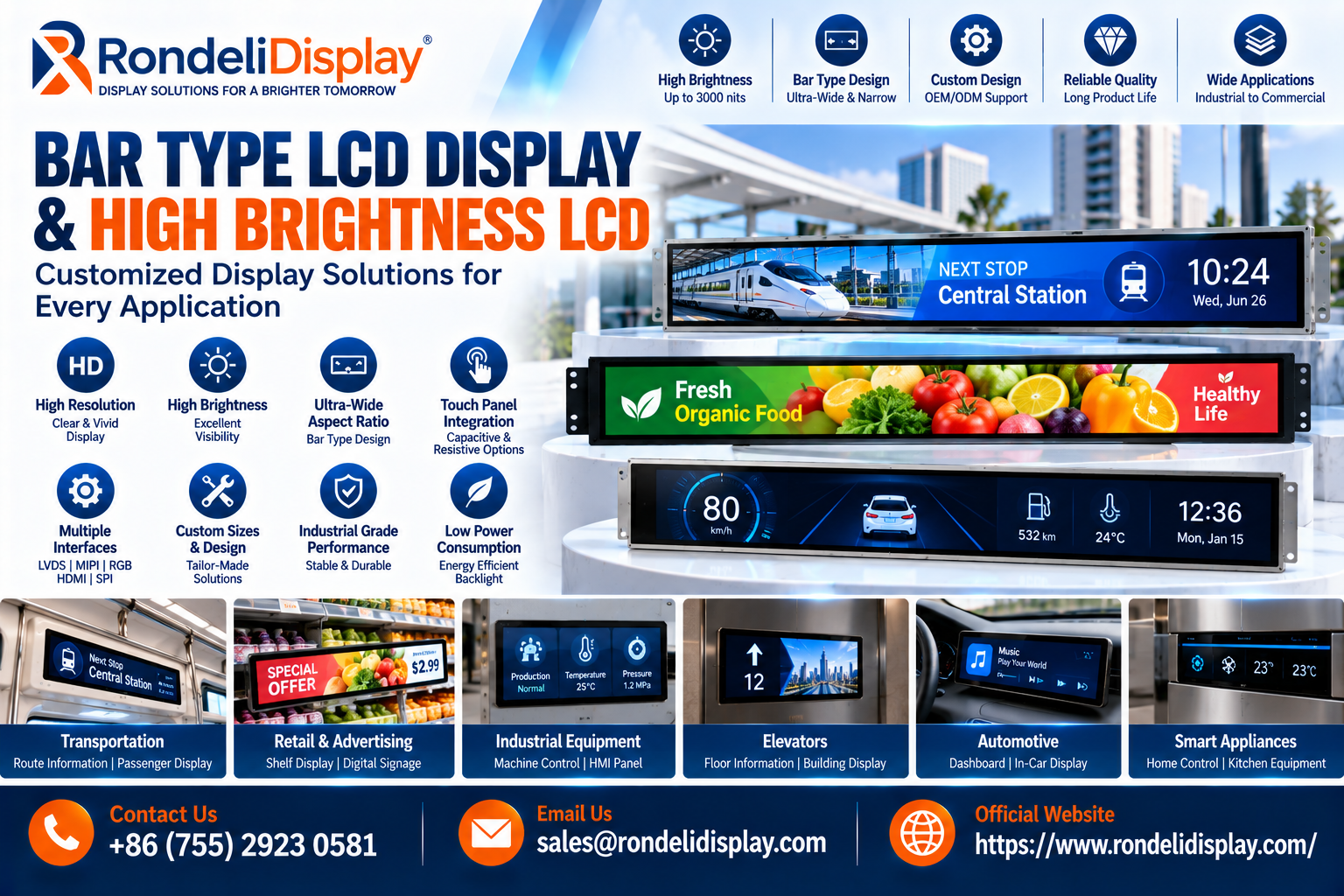
Transportation infrastructure is creating new opportunities for specialised display technologies that make public information easier to access. Airports, railway stations, metro networks, and passenger terminals require screens capable of presenting directions, service information, and important announcements in environments with varying space and lighting conditions.
A bar type lcd display offers an elongated screen format suitable for narrow installation areas, such as overhead panels, passageways, and information boards.
Meanwhile, a High Brightness LCD provides increased display luminance, helping improve visibility in brightly illuminated environments.
Together, these technologies can support more effective visual communication when integrated into appropriately designed passenger information systems.
For transportation equipment manufacturers, digital signage integrators, and display technology buyers, the focus is on improving readability, installation flexibility, and long-term operational reliability.
Public transport facilities often contain complex layouts, multiple routes, and changing passenger information.
Conventional screens may not fit every installation location.
Narrow corridors, entrance structures, and overhead mounting areas can present physical limitations.
Specialised LCD formats allow system designers to make use of available space without significantly altering surrounding infrastructure.
However, selecting a screen involves more than matching its dimensions to a mounting location.
This principle places readability and practical communication at the centre of display selection.
A bar type lcd display is an elongated liquid crystal display with an aspect ratio that differs from conventional widescreen formats.
It is also commonly described as a stretched LCD screen.
Its unusual proportions make it suitable for presenting directional information, route indicators, promotional graphics, and operational messages.
Depending on the product, these displays may offer different resolutions, interfaces, brightness levels, and mounting configurations.
For example, a narrow screen may fit above a station entrance where a conventional monitor would be impractical.
However, displayed content must be designed specifically for the screen’s proportions to maintain readability.
A High Brightness LCD uses an appropriately designed backlighting system to provide greater screen luminance than many standard indoor displays.
Brightness is commonly measured in nits.
Higher luminance may improve screen visibility where strong ambient lighting makes ordinary displays difficult to read.
Transportation terminals frequently feature glass walls, bright overhead lighting, and exposed entrance areas.
These conditions can influence the visibility of passenger information.
However, brightness alone does not determine display quality.
Reflection control, contrast, viewing angles, and enclosure design are equally important.
Equipment buyers should evaluate complete optical performance under representative installation conditions.
Wayfinding systems help passengers identify routes, exits, platforms, and service areas.
Traditional printed signs remain useful, but digital displays provide flexibility where information needs to change.
A stretched LCD can present directional arrows, route names, platform identifiers, and other relevant messages within a compact horizontal space.
Its shape may be particularly suitable for overhead information panels.
However, placing excessive information on a narrow screen can reduce clarity.
Designers should prioritise short messages, readable typography, and consistent visual symbols.
A screen viewed from several metres away requires different design considerations from a screen used at close range.
Text size, contrast, pixel resolution, and viewing angles affect whether information remains understandable.
A display installed above a terminal entrance should present essential details without requiring passengers to stand directly underneath it.
High brightness can assist visibility in suitable lighting conditions, but it cannot compensate for poorly designed content.
Testing should therefore reflect the intended viewing location.
| Evaluation Factor | Bar Type LCD Display | High Brightness LCD |
| Primary Characteristic | Elongated screen format | Increased screen luminance |
| Main Advantage | Fits narrow installation spaces | Improves visibility in bright conditions |
| Typical Application | Overhead route signs and directional panels | Entrance displays and illuminated terminals |
| Design Priority | Aspect ratio and content layout | Brightness, contrast and reflections |
| Installation Concern | Mounting dimensions and orientation | Heat management and power consumption |
| Integration Requirement | Compatible display controller | Appropriate backlight and control system |
A suitable display may combine both characteristics depending on project requirements.
Transportation displays frequently operate as components of larger information systems.
A screen may receive messages from a compatible media player, control computer, or dedicated information platform.
System designers must verify interface compatibility and supported display resolutions.
Content layouts should also accommodate changes in message length.
Where important service information is involved, appropriate fallback messages and communication procedures may be necessary.
The display itself cannot guarantee accurate information; dependable operation requires suitable software and system management.
Passenger information displays may remain active throughout extended operating periods.
This creates requirements involving component durability, backlight performance, and maintenance accessibility.
High-brightness backlights can generate additional heat, making thermal management important.
Installation teams should consider ventilation, enclosure dimensions, environmental temperatures, and electrical requirements.
For stretched screens, mounting arrangements should provide suitable mechanical support.
Manufacturers should verify operating specifications before selecting equipment for demanding commercial environments.
Digital displays should support users with different visual and mobility requirements.
Clear colour contrast, readable text, understandable symbols, and logical information arrangements can improve accessibility.
Important information should not depend exclusively on colour distinctions.
Where appropriate, transportation facilities may need additional accessible communication methods beyond visual displays.
For example, audio announcements or tactile signage can complement digital information systems.
Accessibility requirements should be considered during planning rather than after equipment installation.
Transportation system integrators and equipment manufacturers should evaluate suppliers against project-specific requirements.
Important considerations include:
Representative testing can help identify potential problems before wider installation.
1. What is a bar type LCD display?
A bar type LCD display is an elongated liquid crystal screen designed for narrow installations and specialised information presentation.
2. What is a High Brightness LCD?
A High Brightness LCD is a display designed with increased luminance to support visibility in relatively bright environments.
3. Can stretched LCD screens be used in railway stations?
Yes. Suitable models can display route directions, passenger information, and operational messages when integrated into compatible systems.
4. Are high-brightness displays suitable for outdoor terminals?
Certain models may be suitable, but outdoor use also requires appropriate environmental protection, thermal management, and optical characteristics.
5. What should transportation companies consider when selecting LCD displays?
They should evaluate viewing distance, brightness, screen dimensions, content compatibility, installation conditions, accessibility, and maintenance requirements.
Department: Custom LCD Display and Transportation Display Enquiries
Email: sales@rondelidisplay.com
Official Website: https://www.rondelidisplay.com/