


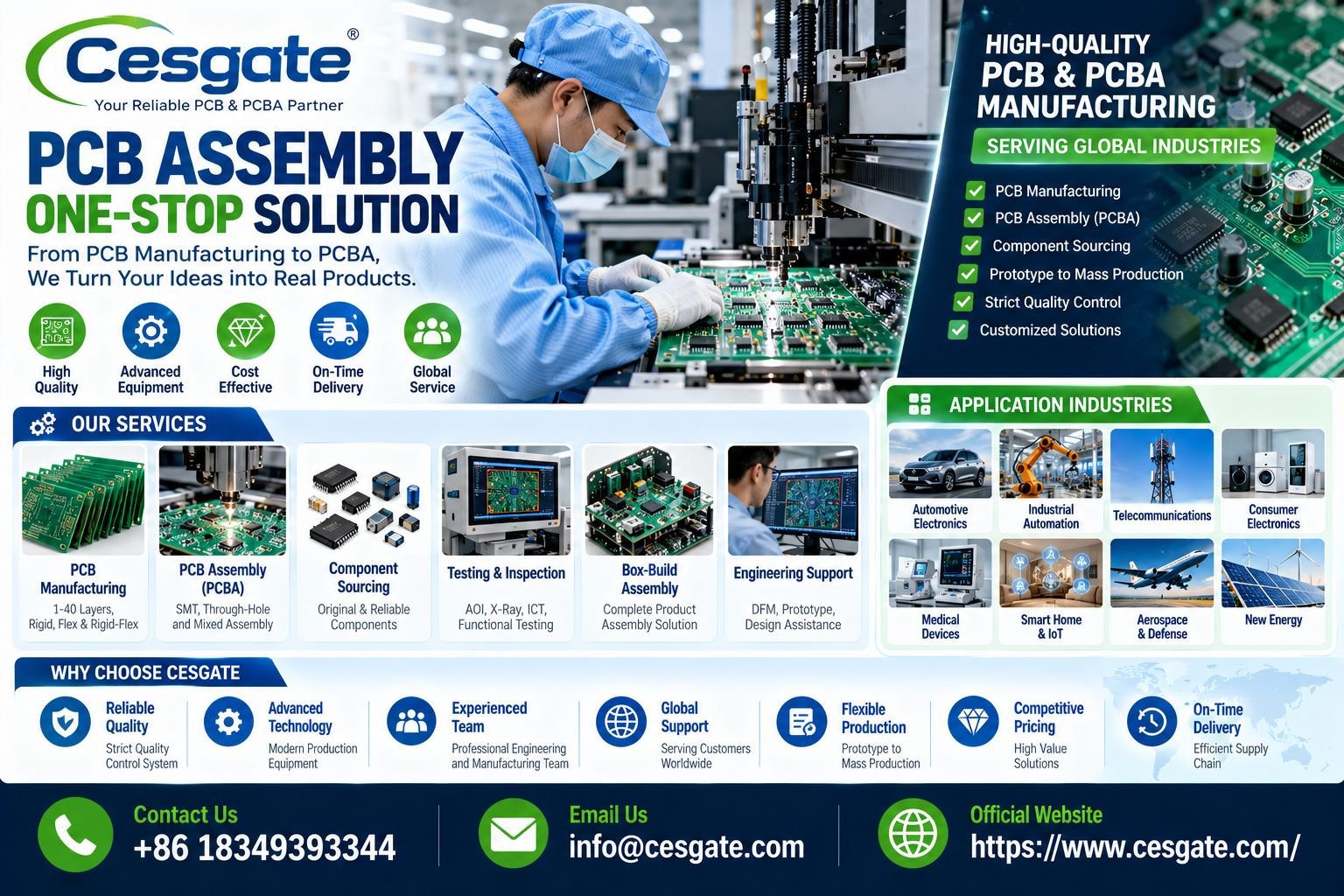
As demand rises across automotive electronics, industrial automation, telecommunications, consumer devices, medical equipment, smart-home technology, and connected products, pcb assembly services are becoming increasingly important to modern product development. At the same time, the pcb china manufacturing sector continues to attract global buyers looking for scalable production, component sourcing, prototyping support, and integrated electronics manufacturing capabilities.
Printed circuit boards form the physical and electrical foundation of most modern electronic devices. However, producing the bare board is only one stage. Components must be sourced, placed, soldered, inspected, tested, and prepared for final integration before the finished assembly can perform its intended function.
pcb assembly is the process of mounting and soldering electronic components onto a fabricated printed circuit board.
The completed product is often called a printed circuit board assembly, or PCBA.
The process may involve:
The exact manufacturing sequence depends on board complexity, component types, production volume, and customer specifications.
A PCB may be designed correctly but still fail if components are installed incorrectly.
Professional pcb assembly helps manufacturers control:
Modern surface-mount components can be extremely small and require accurate automated placement.
Poor solder joints can create intermittent electrical connections or premature failure.
Certain components must be installed in the correct direction.
Automated processes help maintain repeatability across larger manufacturing runs.
Production records can help manufacturers identify materials, batches, and quality results.
Surface Mount Technology, commonly known as SMT, is widely used in modern electronics.
In SMT production, components are placed directly onto the surface of the PCB.
A typical SMT process may include:
SMT supports compact designs and high component densities, making it suitable for smartphones, communication products, industrial controllers, smart devices, and many other electronic systems.
Through-hole technology uses components with leads inserted through drilled PCB holes.
The leads are then soldered on the opposite side of the board.
Through-hole components can be useful when:
Many modern assemblies combine SMT and through-hole technology on the same board.
Mixed assembly combines surface-mount and through-hole components.
This approach is common in:
The correct production sequence must be carefully planned to avoid damaging components during multiple soldering stages.
The pcb china manufacturing market has developed into a large electronics supply ecosystem covering PCB fabrication, component procurement, assembly, testing, tooling, packaging, and logistics.
International buyers often explore Chinese manufacturing for:
However, buyers should evaluate individual suppliers carefully rather than assuming that all manufacturers offer the same capabilities.
Prototyping is an important stage before full production.
A prototype allows engineers to evaluate:
Producing a smaller quantity first can help identify design problems before significant resources are committed to a larger manufacturing run.
A reliable pcb assembly partner should be able to support the transition from prototype to production.
The Bill of Materials, or BOM, identifies the components required for the assembly.
Typical information includes:
Accurate BOM management is critical.
Incorrect component selection can affect:
A professional manufacturing partner should also communicate clearly when specified parts are unavailable or approaching end-of-life status.
PCB production usually requires complete design documentation.
Common files can include:
Missing or unclear documentation can cause production delays.
Before submitting a project to a pcb china manufacturer, customers should verify that all design files correspond to the same PCB revision.
Automated Optical Inspection, or AOI, is commonly used after component placement and soldering.
AOI systems can identify potential issues such as:
Automated inspection helps improve efficiency when checking boards with large numbers of components.
However, AOI is only one part of a broader quality-control process.
Some solder joints cannot be inspected visually.
Components such as BGAs may have connections beneath their packages.
X-ray inspection can help identify potential problems including:
This inspection method is particularly useful for high-density assemblies.
A board that looks correct does not necessarily operate correctly.
Functional testing can verify whether the finished assembly performs its intended electrical functions.
Depending on the project, testing might include:
Test requirements should ideally be defined during product development rather than after production begins.
Automotive electronics continue to become more complex.
PCBs may be used in:
Automotive projects often require stronger attention to traceability, reliability, temperature performance, and process control.
Suppliers should be evaluated according to the specific requirements of each automotive application.
Industrial environments may expose electronics to vibration, dust, temperature changes, electrical noise, or continuous operation.
Industrial pcb assembly projects can include:
Design and manufacturing decisions should account for the intended environment.
Connected devices require compact and reliable PCB solutions.
Potential applications include:
These designs may combine processors, wireless modules, antennas, sensors, and power-management circuits on relatively small boards.
Working with a capable pcb china manufacturing partner can help businesses move products from design verification to scalable production.
Not all printed circuit boards are rigid.
Flexible PCBs can bend, while rigid-flex designs combine rigid and flexible sections.
These technologies may be used where:
Assembly processes for these boards can require specialized handling.
Quality control should cover more than final inspection.
Important manufacturing checkpoints can include:
A documented process helps improve consistency and traceability.
Before selecting a manufacturing partner, buyers should evaluate:
The cheapest quotation may not always provide the lowest overall project cost if poor quality leads to rework, delays, or field failures.
pcb assembly is the process of mounting and soldering electronic components onto a printed circuit board to create a functional electronic assembly.
A PCB is the bare printed circuit board, while a PCBA is the board after electronic components have been assembled onto it.
SMT assembly places surface-mount components directly onto PCB pads using automated manufacturing equipment.
Through-hole assembly uses components whose leads pass through drilled holes in the PCB before being soldered.
The pcb china sector can include PCB fabrication, component sourcing, assembly, inspection, testing, packaging, and related electronics manufacturing services.
Yes. Many manufacturers support prototype quantities before larger production runs.
Common files include Gerber data, BOM, pick-and-place files, assembly drawings, and testing instructions.
AOI helps detect placement, orientation, and visible soldering defects during production.
X-ray inspection is useful for components with hidden solder joints, such as BGAs.
Review manufacturing capability, component sourcing, testing, inspection, lead times, communication, quality control, and production capacity.
PCB Manufacturing & Assembly Enquiries
Email: info@cesgate.com
Contact: +86 18349393344
Official Website: https://www.cesgate.com/