


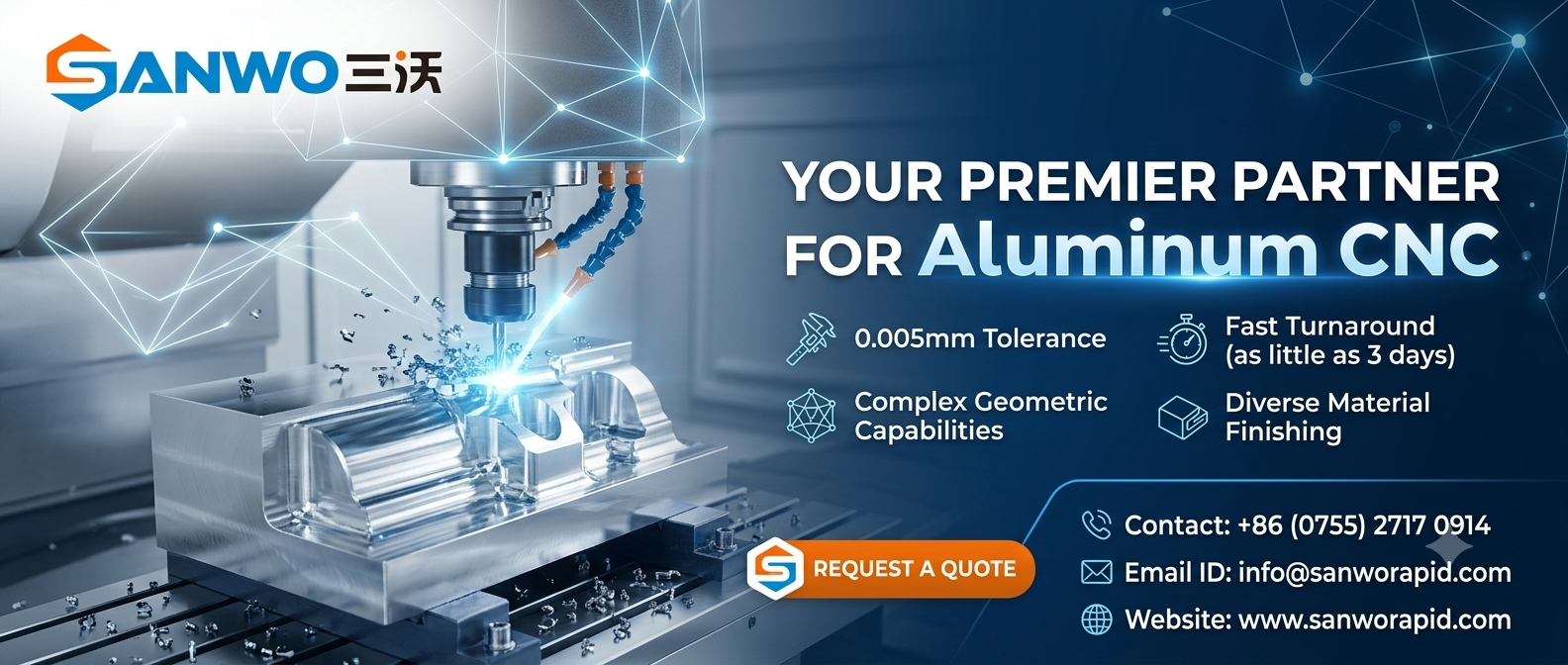
In modern product development, manufacturers need production methods that combine accuracy, speed, material performance, and cost efficiency. Aluminum CNC machining has become a preferred solution for producing precision components, functional prototypes, tooling, and low-volume production parts. Thanks to aluminum’s excellent machinability and strength-to-weight ratio, CNC machining can deliver complex components with consistent dimensions and reliable surface quality.
For companies developing new products, working with an experienced manufacturing partner such as SanwoRapid can simplify the transition from CAD designs to finished aluminum components.
Aluminum CNC machining is a computer-controlled manufacturing process in which cutting tools remove material from an aluminum workpiece to create a specific component. CNC milling, turning, drilling, tapping, and multi-axis machining can be combined depending on the geometry and technical requirements of a part.
The process begins with a digital CAD model. Engineers or machinists use the design to create machining instructions that control tool movement, cutting parameters, and machining operations. Because the process is digitally controlled, manufacturers can achieve consistent results across prototypes and repeated production runs.
Aluminum is one of the most commonly machined metals because it offers several practical advantages. Compared with many steels, it is lightweight and generally easier to machine. It also provides useful corrosion resistance and thermal conductivity.
Key benefits include:
These characteristics make machined aluminum useful in industries ranging from automotive and aerospace to electronics, robotics, medical equipment, and industrial machinery.
Not every aluminum alloy performs identically during machining. The appropriate material depends on the application’s strength, corrosion, weight, thermal, and finishing requirements.
| Aluminum Alloy | Main Characteristics | Typical Uses |
| 6061-T6 | Balanced strength and machinability | Housings, brackets, fixtures |
| 7075 | High strength-to-weight ratio | Aerospace and performance parts |
| 6082 | Strong and corrosion resistant | Industrial components |
| 5052 | Good corrosion resistance | Enclosures and fabricated parts |
| 2024 | High strength and fatigue resistance | Aerospace components |
Material selection should begin with the functional requirements of the component. For general-purpose machined parts, 6061-T6 is often a practical option. Applications requiring higher strength may benefit from 7075, while other environments may require an alloy selected primarily for corrosion resistance or forming characteristics.
Discussing material requirements with a qualified machining provider before production can prevent costly material changes later.
One of the strongest applications for aluminum CNC machining is functional prototyping. Unlike some visual-only prototype methods, CNC machining allows engineers to produce prototypes from actual engineering-grade aluminum.
This makes it possible to evaluate:
For example, a company designing a new electronic enclosure may machine an aluminum prototype and use the actual circuit board, connectors, fasteners, and internal components during testing. Any interference or dimensional issue can then be corrected before larger-scale production begins.
CNC machining is not the only way to manufacture aluminum components. The right process depends on production volume, geometry, tolerances, tooling requirements, and budget.
| Process | Best Suited For | Major Benefit |
| CNC Machining | Prototypes and precision components | High accuracy and flexibility |
| Die Casting | High-volume metal parts | Efficient repeat production |
| 3D Printing | Complex prototypes | Fast design iteration |
| Sheet Metal Fabrication | Thin metal components | Efficient enclosure production |
| Injection Molding | Plastic production parts | Low unit cost at high volume |
For low-volume or highly customized aluminum components, CNC machining can be particularly attractive because manufacturers can begin production without investing in dedicated molds or dies.
A well-designed component can reduce machining time, material waste, and overall manufacturing costs. Design for manufacturability should therefore be considered before a part reaches production.
Deep pockets and narrow slots can increase machining difficulty and may require specialized tooling. Whenever possible, provide adequate tool access and use practical pocket dimensions.
CNC cutting tools are generally cylindrical, meaning internal corners naturally require a radius. Designing appropriate internal radii can make machining easier and reduce the need for specialized tools.
Extremely tight tolerances can increase machining and inspection costs. It is better to specify tight tolerances only for features where they are required for functionality, assembly, or performance.
Machined aluminum can receive several finishing treatments, including anodizing, bead blasting, polishing, brushing, and other processes. The desired finish should be considered early because it can influence dimensions, appearance, and material selection.
The versatility of aluminum makes CNC machining suitable for a wide range of applications.
Common examples include:
In each application, the machining process can be adapted to the component’s geometry, material requirements, tolerance specifications, and production quantity.
Choosing a machining provider involves more than comparing prices. Manufacturing expertise, quality control, communication, material availability, finishing capabilities, and production consistency can all affect the final result.
A capable supplier should be able to review CAD geometry, identify potential manufacturing problems, recommend practical tolerances, and select an appropriate machining strategy.
SanwoRapid supports product development and manufacturing projects by helping customers move from digital designs to precision-machined components. This type of manufacturing support can be particularly valuable when a project involves multiple iterations or requires consistent production quality.
A professional machining workflow generally follows several stages:
This structured approach helps reduce avoidable manufacturing problems and supports consistent part quality.
It is a subtractive manufacturing process that uses computer-controlled cutting tools to manufacture components from aluminum stock.
6061-T6 is widely used for general-purpose machining because it provides a useful combination of strength, machinability, availability, and corrosion resistance.
Yes. CNC machining is an effective method for producing functional aluminum prototypes that can be tested for fit, performance, and assembly.
Yes. Depending on the equipment and tooling, CNC machining can produce detailed pockets, holes, contours, threads, and complex three-dimensional surfaces.
Yes. Aluminum components can often be anodized to improve surface appearance, corrosion resistance, hardness, or wear characteristics.
Yes. CNC machining is commonly used for low-volume production because it does not require dedicated molds for each component.
Designing for manufacturability, avoiding unnecessary tolerances, simplifying setups, choosing suitable materials, and reducing difficult-to-machine features can help control costs.
Automotive, aerospace, electronics, robotics, industrial equipment, consumer products, and medical equipment manufacturers all use aluminum CNC components.
Depending on the alloy and application, options can include anodizing, bead blasting, polishing, brushing, and other surface treatments.
Begin with a suitable CAD file and clearly defined material, dimensions, tolerances, surface finish, quantity, and application requirements. A professional CNC manufacturer can then review the design and recommend the appropriate production approach.
Contact – +86 (0755) 2717 0914
Email ID – info@sanworapid.com
Website – https://www.sanworapid.com/