


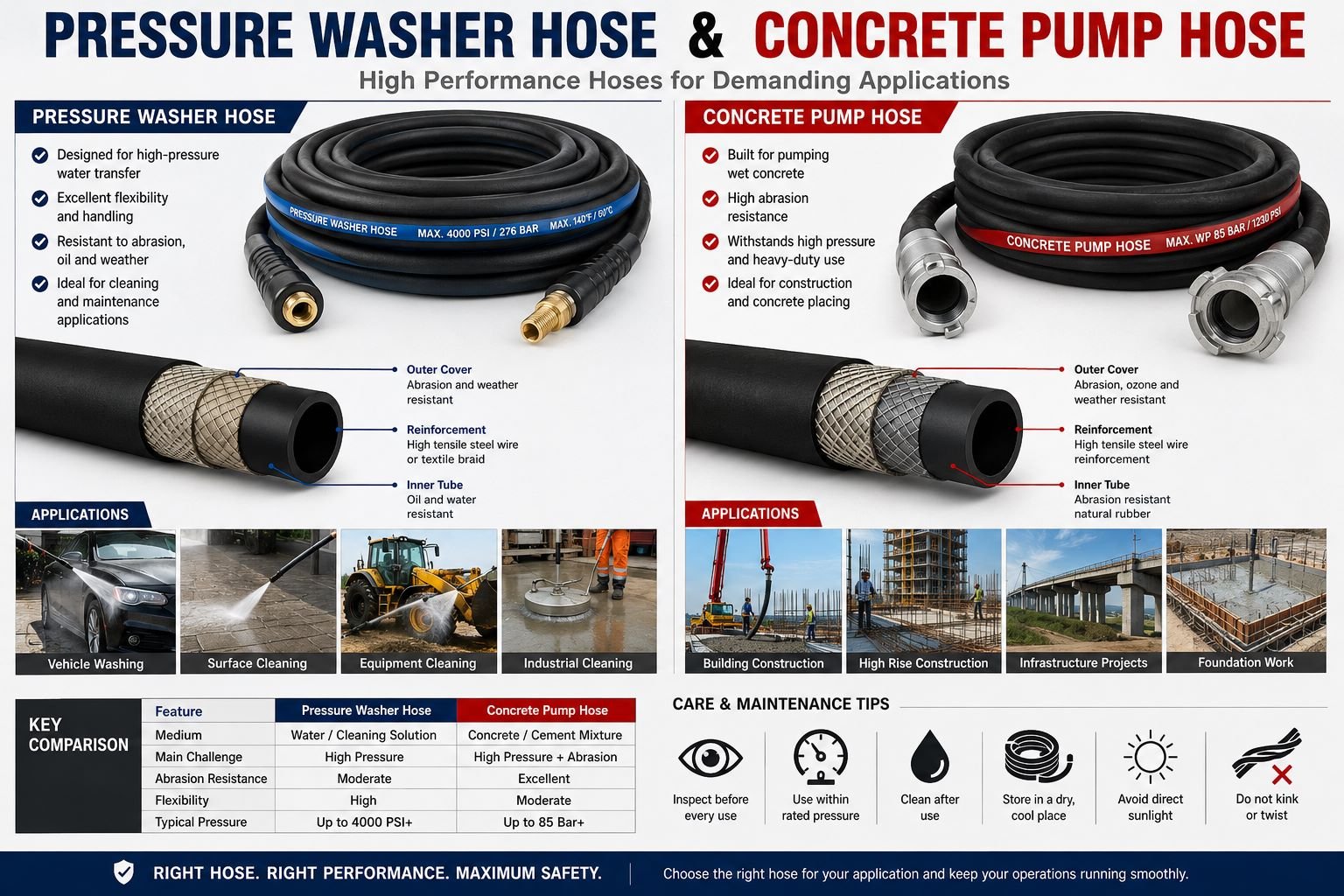
Industrial hoses may appear simple, but their construction, pressure capacity, reinforcement, flexibility, abrasion resistance, and compatibility can directly influence productivity and workplace safety. Two important examples are Pressure Washer Hose and Concrete Pump Hose. Although both are engineered to transport material under demanding pressure conditions, their operating environments, internal construction, safety requirements, and performance characteristics are very different.
Understanding these differences helps contractors, cleaning professionals, construction companies, equipment operators, and procurement teams choose the correct hose for a specific application rather than relying only on diameter or price.
A Pressure Washer Hose is specifically designed to carry high-pressure water from a pressure washing machine to a spray gun or cleaning attachment. It must continuously withstand pressure while remaining flexible enough for operators to move around vehicles, machinery, buildings, floors, and industrial equipment.
Unlike ordinary water hoses, pressure washer hoses normally contain reinforced layers that resist expansion and bursting.
Common applications include:
A high-quality Pressure Washer Hose generally uses multiple engineered layers rather than a single rubber or plastic tube.
The inner tube transports pressurized water. It should resist water, cleaning chemicals, detergents, and temperature variations.
Reinforcement is responsible for pressure resistance. Depending on the operating pressure, manufacturers may use textile braiding, steel-wire reinforcement, or multiple reinforcement layers.
The outer cover protects the hose from abrasion, weather exposure, oil contamination, dragging, and general workplace damage.
Reinforcement controls hose expansion when water is pressurized. Without sufficient reinforcement, the hose may swell, develop weak areas, or fail unexpectedly.
Choosing a Pressure Washer Hose requires more than matching the connection size.
Key considerations include working pressure, burst pressure, temperature rating, hose diameter, length, fitting compatibility, chemical resistance, and flexibility.
A hose should always have a rated working pressure equal to or higher than the maximum pressure generated by the machine.
Excessively long hoses can also contribute to pressure loss, particularly where flow requirements are high or the internal diameter is too small.
A Concrete Pump Hose is developed for transporting wet concrete, grout, cement mixtures, and similar abrasive materials from pumping equipment to the required placement location.
Concrete creates significantly different stresses from water. The material is heavy, abrasive, and capable of creating substantial internal wear.
For this reason, Concrete Pump Hose construction focuses heavily on abrasion resistance, reinforcement strength, flexibility, and reliable coupling performance.
Typical applications include:
A concrete hose must survive severe internal and external operating conditions.
Wet concrete contains sand, aggregate, cement, and other abrasive components. The inner lining therefore needs excellent resistance to continuous material wear.
A Concrete Pump Hose generally incorporates strong reinforcement capable of handling pumping pressure, pulsation, movement, and mechanical stress.
Construction sites expose hoses to rough concrete, steel reinforcement, gravel, mud, weather, and machinery. A robust outer layer protects the reinforcement against these hazards.
Reliable couplings are essential because failure near the hose connection can create serious operational and safety risks. Fittings must match the pumping system and be properly secured.
| Feature | Pressure Washer Hose | Concrete Pump Hose |
| Primary medium | Water and cleaning solution | Concrete and cement mixtures |
| Main challenge | High-pressure water | Pressure plus severe abrasion |
| Typical construction | Textile or wire reinforced | Heavy-duty reinforced |
| Flexibility requirement | High operator mobility | Controlled concrete placement |
| Internal abrasion | Moderate | Extremely high |
| Common environment | Cleaning operations | Construction sites |
| Main safety concern | High-pressure water release | Hose burst, whipping, concrete discharge |
Although both products are pressure hoses, they should never be treated as interchangeable.
Pressure ratings are among the most important specifications for Pressure Washer Hose and Concrete Pump Hose selection.
Three terms commonly appear in technical specifications.
Working pressure represents the pressure level at which the hose is designed to operate during normal service.
Burst pressure indicates the pressure at which hose failure may occur under controlled testing conditions.
Manufacturers typically design hoses with a safety margin between working pressure and burst pressure.
Equipment should be matched with the hose’s specified working pressure, not its theoretical burst pressure.
Even premium hoses can fail early when used incorrectly.
Major causes include:
Preventive inspection can significantly reduce unexpected downtime.
Before operating a Pressure Washer Hose, inspect the complete hose length for cracking, bulges, cuts, exposed reinforcement, leaking fittings, and coupling damage.
Avoid attempting temporary repairs on high-pressure hose sections unless an approved repair method exists.
Operators should also prevent vehicles or heavy equipment from crushing hoses and avoid positioning hoses against sharp edges.
High-pressure water can cause serious injury, so operators must never direct pressure washer jets toward people.
Safety becomes especially critical when operating a Concrete Pump Hose because pumped concrete may generate considerable pressure and hose movement.
Operators should:
Concrete buildup inside the hose can reduce internal diameter and create flow restrictions.
Proper maintenance extends the service life of both hose categories.
A Pressure Washer Hose should be flushed after exposure to aggressive cleaning chemicals and stored without tight bends.
A Concrete Pump Hose requires thorough cleaning because hardened concrete deposits can permanently damage or block the hose.
Storage locations should ideally be dry, protected from excessive sunlight, chemicals, sharp equipment, and extreme heat.
Regular inspection records can also help businesses identify recurring wear patterns.
Technical support can be as important as the product itself. A dependable hose supplier should clearly provide working pressure, temperature limits, dimensions, reinforcement construction, application compatibility, coupling information, and relevant testing details.
Purchasing hoses solely based on the lowest cost may increase lifecycle expenses when frequent replacements, downtime, or safety incidents occur.
The correct Pressure Washer Hose or Concrete Pump Hose should always be selected around actual operating conditions.
A Pressure Washer Hose carries pressurized water from a pressure washer machine to a spray gun or cleaning accessory.
No. Standard garden hoses are not engineered to handle the high-pressure output generated by pressure washing equipment.
Reinforcement strength, abrasion resistance, fitting quality, temperature capability, flexibility, and pressure rating strongly influence overall hose performance.
A Concrete Pump Hose transports pumped concrete, grout, or cement-based mixtures to the required placement area at construction sites.
Concrete contains abrasive sand and aggregates that continuously wear the internal hose surface during pumping.
No. A pressure washing hose is not designed for the weight, abrasion, and pumping characteristics of wet concrete.
They should be visually inspected before operation and examined more thoroughly according to usage conditions and manufacturer recommendations.
Bulges, cracking, leakage, exposed reinforcement, damaged fittings, excessive surface wear, and abnormal deformation indicate potential deterioration.
Yes. Excessive length or inadequate internal diameter may contribute to pressure or flow losses depending on the system.
No. Hose diameter, pressure rating, construction, reinforcement, abrasion resistance, fitting type, and intended pumping application can vary significantly.
Couplings provide secure system connections. Incorrect, worn, or poorly installed couplings can cause leakage, separation, and dangerous failures.
Correct pressure, proper cleaning, careful handling, suitable storage, compatible media, and regular inspection can substantially improve service life.