


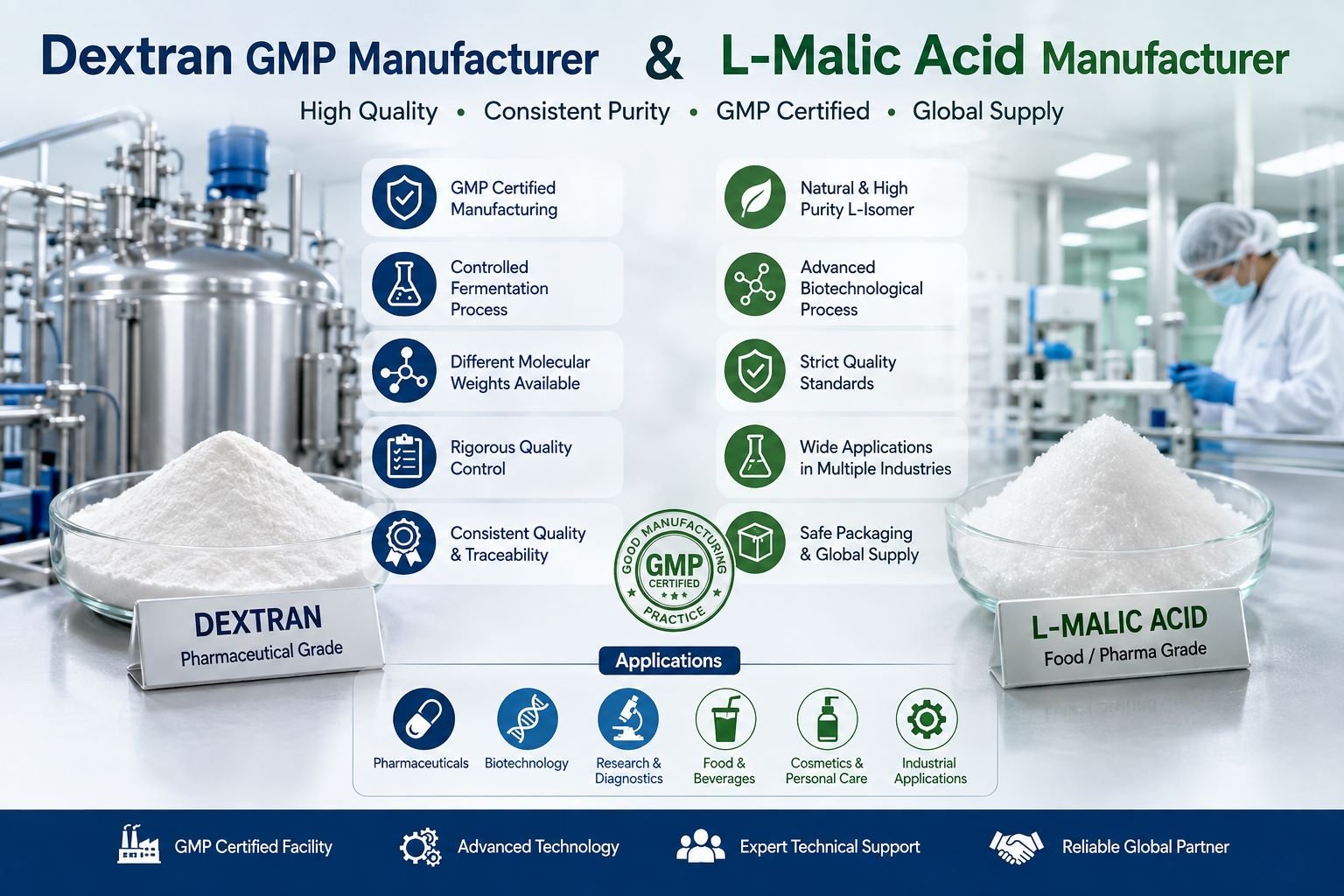
Behind every pharmaceutical formulation, functional food, biotechnology process, or specialty chemical product is a supply chain of carefully selected ingredients. While end users rarely think about where these materials come from, manufacturers know that ingredient quality can directly influence production efficiency, product consistency, stability, and regulatory compliance.
Two specialty ingredients receiving significant attention across different industries are dextran and L-malic acid.
Choosing the right dextran GMP manufacturer is particularly important when dextran is intended for pharmaceutical, biotechnology, diagnostic, or other controlled applications. At the same time, selecting an experienced L-malic acid manufacturer can help food, beverage, pharmaceutical, nutraceutical, and formulation businesses maintain reliable product quality.
So, what actually separates a dependable manufacturer from an ordinary supplier? Let’s explore the manufacturing processes, quality considerations, applications, and purchasing factors that matter.
Buying a specialty ingredient is very different from purchasing a standard commodity.
A product may appear chemically correct while variations in purity, molecular characteristics, moisture, microbial quality, or processing history create problems during commercial manufacturing.
This is why experienced buyers examine the complete manufacturing system.
Important considerations include:
A dependable manufacturer should be capable of demonstrating how these areas are controlled.
Dextran is a polysaccharide primarily composed of glucose units. It is generally produced through microbial fermentation and can be manufactured in different molecular-weight ranges.
Its characteristics make it useful in several specialized applications, particularly across pharmaceutical and biotechnology environments.
A professional dextran GMP manufacturer does much more than simply produce dextran powder. Manufacturing requires careful control over fermentation, purification, fractionation, drying, testing, and packaging.
Dextran production typically begins with a suitable carbohydrate source and selected microorganisms.
During fermentation, microorganisms facilitate the formation of dextran. Parameters such as temperature, pH, substrate concentration, fermentation time, and microbial conditions must be carefully monitored.
Once fermentation is completed, downstream processing begins.
Each stage can influence the quality of the finished ingredient.
Good Manufacturing Practice is built around one fundamental idea: quality should be created throughout production rather than inspected only at the end.
A qualified dextran GMP manufacturer therefore establishes documented procedures for manufacturing operations.
GMP-focused systems may address:
This structured approach becomes especially valuable when dextran is intended for applications with demanding quality requirements.
Not all dextran grades behave identically.
One of the most important differences is molecular weight. Changes in molecular size and distribution can influence viscosity, solubility, diffusion, processing behavior, and suitability for different applications.
A capable dextran GMP manufacturer should therefore maintain appropriate controls for molecular-weight specifications.
| Quality Factor | Why It Matters |
| Molecular weight | Influences functional performance |
| Purity | Indicates overall product quality |
| Solubility | Affects formulation processing |
| Moisture | Influences storage characteristics |
| Microbial quality | Important for sensitive applications |
| Physical appearance | Supports consistency monitoring |
Rather than requesting “dextran” generally, buyers should communicate the exact grade and technical characteristics required.
Dextran has applications across several specialized industries.
Depending on grade and specification, applications may include biotechnology processing, laboratory research, pharmaceutical development, diagnostics, chromatography-related processes, and other technical uses.
Application requirements can vary considerably, making manufacturer selection particularly important.
For example, material suitable for laboratory experimentation may not automatically satisfy specifications required for pharmaceutical manufacturing.
L-malic acid is an organic acid naturally associated with fruits and biological metabolism. Its acidity profile and formulation characteristics make it valuable across several commercial industries.
A reliable L-malic acid manufacturer may supply grades designed for food, beverage, pharmaceutical, nutraceutical, cosmetic, or specialty applications.
Common functions include:
Its versatility has made quality consistency an important consideration for large-scale users.
Industrial L-malic acid production requires controlled processing followed by effective purification.
Depending on manufacturing technology, production may involve biochemical or other suitable processes designed to obtain the desired L-form.
After the primary production stage, the material typically undergoes several downstream operations.
The goal is not simply to create malic acid. Unwanted process components must also be reduced to levels appropriate for the intended grade.
Purification can involve separation, concentration, filtration, crystallization, and drying.
Crystallization can influence:
A technically capable L-malic acid manufacturer controls these characteristics to provide predictable material for downstream customers.
Customers should never evaluate L-malic acid solely by appearance or price.
Several analytical characteristics can help establish quality.
| Parameter | Importance |
| Identity | Confirms correct ingredient |
| Assay | Indicates concentration |
| Optical characteristics | Helps evaluate stereochemical identity |
| Moisture | Supports stability assessment |
| Related substances | Identifies unwanted impurities |
| Heavy metals | Supports purity requirements |
| Residue | Evaluates inorganic material |
| Appearance | Helps monitor consistency |
Specifications should ultimately correspond to the intended application and applicable requirements.
Dextran and L-malic acid are chemically very different, yet reliable manufacturing follows similar quality principles.
| Feature | Dextran | L-Malic Acid |
| Chemical category | Polysaccharide | Organic acid |
| Key manufacturing focus | Fermentation | Controlled production |
| Important downstream step | Fractionation | Crystallization |
| Critical characteristic | Molecular weight | Purity and stereochemistry |
| Major applications | Pharma and biotechnology | Food, pharma and nutraceuticals |
| Quality priority | Consistency and traceability | Purity and consistency |
Both products demonstrate why buyers should evaluate manufacturing capability instead of relying only on supplier quotations.
Finding a dextran GMP manufacturer or L-malic acid manufacturer should involve technical qualification.
Before approving a supplier, ask:
These questions can reveal significantly more about supplier capability than price comparison alone.
Imagine developing a successful formulation using one ingredient batch and discovering that the next commercial batch behaves differently.
Such inconsistencies can create production delays, reformulation work, additional testing, rejected finished products, and increased costs.
A dependable dextran GMP manufacturer should control critical characteristics across batches.
Likewise, an experienced L-malic acid manufacturer should maintain consistent purity, physical properties, and analytical specifications.
Consistency becomes increasingly important as production volumes grow.
Documentation provides evidence of how an ingredient was manufactured and tested.
Depending on the application, customers may request:
Good documentation also makes supplier qualification and internal quality review considerably easier.
A dextran GMP manufacturer produces dextran using controlled manufacturing and quality-management practices aligned with applicable GMP requirements.
Dextran is commonly produced through microbial fermentation followed by purification, fractionation, filtration, drying, testing, and packaging.
Molecular weight can influence viscosity, solubility, processing behavior, diffusion, and suitability for particular applications.
Dextran can be used in pharmaceutical, biotechnology, diagnostic, laboratory, chromatography, and specialized research applications.
L-malic acid is the L-form of malic acid and is widely used as a functional organic acid in multiple industries.
An L-malic acid manufacturer produces controlled L-malic acid grades for applications such as food, beverages, pharmaceuticals, and nutraceuticals.
Purity helps ensure predictable functionality, formulation consistency, regulatory suitability, and dependable finished-product performance.
Buyers commonly request specifications, Certificates of Analysis, safety information, quality documentation, and relevant manufacturing information.
Compare technical capability, quality systems, production capacity, testing facilities, specifications, documentation, traceability, and supply reliability.
No. Lower ingredient costs can be outweighed by inconsistent quality, rejected batches, production delays, or inadequate technical support.