


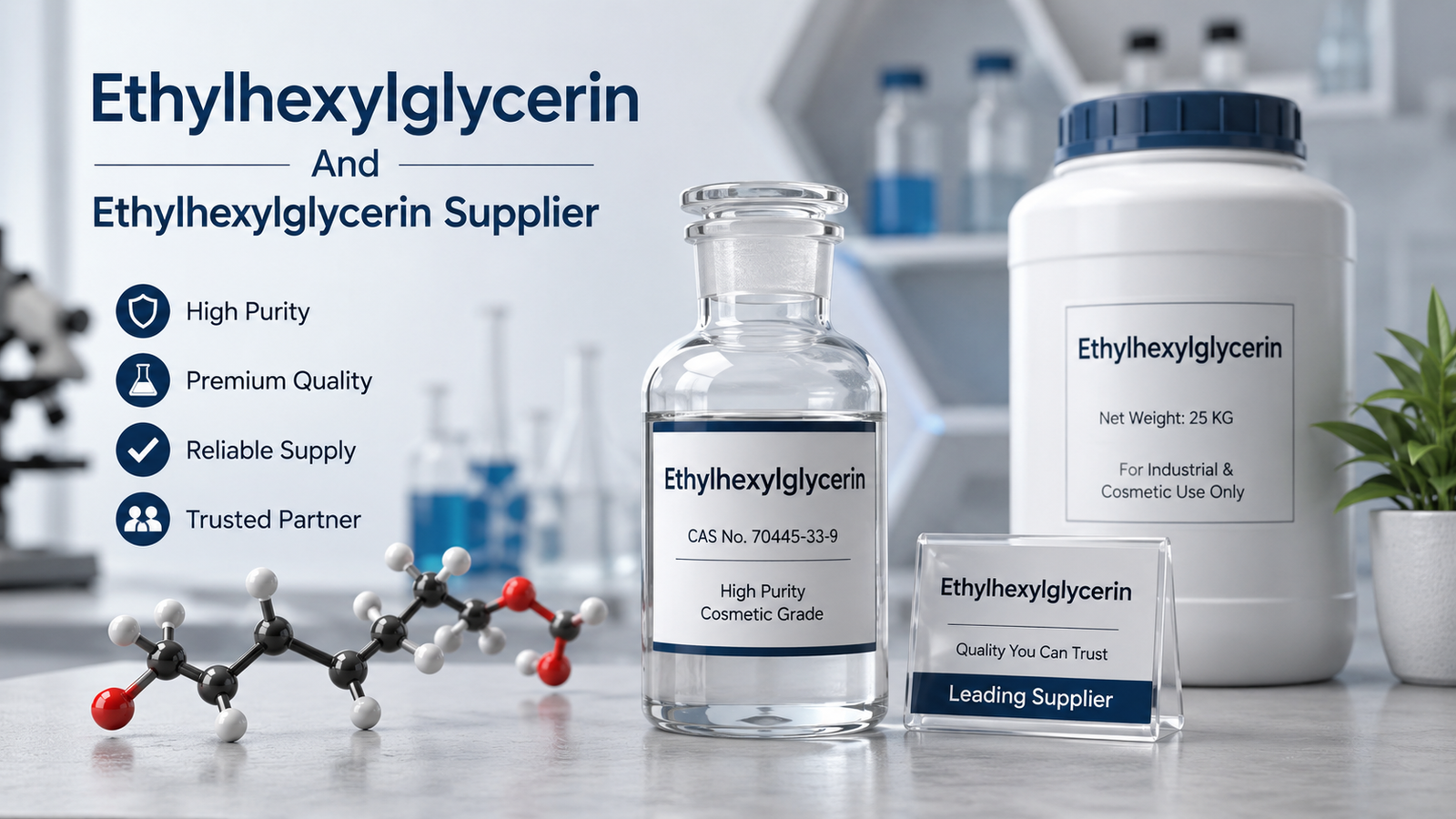
The beauty and personal care industry has moved far beyond simply creating products that smell good or feel pleasant. Today’s consumers pay closer attention to ingredient lists, product stability, skin compatibility, and overall formulation quality. Behind every effective cream, serum, shampoo, cleanser, or deodorant is a carefully designed system of ingredients working together.
One ingredient receiving considerable attention from cosmetic formulators is Ethylhexylglycerin. Its multifunctional nature makes it particularly useful in modern formulations where manufacturers want ingredients capable of performing more than one role.
But ingredient selection is only half the story. Finding a dependable Ethylhexylglycerin Supplier is equally important for manufacturers that require consistent quality, technical documentation, and uninterrupted production.
Ethylhexylglycerin is a multifunctional ingredient widely used in cosmetics and personal care products. It is particularly known for its skin-conditioning properties and its ability to enhance certain preservation systems.
Instead of approaching preservation through one ingredient alone, formulators can develop complementary systems where different ingredients work together.
This versatility has made Ethylhexylglycerin relevant across numerous product categories, from everyday moisturizers to sophisticated cosmetic formulations.
Formulating cosmetics involves balancing several requirements simultaneously. A product must remain stable, provide a pleasant sensory experience, withstand normal consumer use, and maintain appropriate microbial quality.
This is where multifunctional ingredients become valuable.
Key reasons formulators consider Ethylhexylglycerin include:
The ingredient therefore has value beyond a single technical function.
Water-containing cosmetics require careful microbial protection. Without an effective preservation strategy, microorganisms may potentially affect product quality and safety.
Ethylhexylglycerin is commonly used as a preservative booster. Rather than assuming it will protect every formulation independently, formulators often combine it with appropriate antimicrobial ingredients.
A preservative booster can enhance the overall effectiveness of a preservation system when ingredients are properly selected and tested.
Phenoxyethanol and Ethylhexylglycerin, for example, are frequently encountered together in personal care formulations.
However, preservation effectiveness depends on much more than ingredient selection.
Factors include:
This is why finished products should undergo appropriate microbiological evaluation rather than relying solely on theoretical ingredient performance.
One reason Ethylhexylglycerin has become useful in cosmetic development is its ability to contribute to skin feel while supporting other formulation objectives.
Consumers often judge skincare products within seconds of application. They notice spreadability, texture, absorption, softness, and after-feel.
Imagine two moisturizers offering similar functional benefits. One spreads smoothly and leaves skin feeling comfortable, while the other feels unpleasant.
Most consumers will naturally prefer the first.
This illustrates why sensory performance matters in formulation development. Ingredients that contribute functional and sensory benefits can therefore provide significant formulation value.
Another interesting application of Ethylhexylglycerin is in deodorant and hygiene products.
Body odor can develop when microorganisms interact with components of perspiration on the skin. Ingredients that help control odor-associated microbial activity can therefore support deodorizing formulations.
Potential applications include:
Its multifunctionality makes it particularly attractive when formulators are looking to achieve several objectives through a carefully designed ingredient system.
The applications of Ethylhexylglycerin extend across the beauty and personal care industry.
| Product | Common Formulation Role |
| Face cream | Conditioning and preservation support |
| Facial serum | Preservation enhancement |
| Body lotion | Skin-conditioning support |
| Shampoo | Formula protection |
| Conditioner | Conditioning support |
| Cleanser | Preservation assistance |
| Deodorant | Odor-control support |
| Wet wipes | Microbial protection support |
| Sunscreen | Formulation support |
| Hygiene products | Multifunctional performance |
The appropriate concentration and preservation strategy should always be determined according to the complete formulation and relevant testing.
Finding the ingredient online or receiving a low quotation does not automatically mean you have found the right source.
For manufacturers, an Ethylhexylglycerin Supplier becomes part of the production supply chain. Any inconsistency in raw materials can potentially influence manufacturing efficiency and finished-product quality.
A supplier should therefore be evaluated on more than price.
Before purchasing commercial quantities, ask your Ethylhexylglycerin Supplier about:
Having these details before purchasing can simplify internal quality-control and procurement procedures.
Raw-material procurement often involves pressure to reduce costs. However, selecting the cheapest option without evaluating quality can create expensive problems later.
Consider the difference:
| Factor | Quality-Focused Supplier | Price-Only Source |
| Batch documentation | Available | May be limited |
| Specifications | Clearly defined | May vary |
| Traceability | Reliable | Potentially unclear |
| Technical assistance | Usually available | Often limited |
| Quality consistency | Prioritized | Can vary |
| Supply planning | Structured | Potentially uncertain |
For manufacturers producing thousands of units, consistency often provides greater long-term value than a small difference in raw-material price.
Choosing a reliable Ethylhexylglycerin Supplier becomes easier when procurement teams follow a structured process.
Understand exactly what material is being offered rather than purchasing based solely on the ingredient name.
Check available COA, SDS, technical documentation, storage information, and relevant regulatory documents.
Where possible, conduct laboratory evaluation before moving directly into commercial quantities.
Compatibility, stability, and preservation performance should be evaluated within the actual formulation.
Compare MOQ, packaging, lead times, inventory capability, logistics, and long-term availability.
A strong supplier relationship combines technical confidence with dependable commercial service.
Ethylhexylglycerin is commonly used for skin conditioning and as a booster in cosmetic preservation systems.
It is widely incorporated into various skincare formulations, including creams, lotions, cleansers, serums, and other personal care products.
It is commonly treated as a preservative booster rather than automatically relying on it as the sole preservation system.
The ingredients can work together within appropriately formulated preservation systems to support antimicrobial protection.
Yes. It can be incorporated into shampoos and other haircare formulations when technically appropriate.
Yes. Its ability to support control of odor-associated microorganisms makes it useful in certain deodorant formulations.
Ask about purity, specifications, COA, SDS, packaging, MOQ, shelf life, lead times, traceability, and regulatory documentation.
A Certificate of Analysis provides batch-specific information showing whether the supplied material meets defined specifications.
No. Suitable usage depends on formulation composition, product type, preservation strategy, regulatory requirements, and testing.
Appropriate microbiological testing helps manufacturers verify whether the final preservation system performs effectively under intended conditions.