


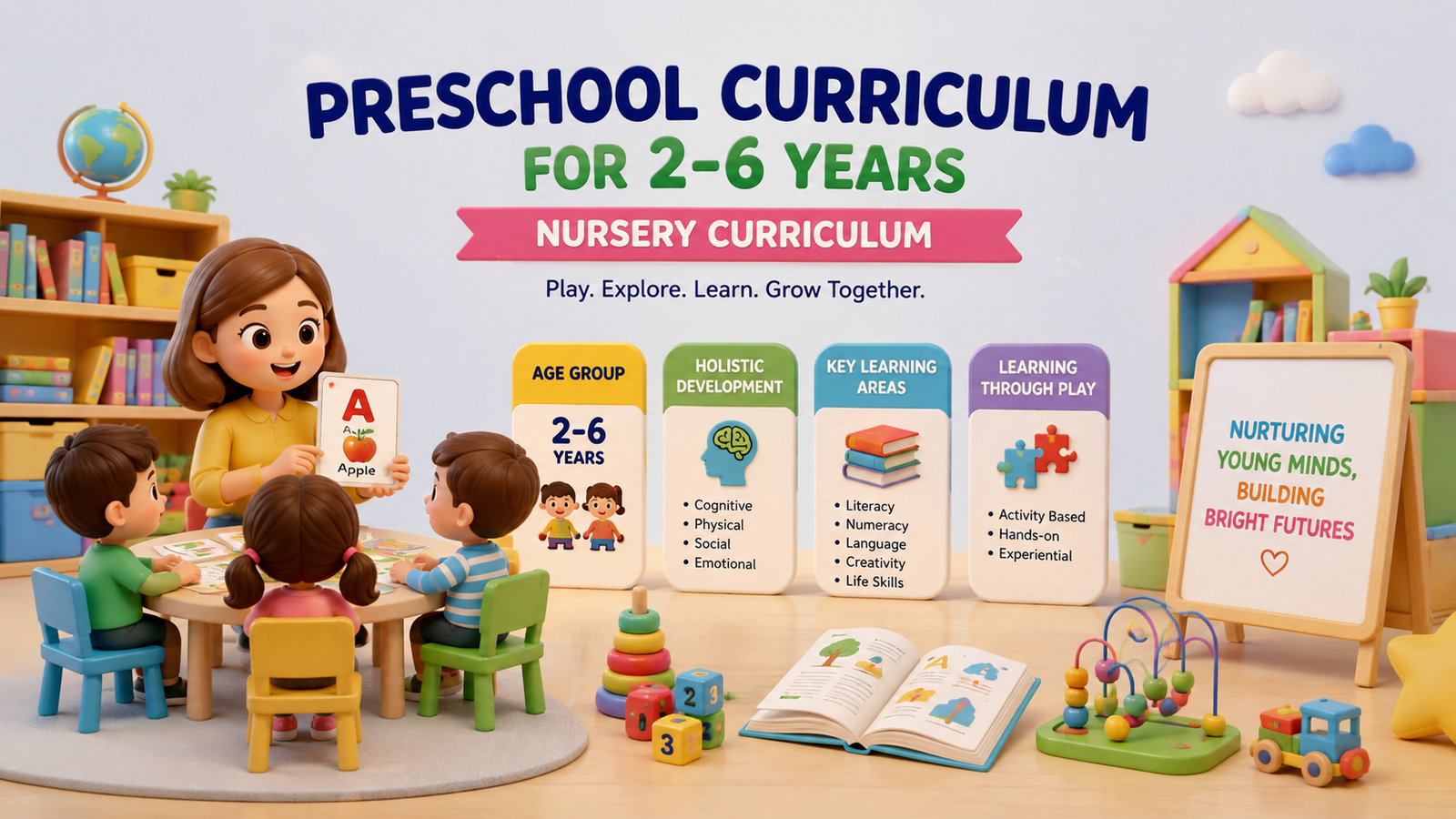
The early years are a period of rapid growth in language, movement, thinking, confidence, and social interaction. A thoughtfully planned preschool curriculum for 2-6 years gives children opportunities to develop these abilities naturally through play, exploration, conversation, creativity, and age-appropriate activities.
A strong nursery curriculum is not simply a smaller version of primary school. Young children learn differently. They need opportunities to touch, move, observe, experiment, imagine, ask questions, communicate, and interact with others. Therefore, an effective early-years programme balances foundational academics with physical, emotional, social, and creative development.
A preschool curriculum for 2-6 years is a structured but flexible learning framework designed around the developmental needs of young children. Instead of concentrating only on reading, writing, and numbers, it supports the whole child.
The curriculum generally focuses on:
Children develop at different speeds, so activities should offer appropriate challenges without creating unnecessary academic pressure.
Between two and six years, children gradually learn how to communicate ideas, manage emotions, cooperate with others, follow routines, solve simple problems, and become more independent.
A developmentally appropriate nursery curriculum creates an environment where these abilities can grow together.
For example, building a tower with blocks can introduce size, balance, counting, comparison, creativity, and problem-solving. A storytelling session can strengthen vocabulary, listening, imagination, memory, and communication.
Effective preschool education therefore connects learning areas instead of teaching every skill in isolation.
Children between two and three learn primarily through sensory experiences, movement, imitation, repetition, and simple interactions.
Learning activities can include:
At this stage, a preschool curriculum for 2-6 years should provide plenty of free movement and guided play rather than lengthy desk-based lessons.
At three to four years, children often become increasingly curious about people, objects, numbers, words, and their surroundings.
The curriculum can gradually introduce:
A good nursery curriculum encourages children to communicate what they see, think, and feel. Teachers can use open-ended questions to encourage children to think rather than simply memorise answers.
Between four and five years, learning can become more structured while remaining play-based and interactive.
Children may explore:
Hands-on experiences are particularly useful. Instead of explaining numbers only through worksheets, teachers can encourage children to count toys, buttons, blocks, fruits, or classroom objects.
The final preschool stage can help children prepare for a smoother transition into formal schooling without turning preschool into an academically intensive environment.
A balanced preschool curriculum for 2-6 years may include:
School readiness includes much more than academics. Confidence, attention, independence, emotional regulation, and the ability to communicate needs are equally valuable.
A comprehensive nursery curriculum should integrate multiple developmental areas.
| Learning Area | Example Activities | Development Focus |
| Language | Stories, rhymes, conversations | Vocabulary and communication |
| Numeracy | Counting, sorting, patterns | Mathematical thinking |
| Physical | Running, balancing, threading | Motor development |
| Creative | Drawing, music, craft | Imagination and expression |
| Social | Group games, role play | Cooperation and confidence |
| Sensory | Sand, water, textures | Exploration and observation |
Combining these areas helps children understand concepts through meaningful experiences rather than disconnected exercises.
Play is one of the most effective learning approaches during early childhood. Through play, children experiment with ideas, practise communication, negotiate roles, solve problems, and understand their environment.
Useful activities include pretend shops, building blocks, puzzles, puppet stories, water play, gardening, sorting games, music, dance, and outdoor exploration.
Teachers can intentionally connect these experiences with learning goals while allowing children enough freedom to explore independently.
Language development should be an important part of any nursery curriculum.
Teachers can strengthen communication through storytelling, picture discussions, songs, rhymes, show-and-tell sessions, puppets, and everyday conversations.
Early literacy can gradually introduce letter sounds, print awareness, vocabulary, listening comprehension, and pre-writing skills. Children should first develop confidence with language before being expected to complete complex reading or writing tasks.
Preschool mathematics should begin with real objects and everyday experiences.
Children can count blocks, compare pencils, sort buttons, identify patterns, arrange objects by size, and explore shapes around the classroom.
These activities help develop number sense and logical thinking. As children progress, teachers can introduce written numbers and simple mathematical operations alongside practical examples.
An effective preschool curriculum for 2-6 years should also teach children how to interact positively with others.
Group activities can help children practise:
A supportive classroom environment allows children to make mistakes, ask questions, and gradually become more confident learners.
1. What is a preschool curriculum for 2-6 years?
It is an age-appropriate learning framework supporting language, numeracy, physical, social, emotional, and creative development.
2. What should a nursery curriculum include?
It should include communication, early literacy, numeracy, sensory play, physical activities, creativity, and social learning.
3. Should two-year-olds learn alphabets formally?
Formal instruction should be limited. Songs, stories, pictures, and playful exposure are generally more suitable.
4. Is play important in preschool education?
Yes. Play supports communication, imagination, problem-solving, movement, and social interaction.
5. When should phonics be introduced?
Basic sound awareness can be introduced gradually when children show developmental readiness.
6. How can preschoolers learn mathematics?
Counting objects, sorting, matching, patterns, puzzles, and everyday comparisons make early mathematics meaningful.
7. Should preschool children receive homework?
Learning at this age is generally more effective when activities remain short, engaging, practical, and appropriate to the child’s development.
8. Why are creative activities important?
Art, craft, music, dance, and imaginative play encourage expression, coordination, creativity, and confidence.
9. How does nursery prepare children for school?
It develops foundational academic abilities alongside independence, communication, routines, confidence, and social skills.
10. What makes a preschool curriculum effective?
An effective curriculum is age-appropriate, inclusive, engaging, flexible, play-based, and responsive to individual development.