


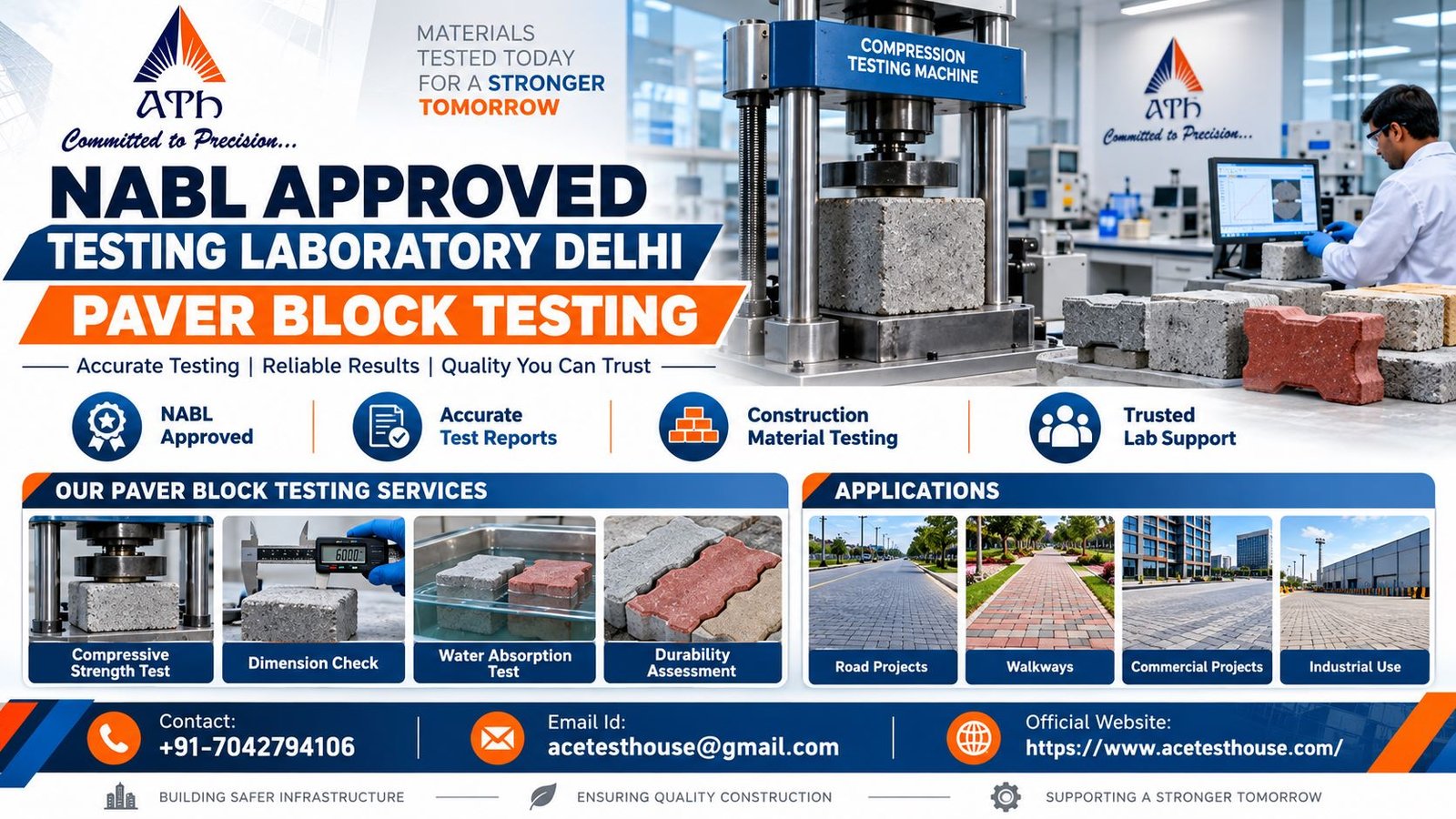
The quality of roads, pedestrian pathways, parking areas, and commercial landscapes depends heavily on the construction materials used. Among these materials, concrete paver blocks play an important role in creating durable, functional, and visually appealing paved surfaces.
However, attractive appearance alone cannot guarantee reliable performance. Factors such as compressive strength, water absorption, dimensional accuracy, and abrasion resistance can influence the suitability of paving blocks for different applications.
Construction professionals searching for a nabl approved testing laboratory delhi often require technically competent laboratories that can evaluate materials against relevant specifications.
Similarly, professional Paver Block Testing provides measurable information that helps manufacturers, contractors, and infrastructure developers assess product quality and make informed procurement decisions.
Concrete paving blocks are commonly used in residential developments, industrial premises, parking facilities, footpaths, and landscaped areas.
These surfaces may experience pedestrian movement, vehicle loading, weather exposure, and repeated operational stress.
Poor-quality blocks can contribute to cracking, surface deterioration, excessive wear, or inconsistent pavement appearance.
However, pavement failure may also result from inadequate subgrade preparation, poor drainage, unsuitable bedding, or incorrect installation.
This makes laboratory evaluation an important part of a broader pavement quality assurance strategy.
The search phrase nabl approved testing laboratory delhi is commonly used by organizations looking for accredited material testing facilities.
Technically, the National Accreditation Board for Testing and Calibration Laboratories (NABL) accredits laboratories rather than issuing a general approval covering all testing services.
Accreditation demonstrates that a laboratory has been assessed for competence in specific testing activities within its defined scope.
For construction companies, this distinction is important.
A laboratory may hold accreditation for certain material tests without being accredited for every test it offers.
Before selecting a service provider, customers should verify that the required test method and material category are included in the laboratory’s applicable accreditation scope.
Paver Block Testing is the laboratory evaluation of concrete paving blocks to determine selected physical, mechanical, and dimensional properties.
These examinations help establish whether submitted specimens satisfy relevant product specifications.
Concrete paving blocks in India are commonly evaluated with reference to applicable provisions of IS 15658.
The specific tests and acceptance requirements depend on the relevant standard, specified product grade, and intended application.
Each result provides information about a particular material characteristic.
Compressive strength is an important parameter for concrete paving blocks exposed to loading.
Laboratory testing involves preparing or conditioning specimens according to the relevant method and applying a controlled load using suitable equipment.
The results help determine whether the submitted blocks satisfy specified strength requirements.
However, higher compressive strength does not automatically guarantee superior pavement performance.
The supporting layers, installation method, joint arrangement, and actual loading conditions also influence the completed pavement.
A suitable strength grade should therefore be selected according to engineering requirements rather than appearance or marketing descriptions.
Water absorption testing provides information about the amount of water absorbed by a paving block under specified conditions.
Excessive absorption may indicate characteristics that require further evaluation, depending on the applicable specification.
Abrasion resistance is another important consideration, particularly for paved areas exposed to regular movement and surface friction.
A qualified laboratory can help project teams understand these properties within the limits of the prescribed testing methods.
Material disputes can arise when supplied paving blocks do not match agreed technical requirements.
For example, a contractor may receive blocks with inconsistent dimensions or characteristics that differ from the approved specification.
Without documented testing requirements, disagreements can become difficult to resolve.
Independent laboratory examination provides objective evidence relating to the submitted samples.
For better procurement control, project teams should define the applicable standard, product grade, sampling procedure, testing requirements, and acceptance criteria before accepting a consignment.
This creates clearer expectations for manufacturers, suppliers, and buyers.
Paving block requirements differ according to the intended use.
| Application | Important Quality Considerations |
| Pedestrian Footpaths | Dimensional consistency and suitable surface performance |
| Parking Areas | Appropriate strength and abrasion resistance |
| Commercial Premises | Surface durability and product consistency |
| Industrial Yards | Suitability for expected loading conditions |
| Residential Landscaping | Dimensional accuracy and specified material quality |
| Public Infrastructure | Compliance with approved project specifications |
A successful installation must also include suitable pavement design, drainage, and construction practices.
The reliability of Paver Block Testing depends partly on how samples are selected.
A carefully tested specimen may provide accurate information about itself without necessarily representing an entire production batch.
For this reason, sampling procedures should reflect the applicable standard and project requirements.
Representative sampling improves the usefulness of laboratory results for quality control decisions.
A technical laboratory report should provide enough information for customers to understand the examinations performed.
Important details include sample identification, test methods, measured results, units, and any stated limitations.
A report may also include a conformity statement where appropriate criteria and decision rules have been established.
Construction professionals researching a nabl approved testing laboratory delhi should examine reporting clarity alongside accreditation information.
Reports should distinguish between observed test results and conclusions that require additional engineering assessment.
Before choosing a laboratory, contractors and manufacturers should confirm the availability of the required tests.
Important evaluation factors include suitable equipment, trained personnel, documented procedures, sample handling arrangements, and clear reporting practices.
Customers should also verify the laboratory’s accreditation status and whether the relevant tests fall within its accredited scope.
Where a project specifies independent witnessing or sampling, those requirements should be established separately.
The objective is to obtain technically reliable results that support meaningful construction quality decisions.
1. What is a nabl approved testing laboratory delhi?
It is a commonly searched phrase for laboratories accredited by NABL. Accreditation must be verified for the specific testing method and scope required.
2. What is the purpose of Paver Block Testing?
It evaluates selected properties of concrete paving blocks, helping manufacturers and contractors assess compliance with relevant specifications.
3. Which Indian Standard applies to concrete paving blocks?
IS 15658 addresses precast concrete blocks for paving. The applicable provisions should be confirmed for the intended product and project.
4. Does laboratory testing guarantee that a paved surface will not fail?
No. Pavement performance also depends on subgrade conditions, supporting layers, drainage, installation quality, and loading.
5. Why is NABL accreditation important for construction material testing?
Accreditation provides recognized evidence of laboratory competence for testing activities included within the laboratory’s defined scope.
Department: Construction Material and Paver Block Testing Enquiries
Email: info@acetesthouse.com
Contact: +91 7042794106
Address: Kh. No. 1048, Near Laxmi Narayan Mandir, Village Bhalswa, New Delhi – 110033, India
Official Website: https://www.acetesthouse.com/