


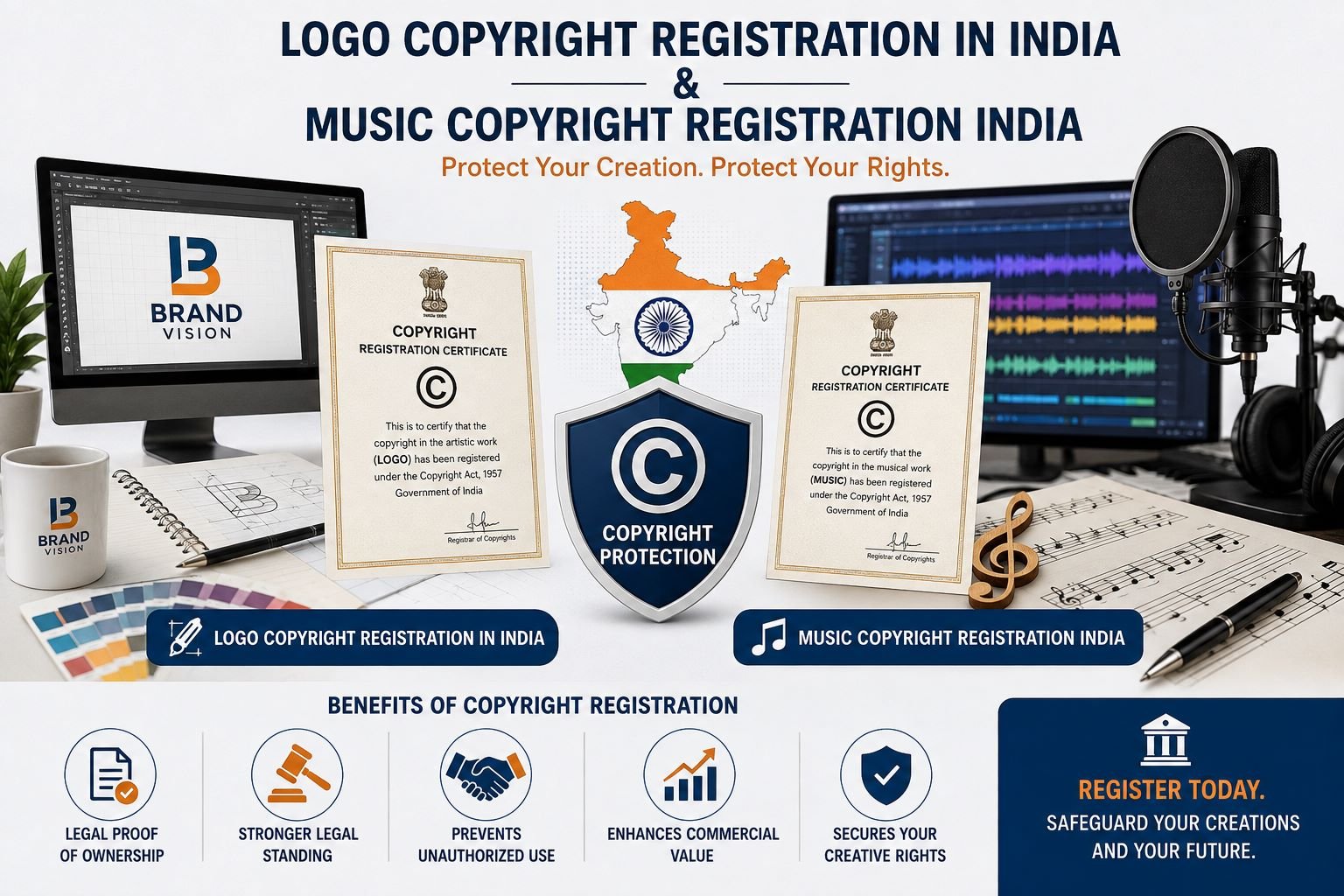
The rapid expansion of digital businesses, independent music, online entertainment and creator-led brands is placing intellectual property protection firmly on the agenda for Indian entrepreneurs and creative professionals. As original designs and music increasingly become commercially valuable digital assets, awareness surrounding Logo Copyright Registration in India and Music Copyright Registration India is growing.
For startups, established companies, designers, composers, musicians and production houses, the issue extends beyond simply proving that a creative work exists. Clearly establishing authorship, ownership and commercial rights can be essential when intellectual property is licensed, assigned, distributed or challenged.
India’s copyright framework provides legal protection for eligible original works, while copyright registration offers creators and rights holders an official mechanism for recording relevant particulars concerning those works.
The commercial role of creative content has changed considerably.
A logo that once appeared primarily on a storefront or printed brochure can now be displayed across e-commerce marketplaces, mobile applications, websites, social networks and international advertising campaigns.
Music has undergone an even greater transformation. Independent creators can release original compositions to audiences without relying exclusively on conventional record distribution.
This accessibility brings opportunities, but it also makes original work easier to reproduce and redistribute.
For this reason, businesses and creators are increasingly treating copyright as part of commercial risk management rather than addressing it only after a dispute occurs.
A logo represents much more than decoration. Over time, it can become closely connected with the commercial reputation and visual identity of a business.
Where a logo contains sufficiently original artistic elements, the relevant artwork may potentially qualify for copyright protection.
Logo Copyright Registration in India provides a formal process for recording particulars concerning qualifying logo artwork.
For businesses, such documentation can become relevant when dealing with licensing arrangements, brand acquisitions, investor due diligence or potential copying.
However, copyright protects eligible creative expression. It does not automatically provide ownership over an abstract branding concept or business idea.
One significant source of confusion involves the relationship between copyright and trademarks.
A logo can potentially have relevance under both systems, but the nature of protection differs.
| Key Area | Copyright | Trademark |
| Main focus | Original creative expression | Commercial brand identity |
| Logo relevance | Artistic design | Source identifier |
| Typical concern | Copying of protected artwork | Confusing use in the marketplace |
| Primary legislation | Copyright Act, 1957 | Trade Marks Act, 1999 |
| Commercial objective | Protect creative rights | Distinguish goods or services |
Consequently, obtaining Logo Copyright Registration in India does not necessarily remove the need to consider trademark protection.
A comprehensive brand-protection strategy may involve both, depending on the nature of the logo and its commercial use.
Businesses frequently outsource branding to freelance designers and creative agencies.
This can create an important question: who owns the resulting copyright?
Payment for design services should not be treated as a substitute for properly drafted intellectual property terms.
Before commercialising a commissioned logo, businesses should consider documentation covering:
For a young business, these details may initially appear unnecessary. They can become significantly more important when the brand attracts investment, enters licensing arrangements or is sold.
Businesses seeking Logo Copyright Registration in India should first identify the relevant artistic work and confirm the chain of ownership.
The broad registration journey generally involves:
Special procedural requirements may apply where artistic work is used or capable of being used in relation to goods or services.
Professional review can be particularly valuable where trademark and copyright considerations overlap.
India’s independent music ecosystem is expanding alongside film, streaming, digital advertising and short-form video content.
Creators can now compose, record and distribute songs using relatively accessible technology. A track produced in a home studio can potentially reach listeners across multiple countries.
But digital distribution also creates complex questions about ownership.
This has increased the practical relevance of Music Copyright Registration India, particularly for creators planning to license or monetise original music.
Music copyright is frequently misunderstood because listeners perceive a song as one creative product.
Legally, several elements may exist independently.
| Part of a Song | Possible Copyright Interest |
| Melody or composition | Musical work |
| Lyrics | Literary work |
| Recorded audio | Sound recording |
| Singer or musician performance | Performers’ rights may apply |
Imagine that a lyricist writes the words, a composer creates the melody, singers perform the track and a producer manages the recording.
Multiple parties can therefore have legally relevant interests in the finished product.
This makes accurate agreements particularly important.
Before applying for Music Copyright Registration India, creators should determine precisely which work they want to register.
Registering a musical composition is different from registering the final sound recording.
Similarly, lyrics may represent an independent literary work.
A creator should therefore consider several questions before filing:
Who wrote the lyrics?
Who composed the music?
Who produced the recording?
Were any rights assigned?
Are there collaborators?
Has the work already been published?
Answering these questions can help establish the correct registration strategy.
The value of copyright becomes more apparent when music moves beyond its original release.
An original track may potentially be used in:
Each commercial use can involve permissions and licensing arrangements.
Music Copyright Registration India can support rights management by creating a registration record, but contracts remain critical for determining how copyright is commercially exploited.
Creators do not always need to transfer copyright to generate revenue.
Licensing can permit another party to use specified rights while ownership may remain with the copyright holder.
For example, a composer could permit a brand to use an original composition in an advertising campaign for a defined period.
A well-structured licence should clearly address matters such as:
An assignment, by contrast, may transfer specified copyright interests to another party, subject to applicable legal requirements.
Understanding this distinction can significantly influence the long-term commercial value of creative work.
Another misconception is that obtaining registration makes copying impossible.
It does not.
Digital content can still be reproduced without permission. Copyright owners may need to monitor usage and take appropriate enforcement measures when infringement occurs.
Depending on the circumstances and applicable law, remedies for infringement can potentially include civil relief, while certain conduct may also attract criminal consequences.
Registration should therefore form part of a broader intellectual property strategy involving documentation, contracts, licensing and monitoring.
1. What is Logo Copyright Registration in India?
It is the registration of qualifying original artistic elements of a logo through the Indian copyright framework.
2. Is registration necessary before copyright exists?
Eligible original works generally receive copyright protection without registration being mandatory.
3. Can a company logo have copyright and trademark protection?
Potentially yes, because the two intellectual property systems protect different legal interests.
4. Does copyright protect a logo idea?
Copyright protects eligible original expression rather than an abstract idea.
5. Who can apply for logo copyright registration?
An eligible author, copyright owner or authorised applicant may apply subject to applicable requirements.
6. What is Music Copyright Registration India?
It involves registering eligible musical or related copyright works through India’s copyright registration system.
7. Can lyrics be registered independently?
Original lyrics may qualify for protection as literary works.
8. Are composition and sound recording identical?
No. They represent separate categories of copyright subject matter.
9. Can several people hold rights connected with one song?
Yes. Different creative contributions can involve different rights and ownership interests.
10. Can copyright be licensed commercially?
Yes. Copyright owners can grant defined usage rights through licensing arrangements.
https://newsgrow.blogspot.com/2026/08/logo-copyright-registration-in-india.html