


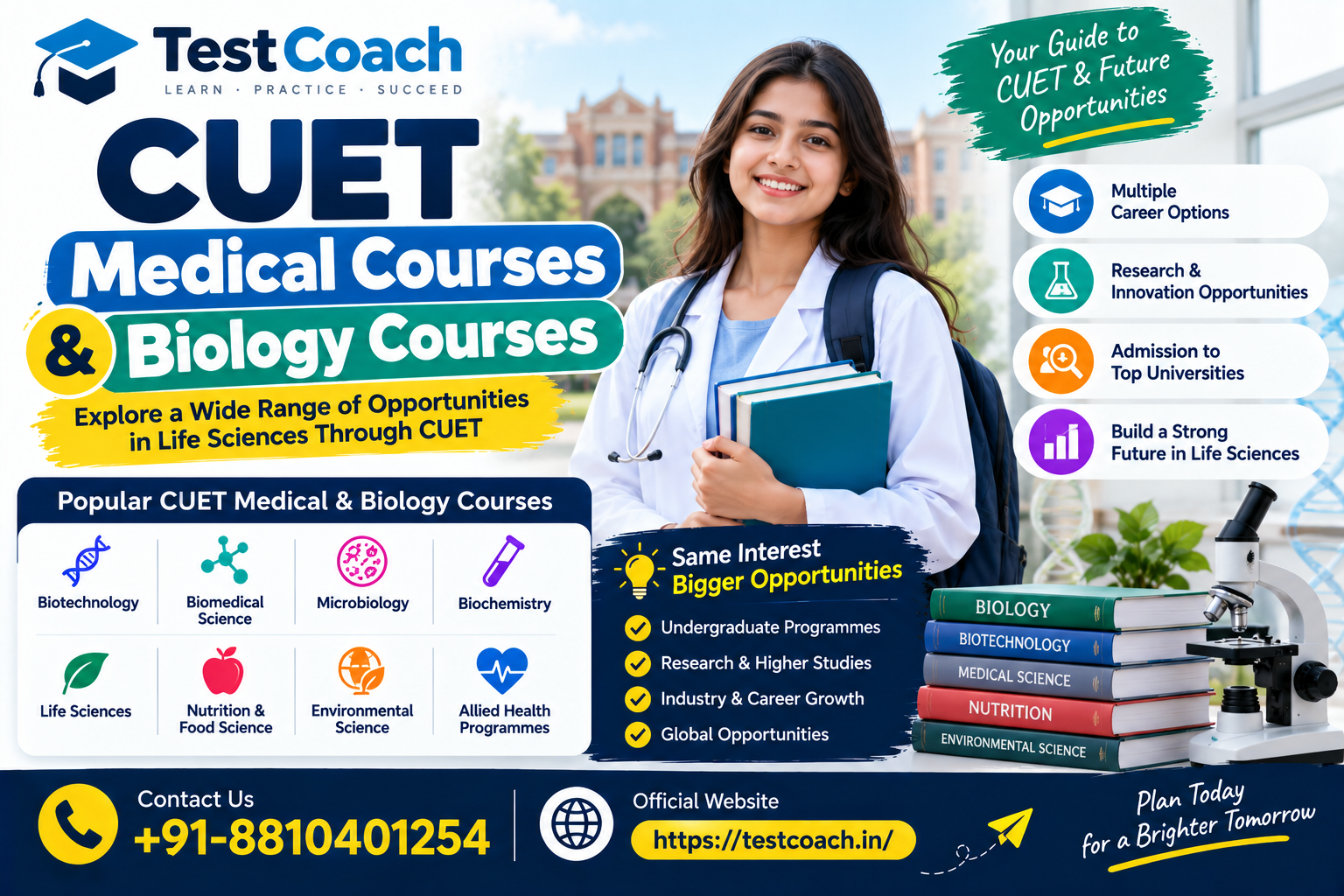
The healthcare and life sciences sectors offer diverse educational opportunities for students interested in biology, scientific research, medical technology, and human health. While many science students traditionally consider becoming doctors, several other academic pathways allow them to explore healthcare-related fields.
For students researching CUET Medical Courses, understanding the difference between clinical medical degrees and science-based undergraduate programmes is essential.
Similarly, CUET Biology Courses can provide opportunities to study subjects such as biotechnology, microbiology, biochemistry, and biological sciences at participating universities, subject to programme availability and eligibility.
As students explore undergraduate options, selecting the appropriate course requires careful consideration of academic interests, entrance examination requirements, and long-term career goals.
The term CUET Medical Courses is commonly used by students searching for healthcare-related undergraduate programmes accessible through the Common University Entrance Test.
However, an important distinction must be understood.
CUET-UG is not the standard entrance examination for MBBS, BDS, or other undergraduate medical programmes for which NEET-UG is prescribed.
Instead, CUET may provide an admission pathway for selected undergraduate courses in biological sciences, healthcare-related disciplines, and allied fields at participating institutions.
The availability of these programmes depends on individual universities and their admission criteria.
This distinction helps students identify realistic academic opportunities.
Biology is a broad field that examines living organisms, biological processes, and interactions within natural environments.
Students interested in CUET Biology Courses may explore several undergraduate disciplines.
These are examples of academic disciplines, not a guarantee that every participating university offers them through CUET.
Students must verify programme availability and eligibility individually.
Healthcare systems depend on professionals working in research, diagnostics, pharmaceutical development, medical technology, and scientific analysis.
Not every healthcare-related career involves diagnosing patients or providing clinical treatment.
For example, biotechnology graduates may pursue opportunities involving biological research or industrial applications.
Microbiology graduates may explore laboratory-related fields, while biochemistry students can develop knowledge relevant to research and analytical sciences.
Specific professional roles may require postgraduate qualifications, specialised training, registration, or additional certifications.
Understanding these distinctions helps students avoid selecting a course based solely on its name.
Course selection should begin with identifying personal interests and preferred learning experiences.
A student fascinated by laboratory experiments may enjoy a different academic pathway from someone interested in ecosystems or animal biology.
Academic Interest: Identify whether laboratory research, human biology, environmental science, or biotechnology is most appealing.
Course Content: Review subjects, practical components, and laboratory requirements.
University Facilities: Examine available educational and research infrastructure.
Future Qualifications: Understand whether further education is necessary for intended careers.
Admission Requirements: Confirm the required CUET subjects and eligibility conditions.
Students researching CUET Medical Courses should not assume that all programmes follow identical eligibility requirements.
Universities may specify particular qualifying examination subjects, minimum academic criteria, and accepted CUET test combinations.
For biology-related programmes, relevant science subjects may include Biology, Chemistry, Physics, or other subjects depending on the course.
However, requirements vary.
Candidates should review the admission information published by their intended universities before selecting examination subjects.
This prevents students from preparing for tests that may not satisfy their preferred programme’s eligibility conditions.
Biology education involves understanding scientific concepts through observation, experimentation, and analysis.
Practical laboratory experiences can help students connect theoretical knowledge with scientific applications.
For instance, microbiology education may introduce laboratory techniques used to study microorganisms.
Biochemistry programmes may include practical exercises involving biological molecules and analytical methods.
Such experiences encourage scientific thinking, accuracy, and responsible laboratory practices.
Students should examine the laboratory components of a programme before making an admission decision.
A strong preparation strategy should focus on conceptual clarity rather than memorising isolated facts.
Biology requires understanding processes, relationships, terminology, and scientific reasoning.
Students should also practise interpreting questions carefully.
Understanding why an answer is correct can be more valuable than simply memorising the answer itself.
Different academic disciplines can lead towards different areas of further study and professional development.
| Academic Discipline | Potential Area of Interest |
| Biotechnology | Biological technology and applied research |
| Microbiology | Microorganism research and laboratory sciences |
| Biochemistry | Molecular processes and scientific analysis |
| Zoology | Animal biology and ecological research |
| Botany | Plant sciences and environmental studies |
| Biomedical Science | Human biology and biomedical research |
Career opportunities depend on qualifications, institutional training, and employer requirements.
A bachelor’s degree alone does not automatically qualify graduates for regulated medical professions.
Selecting a programme requires more than comparing course titles.
Students should examine university recognition, curriculum structure, laboratory facilities, eligibility conditions, and opportunities for further study.
They should also distinguish between academic degrees and professional qualifications.
A programme involving human biology, for example, does not necessarily provide eligibility to practise medicine.
For candidates exploring CUET Biology Courses, careful research can help establish realistic expectations about educational and professional opportunities.
1. What are CUET Medical Courses?
The phrase generally refers to healthcare-related or biological science undergraduate programmes that may accept CUET scores. It should not be confused with MBBS or other programmes requiring NEET-UG.
2. Which CUET Biology Courses can students explore?
Depending on university availability, students may explore biotechnology, microbiology, biochemistry, zoology, botany, biomedical science, and related disciplines.
3. Can students pursue MBBS through CUET?
No. MBBS admission in India follows the prescribed NEET-UG route rather than CUET-UG.
4. Is Biology compulsory for every CUET healthcare-related course?
Not necessarily. Subject requirements depend on the specific programme and university. Candidates must verify the applicable eligibility conditions.
5. What career opportunities are available after biology-related undergraduate courses?
Possible directions include scientific research, laboratory sciences, biotechnology, environmental studies, and further specialised education, depending on qualifications and training.
Department: CUET Biology Preparation and Undergraduate Education Enquiries
Email: support@testcoach.in
Phone: +91-8810401254
Official Website: https://testcoach.in/