


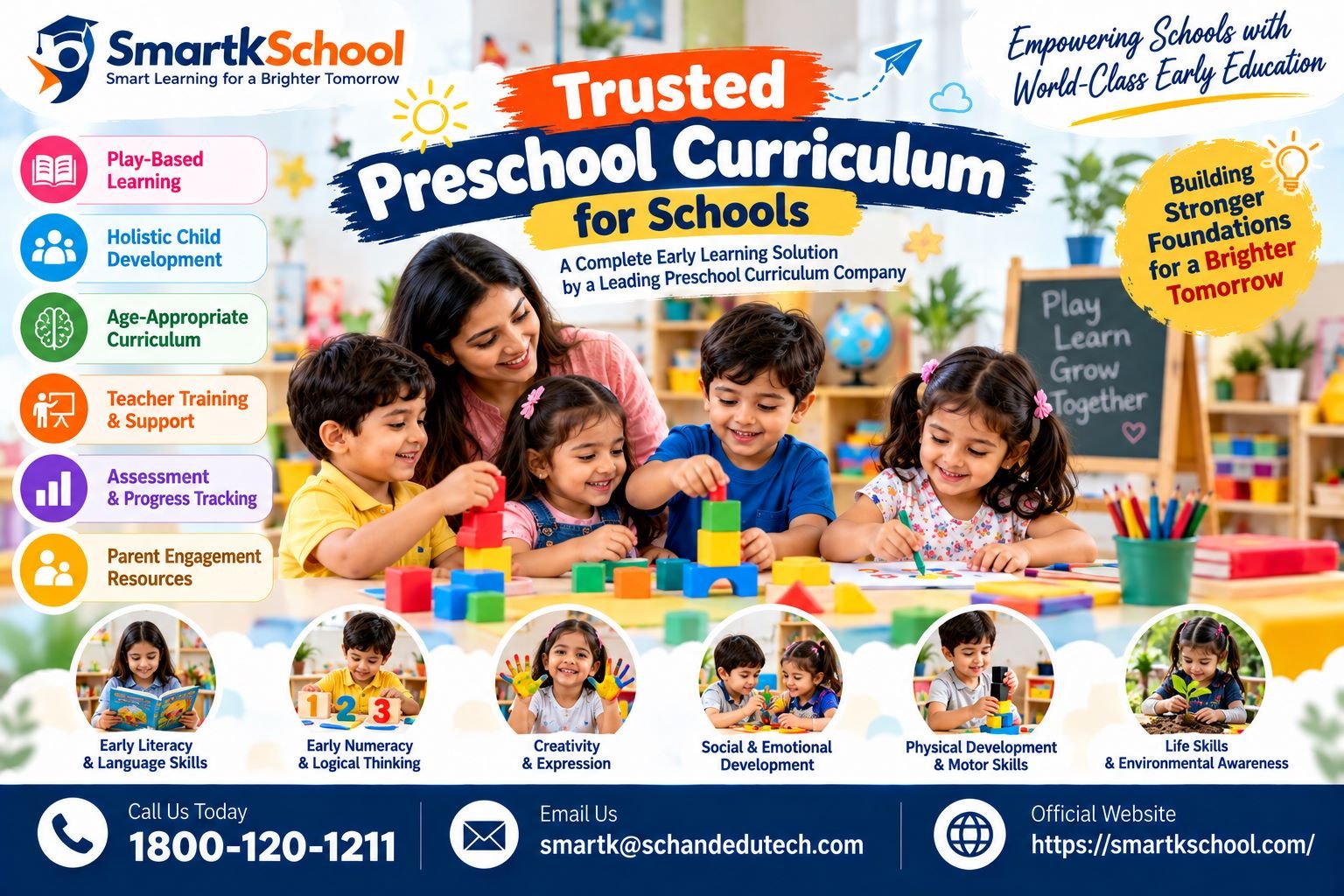
For schools, delivering quality preschool education requires more than attractive classrooms, colourful books, and a collection of learning activities. It requires a carefully designed educational framework that connects teaching objectives with children’s developmental needs.
A professional preschool curriculum company can support educational institutions by providing structured learning resources, classroom activity frameworks, and guidance for consistent teaching practices.
Similarly, a well-planned preschool curriculum for schools can help educators establish meaningful learning experiences while maintaining flexibility for different children and classroom settings.
The central challenge for schools is ensuring that curriculum planning translates into genuine learning opportunities rather than simply completing a prescribed collection of activities.
Preschool learning involves several interconnected developmental areas.
Children develop communication skills, emotional awareness, physical coordination, problem-solving abilities, and creativity through daily experiences.
When activities are planned independently without clear learning objectives, children may encounter disconnected experiences that do not build naturally upon previous learning.
A connected curriculum creates continuity between classroom activities and developmental goals.
For educational institutions, this approach supports more purposeful classroom planning.
A preschool curriculum company develops educational frameworks and resources designed to support early childhood learning.
Depending on the organisation, its work may involve curriculum planning, activity development, teacher resources, classroom materials, and implementation guidance.
Its responsibility is not limited to supplying educational content.
A curriculum development organisation should understand how children learn and how teachers translate educational goals into practical classroom experiences.
These elements help schools establish coherent educational practices.
An effective preschool curriculum for schools should provide a common educational direction without restricting teachers’ creativity.
Consistency means that children experience appropriate learning opportunities across classrooms, even when educators use different activities or teaching approaches.
For example, one classroom may introduce shapes through building blocks, while another uses artwork and sorting activities.
Although the methods differ, both can support the same mathematical understanding.
This flexibility helps schools maintain educational objectives while recognising the importance of individual classroom needs.
Young children do not naturally separate their learning into academic subjects.
A simple classroom activity can develop several skills simultaneously.
Consider a pretend grocery shop organised within the classroom.
Children can identify fruits and vegetables, count objects, communicate with classmates, and participate in role-playing.
The same activity may support:
Integrated activities demonstrate how structured curriculum planning can remain playful and engaging.
One important function of preschool education is helping children become comfortable with structured learning environments.
However, school readiness should not be reduced to early reading, handwriting, or memorisation.
Children also benefit from developing independence, communication, emotional regulation, curiosity, and the ability to participate in group activities.
A thoughtfully designed preschool curriculum for schools supports these abilities through everyday classroom routines.
Activities such as storytelling, collaborative games, organising personal belongings, and participating in group discussions can contribute to a smoother educational transition.
The emphasis should remain on development rather than unnecessary academic competition.
Curriculum planning extends beyond individual lessons.
Daily routines also provide valuable learning opportunities.
Greeting classmates encourages communication and social confidence.
Cleaning up learning materials develops responsibility and independence.
Group conversations help children practise listening and expressing ideas.
Outdoor play supports movement, coordination, and interaction.
A comprehensive educational framework recognises these everyday experiences as meaningful components of learning.
Schools can therefore create a more effective programme by connecting routine activities with developmental objectives.
Adopting educational resources is only the beginning of curriculum implementation.
School administrators should establish practical processes that support teachers and encourage continuous improvement.
Review Existing Practices: Identify classroom strengths and areas requiring improvement.
Establish Learning Goals: Define developmentally appropriate expectations.
Prepare Teaching Resources: Organise materials according to classroom activities.
Support Teachers: Provide guidance on educational objectives and activity adaptation.
Observe Classroom Engagement: Understand how children respond to learning experiences.
Refine the Approach: Adjust activities based on observations and educator feedback.
This process helps schools move from curriculum documentation to meaningful classroom practice.
A curriculum becomes more effective when teachers share experiences and ideas.
Regular planning discussions can help educators identify successful activities, address classroom difficulties, and develop alternative approaches.
For example, an educator may discover that a storytelling activity becomes more engaging when children use puppets or picture cards.
Sharing such observations can benefit other classrooms.
A preschool curriculum company may support this process through practical guidance and teaching resources, depending on its services.
Ultimately, successful implementation requires active participation from educators and school leadership.
Worksheets and completed books do not provide a complete picture of preschool learning.
Children demonstrate understanding through conversations, creative expression, movement, experimentation, and interaction with others.
Observation-based assessment can help teachers understand developmental progress.
Schools may maintain learning portfolios containing artwork, activity samples, and documented observations.
These records can support communication with parents and guide future teaching decisions.
Assessment should focus on understanding each child’s development rather than creating unnecessary comparisons.
Parents naturally want to understand what their children experience at preschool.
Schools can strengthen communication by explaining the purpose behind learning activities.
Instead of reporting only that children completed a painting exercise, educators can describe how the activity encouraged fine motor development, creative expression, and colour recognition.
Such communication demonstrates the educational value of classroom experiences.
It also helps parents understand why play-based learning is an important part of early childhood education.
1. What services does a preschool curriculum company provide?
Depending on the organisation, services may include curriculum frameworks, lesson resources, classroom activities, educational materials, teacher guidance, and learning assessment tools.
2. Why is a structured preschool curriculum for schools important?
It helps schools connect classroom activities with developmental objectives while maintaining consistency and flexibility in teaching practices.
3. Can one curriculum support different learning abilities?
Yes. A flexible curriculum can provide common learning goals while allowing teachers to adapt activities according to children’s individual developmental needs.
4. How can schools improve curriculum implementation?
Schools can support teachers through planning, practical resources, classroom observations, professional discussions, and continuous improvement.
5. How should preschool learning outcomes be assessed?
Observation, activity portfolios, conversations, and developmental records can help educators understand children’s progress without relying on formal examinations.
Department: Preschool Curriculum Development and School Education Enquiries
Email: smartk@schandedutech.com
Phone: 1800-120-1211
Official Website: https://smartkschool.com/