


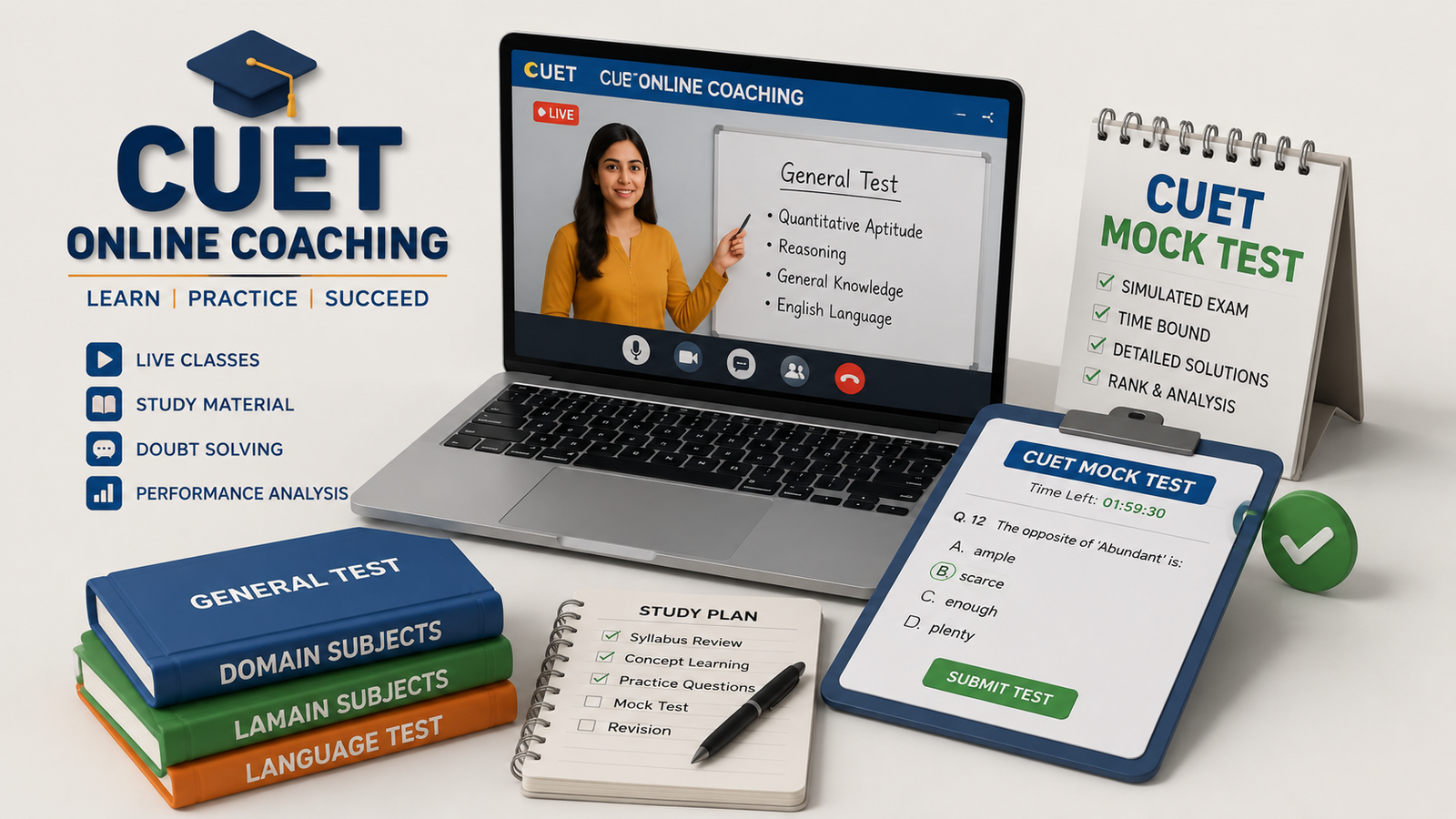
With candidates coming from different boards, cities, and academic backgrounds, preparation needs to be systematic rather than based only on school-level study. CUET online coaching offers students structured guidance, while a CUET mock test helps them understand how effectively they can apply what they have learned under exam-like conditions.
The strongest preparation strategy combines conceptual learning, regular revision, question practice, performance analysis, and time management. Instead of studying everything repeatedly, students should identify exactly where marks are being lost and improve those areas before the actual examination.
CUET preparation is different from simply completing the Class 12 syllabus. Students may need to prepare language, domain-specific subjects, and other applicable sections depending on their selected course and university requirements.
A practical preparation plan should therefore focus on:
A structured strategy prevents students from spending too much time on familiar chapters while ignoring topics that require additional practice.
One major advantage of CUET online coaching is accessibility. Students can attend classes and access preparation resources without travelling to a physical coaching centre.
A well-designed online programme may provide live classes, recorded lessons, study material, practice questions, doubt-solving support, revision sessions, and performance reports.
Recorded lessons are particularly useful when a topic needs to be studied again. Instead of depending entirely on handwritten notes, students can revisit the explanation and strengthen their understanding.
Online preparation can also provide greater flexibility. A student preparing alongside board examinations can create a study schedule around school, revision, and personal commitments.
Not every coaching programme will suit every learner. Students should evaluate a course according to its teaching quality and usefulness rather than advertisements alone.
Important factors include:
Good CUET online coaching should help students become independent problem-solvers rather than making them completely dependent on classes.
Studying concepts and attempting an examination are two different skills. A student might understand a chapter perfectly but still lose marks because of poor time management, rushed reading, or avoidable mistakes.
A CUET mock test creates a practice environment where these weaknesses can be identified.
Regular mock testing helps students evaluate:
Mock tests become significantly more valuable when students analyse them rather than simply checking the final score.
After completing a CUET mock test, divide incorrect or missed questions into categories.
For example:
This process reveals the actual reason behind lost marks.
Suppose a student repeatedly makes mistakes in one topic. Attempting more full tests without correcting that topic may reproduce the same result. Instead, the student should revise the concept, practise targeted questions, and then check improvement in the next mock test.
This creates a continuous learning cycle:
Learn → Practise → Test → Analyse → Improve → Retest
CUET online coaching develops knowledge, while CUET mock test practice evaluates how effectively that knowledge can be used.
| Preparation Method | Main Purpose | Key Benefit |
| Online classes | Concept learning | Builds understanding |
| Recorded lectures | Revision | Allows repeated learning |
| Practice questions | Skill building | Improves problem solving |
| Mock tests | Exam simulation | Develops speed and accuracy |
| Performance analysis | Improvement | Identifies weak areas |
Students should therefore avoid treating coaching and testing as separate activities. Both should be part of the same preparation system.
A productive routine does not necessarily require studying throughout the day. Consistency and focused preparation usually matter more.
Students can divide their preparation into three areas:
Concept Learning: Study new chapters and clarify difficult concepts through classes and reliable study material.
Question Practice: Solve topic-wise and chapter-wise questions immediately after learning a concept.
Testing and Revision: Attempt sectional or full-length mock tests and revise topics where performance remains weak.
During the early stage of preparation, more time can be devoted to understanding concepts. As the examination approaches, revision and mock-test frequency can gradually increase.
One common mistake is collecting too many books, videos, notes, and courses. More resources do not automatically produce better results. A limited number of reliable resources used consistently can be more effective.
Students should also avoid:
A low mock score should be treated as diagnostic information. It highlights what needs attention while there is still time to improve.
There is no universal number suitable for every student. During the initial preparation period, sectional and chapter-level tests may be more useful than frequent full-length examinations.
Once substantial syllabus coverage has been achieved, students can gradually introduce complete mock papers.
Closer to the examination, regular CUET mock test practice can help develop familiarity with timed conditions. However, sufficient time should always be reserved for analysing mistakes and revising weak concepts.
Quality of analysis matters more than simply accumulating test attempts.
1. What is CUET online coaching?
It is a digital preparation programme that may include live classes, recorded lessons, study resources, practice questions, assessments, and doubt support.
2. Is online coaching useful for CUET preparation?
It can be useful for students who prefer structured learning combined with the flexibility to study remotely.
3. What is a CUET mock test?
It is a practice examination designed to help students experience questions and time constraints similar to an examination environment.
4. Why should I attempt mock tests?
They help measure preparation, speed, accuracy, time management, and subject-wise weaknesses.
5. When should I start taking mock tests?
Topic-wise tests can begin early, while full-length tests generally become more useful after reasonable syllabus coverage.
6. Should I analyse every mock test?
Yes. Analysis helps determine why questions were answered incorrectly and what should be revised.
7. Can CUET online coaching replace self-study?
No. Coaching provides direction, but regular self-study, revision, and question practice remain important.
8. How can I improve my mock-test score?
Review mistakes, revise weak chapters, practise similar questions, improve time allocation, and retest yourself.
9. Are recorded classes useful for CUET?
Yes. They allow students to revisit difficult topics and revise according to their own schedules.
10. What should I check before selecting an online course?
Check faculty quality, syllabus coverage, study resources, doubt support, assessments, mock tests, and performance-analysis features.