


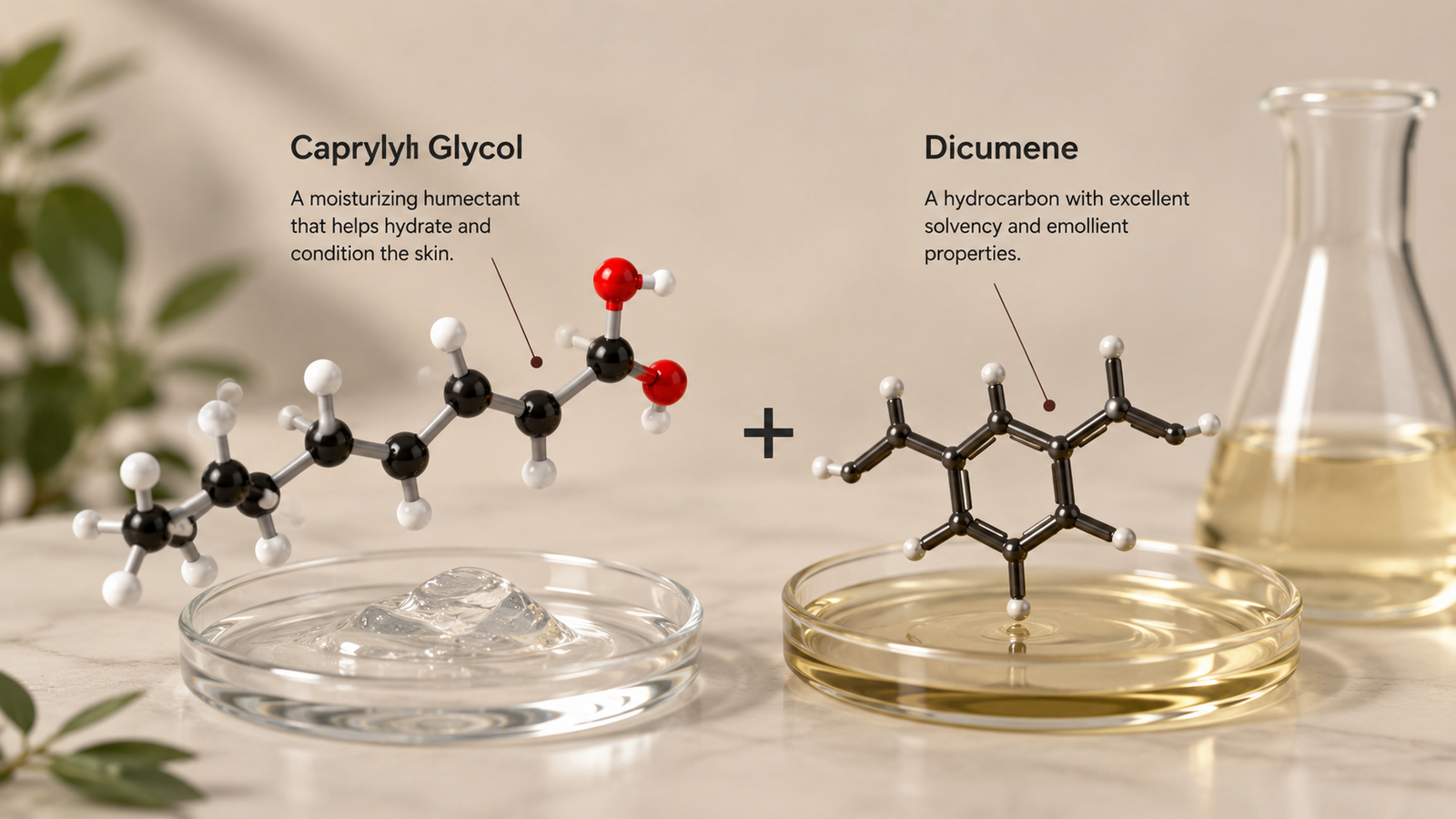
As manufacturers worldwide focus on better product performance, efficient formulations, and specialized material solutions, Caprylyl Glycol and Dicumene are gaining attention across two distinctly different areas of the chemical industry.
Caprylyl Glycol continues to play an important role in cosmetics and personal-care formulations, where manufacturers value multifunctional ingredients capable of supporting moisturization, product feel, and preservation systems. Meanwhile, Dicumene, chemically identified as 2,3-dimethyl-2,3-diphenylbutane, serves specialized applications in plastics and polymer technology, particularly as a synergistic additive in certain flame-retardant systems.
The growing relevance of these chemicals highlights a wider industry trend: manufacturers are increasingly looking beyond basic raw materials toward functional additives capable of delivering specific performance advantages.
Cosmetic formulation has become increasingly sophisticated. Consumers expect creams, lotions, cleansers, serums, and hair-care products to offer attractive textures, reliable stability, comfortable application, and consistent performance.
This environment has increased interest in multifunctional ingredients such as Caprylyl Glycol.
The ingredient is commonly valued for three important characteristics:
Rather than serving only one purpose, it can contribute to multiple aspects of a cosmetic formulation.
Hydration remains one of the most important considerations in skincare development.
Humectant ingredients help formulations support moisture retention and improve the way skin feels following application. Caprylyl Glycol possesses humectant characteristics and is therefore relevant to products designed around moisturization and conditioning.
Modern skincare development is no longer based solely on ingredient functionality.
Consumers also judge products according to spreadability, absorption, texture, after-feel, fragrance, packaging, and overall application experience.
A technically effective formulation that feels excessively greasy, sticky, or uncomfortable may struggle to achieve strong consumer acceptance.
For this reason, cosmetic formulators carefully balance active ingredients with functional materials that contribute to the overall sensory profile.
Another significant application of Caprylyl Glycol involves cosmetic preservation.
Products containing water require careful microbiological management. Without an appropriately designed preservation strategy, microorganisms can potentially compromise product quality and safety.
Caprylyl Glycol is frequently incorporated into preservation systems as a boosting or supporting ingredient rather than automatically being treated as a complete standalone preservative.
Using multifunctional preservation-supporting ingredients does not eliminate the need for proper formulation testing.
Manufacturers must consider:
Preservative efficacy testing, stability assessment, and appropriate regulatory evaluation remain essential before commercial cosmetic products reach consumers.
This represents an important distinction between selecting promising ingredients and developing a genuinely robust finished formulation.
The versatility of Caprylyl Glycol means it can be considered across multiple product categories.
Applications may include:
Its suitability in a particular formulation depends on concentration, compatibility, processing conditions, and desired finished-product characteristics.
While cosmetic manufacturers explore multifunctional formulation ingredients, the plastics industry faces a completely different set of challenges.
Polymer manufacturers need materials capable of meeting increasingly demanding requirements involving processing, durability, thermal behavior, mechanical properties, and fire performance.
This is where Dicumene enters the discussion.
Dicumene is commonly identified as 2,3-dimethyl-2,3-diphenylbutane and carries CAS number 1889-67-4.
Its industrial importance primarily comes from applications in polymer modification and flame-retardant systems.
Fire-performance requirements are important across numerous plastic applications.
Instead of relying on a single additive, manufacturers frequently develop carefully balanced additive packages. Within certain systems, Dicumene can function as a flame-retardant synergist.
A synergist is used to complement the activity of other formulation components, potentially allowing manufacturers to optimize overall system performance.
There is no universal additive formula suitable for every plastic.
The effectiveness of a flame-retardant package depends on factors such as polymer type, processing temperature, additive compatibility, required fire-performance standard, mechanical-property targets, and end-use conditions.
Manufacturers must therefore conduct appropriate technical testing before commercial production.
Industrial applications associated with Dicumene can include several important thermoplastic systems.
These may include:
This range illustrates how specialty additives can contribute to different areas of polymer engineering.
Beyond flame-retardant synergy, Dicumene has relevance to specialized polymer-modification processes.
Chemical modification allows manufacturers to adjust certain characteristics of existing polymers instead of developing entirely new materials.
Polymer modification may be investigated to influence:
Dicumene has been associated with radical-based processes and applications involving grafting and cross-linking.
Performance depends strongly on the complete polymer system.
Manufacturers should therefore determine appropriate additive levels and processing parameters through controlled technical evaluation rather than treating one formulation as universally applicable.
| Industry Factor | Caprylyl Glycol | Dicumene |
| Primary market | Cosmetics | Polymers |
| Main function | Humectant and preservation support | Polymer additive and synergist |
| Typical application | Skincare and personal care | Plastics and masterbatches |
| Common products | Creams, serums, shampoos | PP, PE, PS, ABS |
| Key objective | Formulation performance | Material performance |
| Typical customer | Cosmetic formulator | Polymer compounder |
The comparison makes one point particularly clear: although Caprylyl Glycol and Dicumene are both specialty chemicals, they address fundamentally different manufacturing requirements.
As chemical formulations become increasingly specialized, manufacturers are paying greater attention to raw-material consistency.
Price remains important, but purchasing decisions increasingly involve broader technical considerations.
Buyers should examine:
Reliable raw materials can help manufacturers maintain more consistent production processes and finished-product specifications.
Caprylyl Glycol is a multifunctional ingredient commonly used in cosmetics and personal-care formulations.
Its combination of moisturizing, conditioning, and preservation-supporting properties makes it useful for modern multifunctional formulations.
Yes. It can be found in creams, lotions, serums, cleansers, and numerous other skincare formulations.
Yes. It is commonly used to complement appropriately designed cosmetic preservation systems.
Yes. Its humectant characteristics can contribute to moisture management within personal-care formulations.
Dicumene is 2,3-dimethyl-2,3-diphenylbutane, a specialty chemical associated primarily with polymer applications.
Applications can involve polypropylene, polyethylene, polystyrene, ABS, SAN, masterbatches, and other polymer systems.
It is particularly known for functioning as a synergistic component within certain flame-retardant polymer systems.
Yes. It has relevance to specialized processes involving radical initiation, grafting, and cross-linking.
No. They serve fundamentally different industries and perform different chemical functions.
Consistent chemical specifications help manufacturers maintain predictable processing, formulation quality, and finished-product performance.
https://newsgrow.blogspot.com/2026/08/ethylhexylglycerin-emerges-as-key.html