


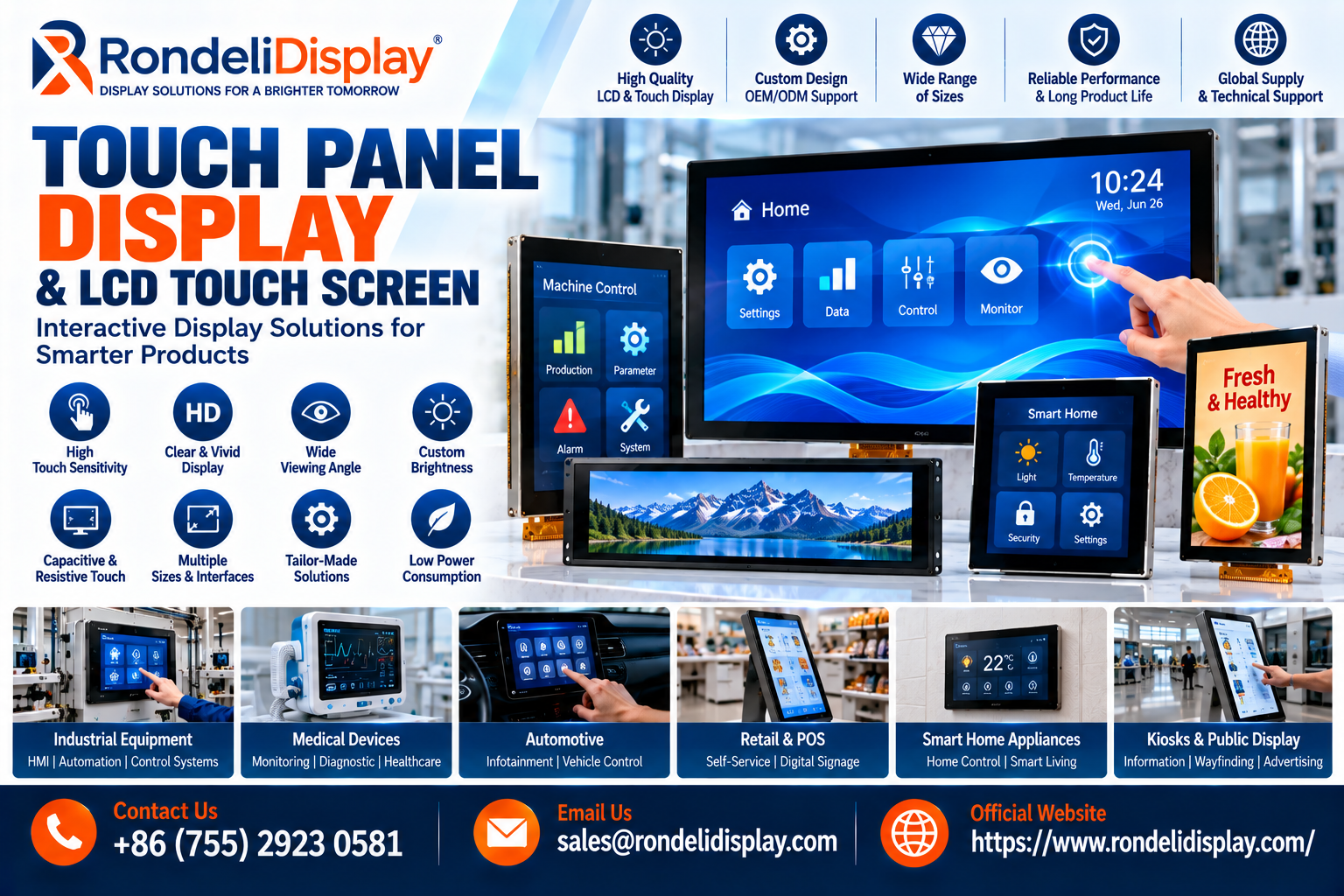
Electronics industry is placing greater emphasis on interactive display technologies that make digital equipment easier to operate, understand, and control. From industrial machines and medical instruments to retail kiosks and smart appliances, touch-enabled interfaces are becoming an important part of electronic product development.
A Touch Panel Display combines visual information with a touch-sensitive input system, allowing users to interact directly with compatible electronic equipment.
Meanwhile, an lcd touch screen integrates liquid crystal display technology with a touch interface to support graphical menus, equipment controls, and interactive applications.
For equipment manufacturers and product designers, the challenge extends beyond developing attractive screens. Reliable touch detection, practical interface layouts, and environmental compatibility are equally important.
Electronic equipment often contains multiple settings, operating modes, and information screens.
Traditional physical buttons can remain effective, but complex applications may require more flexible interaction methods.
Touch-enabled displays allow manufacturers to organise controls through graphical menus and application-specific layouts.
For example, an industrial machine may present different controls depending on its operating mode.
A commercial kiosk may guide customers through a sequence of simple selections.
This makes usability testing a valuable part of product development.
A Touch Panel Display is an electronic display assembly that supports user input through a touch-sensitive surface.
Depending on construction, the touch sensor may be integrated with an LCD or another compatible display technology.
When users touch the surface, the touch controller detects the interaction and communicates the corresponding information to the host system.
The software then determines the appropriate response.
Touch-enabled assemblies may include cover glass, a sensing layer, a display module, and controller electronics.
Their specifications vary according to the intended application, including screen dimensions, touch technology, operating conditions, and interface compatibility.
An lcd touch screen combines a liquid crystal display with touch-input capability.
The LCD presents visual information using a suitable backlight, while the touch system detects user interaction.
These components perform separate functions but operate together through compatible electronics and software.
LCD touchscreens can support graphical interfaces in industrial equipment, electronic terminals, laboratory instruments, and consumer appliances.
However, display quality and touch performance should be evaluated independently.
A screen with excellent brightness and resolution may still provide a poor experience if touch detection is inaccurate or unresponsive.
Two established approaches are projected capacitive touch and resistive touch sensing.
Projected capacitive technology detects changes in an electrical field and commonly supports multi-touch functions.
Resistive technology typically detects physical pressure applied to layered surfaces.
Each approach has advantages depending on the application.
| Feature | Capacitive Touch Panel | Resistive Touch Panel |
| Detection Method | Electrical field changes | Physical pressure |
| Multi-Touch | Commonly supported | Depends on design |
| Input Options | Finger or compatible stylus | Pressure from suitable objects |
| Glove Compatibility | Depends on controller and gloves | Often possible with sufficient pressure |
| Common Applications | Kiosks, appliances, interactive terminals | Selected industrial equipment |
| Selection Priority | Sensitivity and gesture support | Pressure-input requirements |
Neither technology is universally preferable. Selection should reflect intended operating conditions.
Industrial interfaces may be used repeatedly during demanding operating conditions.
Inaccurate touch detection can result in incorrect selections, interrupted workflows, or operator frustration.
Designers should consider the size and spacing of interactive elements.
Buttons should be sufficiently large for the intended users and working environment.
Touch responsiveness must also remain appropriate under expected temperature and electrical conditions.
Where equipment controls involve safety-critical functions, touchscreen interfaces require appropriate safeguards and must not replace essential independent safety controls.
Touchscreen performance can be influenced by operating conditions.
Workers may use protective gloves, while certain applications involve moisture, dust, or frequent cleaning.
Standard capacitive screens may not reliably recognise every glove type.
Some specialised controllers can be configured for suitable glove operation, although performance requires verification.
Water droplets may also interfere with certain touch systems.
Manufacturers should evaluate the complete assembly under representative conditions rather than relying exclusively on laboratory specifications.
For demanding environments, enclosure protection and cleaning compatibility deserve additional consideration.
The physical arrangement of display layers influences the user experience.
Some touchscreen assemblies contain an air gap between the display and protective cover.
Optical bonding uses suitable transparent materials to connect selected layers.
Depending on the design, this approach can reduce internal reflections and improve perceived image clarity.
However, bonding requirements vary according to screen construction and intended use.
Manufacturers must consider material compatibility, production processes, and repair requirements.
Optical improvements should be assessed alongside brightness, viewing angles, and overall display performance.
Interactive screens are widely considered for self-service terminals, information kiosks, and commercial equipment.
These applications require clear navigation and understandable instructions.
Users should be able to identify available actions without unnecessary confusion.
Readable typography, suitable contrast, and consistent button placement contribute to usability.
Error messages should explain how users can recover from unsuccessful actions.
Accessibility should also be considered, including the needs of users who may find touch-only interaction difficult.
Good interface design is a combination of suitable hardware and thoughtful software.
Original equipment manufacturers often require touchscreens tailored to specific products.
Potential customisation options include cover glass dimensions, touch-controller configuration, display brightness, mounting arrangements, and electrical interfaces.
Some applications may also require decorative borders or specialised surface treatments.
However, customisation can influence manufacturing costs, qualification requirements, and component availability.
Businesses should establish specifications before approving designs.
Prototype evaluation can help identify problems involving touch calibration, mechanical alignment, or electrical integration before commercial production.
Businesses should evaluate display suppliers through a structured technical process.
Important considerations include:
Clear documentation helps electronics manufacturers maintain consistency during production.
1. What is a Touch Panel Display?
A Touch Panel Display combines a visual screen with a touch-sensitive input system, allowing users to interact directly with compatible electronic equipment.
2. What is an LCD touch screen?
An LCD touch screen integrates a liquid crystal display and touch technology to provide visual information and interactive input.
3. What is the difference between capacitive and resistive touchscreens?
Capacitive screens detect electrical changes, while resistive screens typically respond to physical pressure applied to their surface.
4. Can LCD touchscreens work with gloves?
Some can. Compatibility depends on the touch technology, controller configuration, glove characteristics, and operating conditions.
5. How should manufacturers select a touchscreen supplier?
Manufacturers should evaluate display specifications, touch accuracy, environmental performance, controller compatibility, customisation options, and product quality.
Department: Touchscreen Technology and Custom LCD Enquiries
Email: sales@rondelidisplay.com
Official Website: https://www.rondelidisplay.com/
Read More:-