


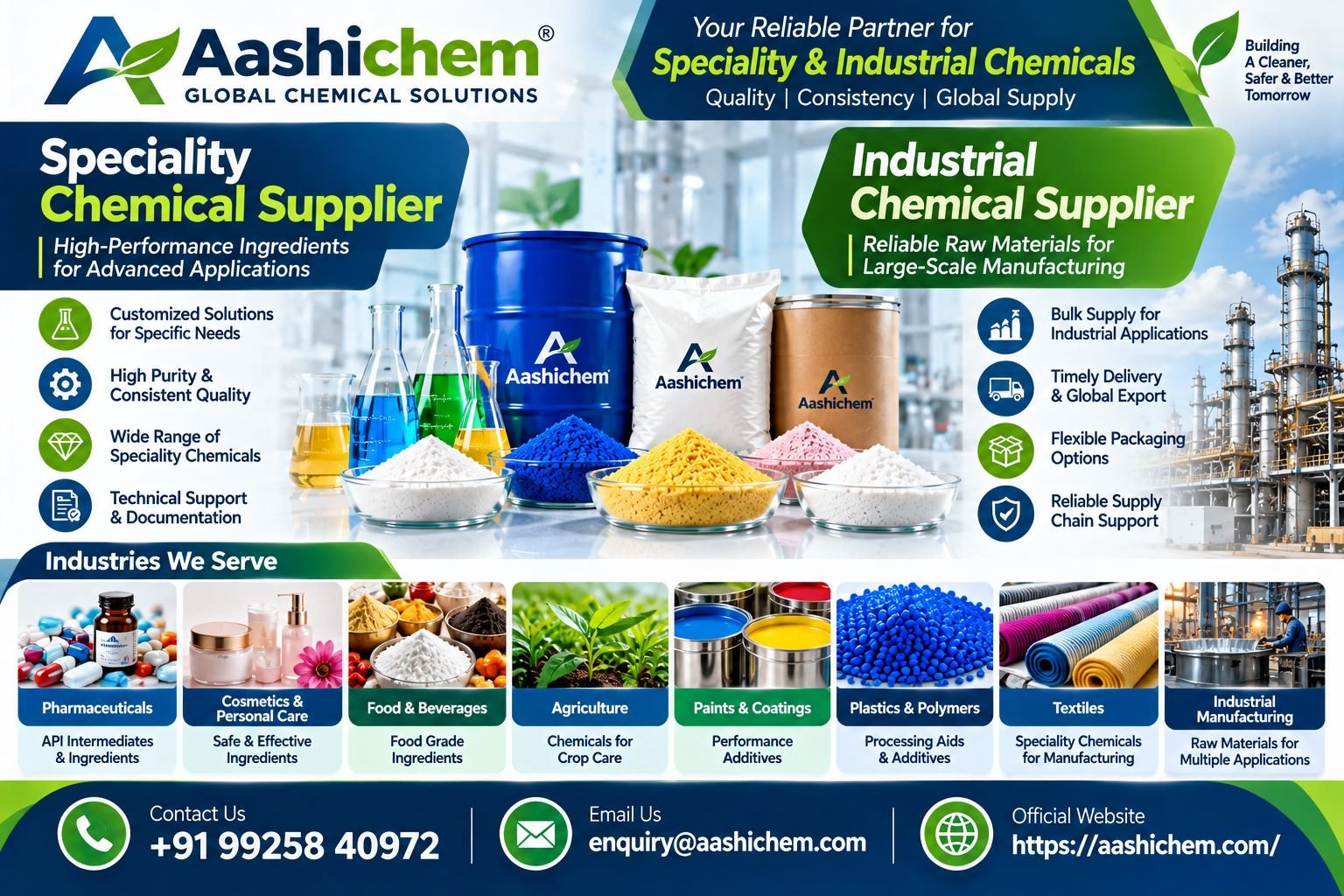
Chemical industry is placing greater importance on application-specific solutions as manufacturers seek improved product performance, efficient processing, and reliable material availability. Chemical purchasing is increasingly connected with technical decision-making, particularly when raw materials influence the characteristics of finished products.
A professional Speciality Chemical Supplier can support businesses looking for chemicals selected according to specific functional requirements, processing conditions, and product development objectives.
Meanwhile, an experienced helps manufacturers obtain chemical materials required for routine production, industrial processing, and broader operational applications.
Although these supplier categories overlap, their roles can differ according to product complexity, technical support requirements, and customer expectations.
For manufacturers in textiles, paints, coatings, plastics, personal care, and other industrial sectors, understanding these differences can help improve chemical selection and manufacturing efficiency.
Chemical selection can directly influence manufacturing performance.
Two materials with similar product descriptions may behave differently under specific processing conditions.
For example, variations in viscosity, purity, particle characteristics, or chemical composition can affect how a material performs within a formulation.
Manufacturers should therefore evaluate chemicals according to their intended functions rather than relying exclusively on commercial product names.
This approach encourages procurement teams to coordinate with production and technical departments before selecting suppliers.
A Speciality Chemical Supplier focuses on chemical products selected for particular functional properties or specialised industrial applications.
These may include suitable additives, surface-treatment chemicals, formulation ingredients, processing aids, and other performance-oriented materials.
Unlike chemicals purchased mainly according to standard commodity specifications, speciality products may require more detailed application evaluation.
Their selection can depend on compatibility, concentration, processing conditions, and interactions with other ingredients.
A supplier may provide technical information, product specifications, or application guidance according to its capabilities.
However, businesses should confirm whether the supplier manufactures the products directly or distributes materials obtained from other producers.
An Industrial Chemical Supplier serves businesses requiring chemical materials for manufacturing, processing, cleaning, treatment, and other industrial activities.
These products may include commodity chemicals, solvents, acids, alkalis, industrial additives, and specialised materials.
The supplier’s responsibilities can involve material sourcing, packaging coordination, product documentation, and commercial distribution.
Reliable industrial supply requires accurate product identification and clear specifications.
The intended application determines whether additional technical evaluation or regulatory controls are necessary.
An industrial chemical should never be selected solely because its chemical name appears similar to an existing approved material.
One important challenge in chemical manufacturing is ensuring that a selected ingredient performs appropriately under actual production conditions.
A material that produces acceptable results during laboratory evaluation may behave differently when introduced into larger manufacturing equipment.
Processing temperature, mixing intensity, moisture exposure, and contact with other ingredients can influence performance.
Manufacturers should therefore evaluate whether the chemical is compatible with the complete production process.
Technical discussions between buyers and suppliers can help identify relevant requirements before commercial purchasing.
Different manufacturing challenges demand different sourcing approaches.
1. Improving Coating Performance
A coatings manufacturer may require an additive with specific flow, wetting, or dispersion properties.
The chemical must be evaluated alongside the coating formulation, application method, and performance objectives.
2. Supporting Polymer Processing
A plastics processor may need a suitable processing aid or functional additive.
Compatibility with the polymer, production conditions, and finished-product requirements becomes important.
3. Maintaining Routine Industrial Production
A manufacturing facility may require consistent supplies of a standard industrial chemical.
In this situation, specification compliance, packaging suitability, reliable availability, and commercial coordination may be the main priorities.
These examples demonstrate why supplier selection should reflect the actual manufacturing objective.
Sample evaluation can help businesses assess chemical suitability before larger purchasing commitments.
However, testing should follow clearly defined acceptance criteria.
A laboratory trial may examine physical characteristics, chemical compatibility, and application-specific performance.
Where necessary, pilot production can provide additional information about processing behaviour.
Manufacturers should document relevant observations and investigate unexpected results.
A successful preliminary test does not automatically guarantee performance under every commercial operating condition.
Appropriate evaluation helps reduce uncertainty when introducing new chemicals into established manufacturing processes.
| Evaluation Factor | Speciality Chemicals | General Industrial Chemicals |
| Main Purchasing Focus | Specific functional performance | Defined industrial requirements |
| Product Selection | Application-dependent | Specification-dependent |
| Technical Evaluation | May require formulation trials | Depends on intended industrial use |
| Common Considerations | Compatibility and functional characteristics | Purity, concentration, and supply consistency |
| Supplier Support | Application-specific information where available | Technical and commercial documentation |
| Quality Requirements | Product- and application-specific | Product- and application-specific |
The distinction is not absolute.
Some products classified as industrial chemicals also require extensive technical evaluation, while certain speciality materials follow established standard specifications.
Chemical purchasing decisions often involve procurement teams, laboratory personnel, production managers, and quality assurance professionals.
Each department may evaluate the same material differently.
Procurement teams focus on availability, pricing, and supply arrangements.
Technical departments assess compatibility and performance.
Quality teams verify relevant specifications and documentation.
Coordinating these perspectives helps businesses avoid selecting materials that meet purchasing requirements but create production difficulties.
Clear communication also supports better management of approved chemical substitutions.
Manufacturers may consider alternative chemical suppliers to improve purchasing flexibility.
However, switching suppliers requires more than comparing product names and prices.
Differences in impurity profiles, manufacturing processes, concentrations, or physical properties can influence downstream performance.
Businesses should establish procedures for evaluating proposed substitutions.
Relevant technical trials and quality assessments may be required before approval.
Where regulatory obligations apply, changes should be reviewed accordingly.
A responsible sourcing strategy balances supply flexibility with material consistency and manufacturing suitability.
Businesses evaluating chemical suppliers should consider several practical questions:
A supplier relationship becomes more valuable when technical expectations and commercial responsibilities are properly defined.
1. What is a Speciality Chemical Supplier?
A speciality chemical supplier provides chemicals selected for particular functional properties or specialised applications, often requiring additional technical evaluation.
2. What does an Industrial Chemical Supplier offer?
An industrial chemical supplier provides materials used in manufacturing, processing, industrial treatment, and other commercial applications according to defined product requirements.
3. What is the difference between speciality and industrial chemicals?
Speciality chemicals are often selected for specific performance characteristics, while general industrial chemicals may be purchased primarily according to established material specifications. The categories can overlap.
4. Why are chemical compatibility trials important?
Compatibility trials help manufacturers evaluate how selected chemicals interact with formulations, equipment, and processing conditions before commercial use.
5. How can businesses choose a dependable chemical supplier?
They should assess product suitability, quality documentation, technical capabilities, supply arrangements, communication, and relevant regulatory requirements.
Department: Industrial and Speciality Chemical Supply Enquiries
Contact: +91 99258 40972
Email: enquiry@aashichem.com
Official Website: https://aashichem.com/
Read More:-