


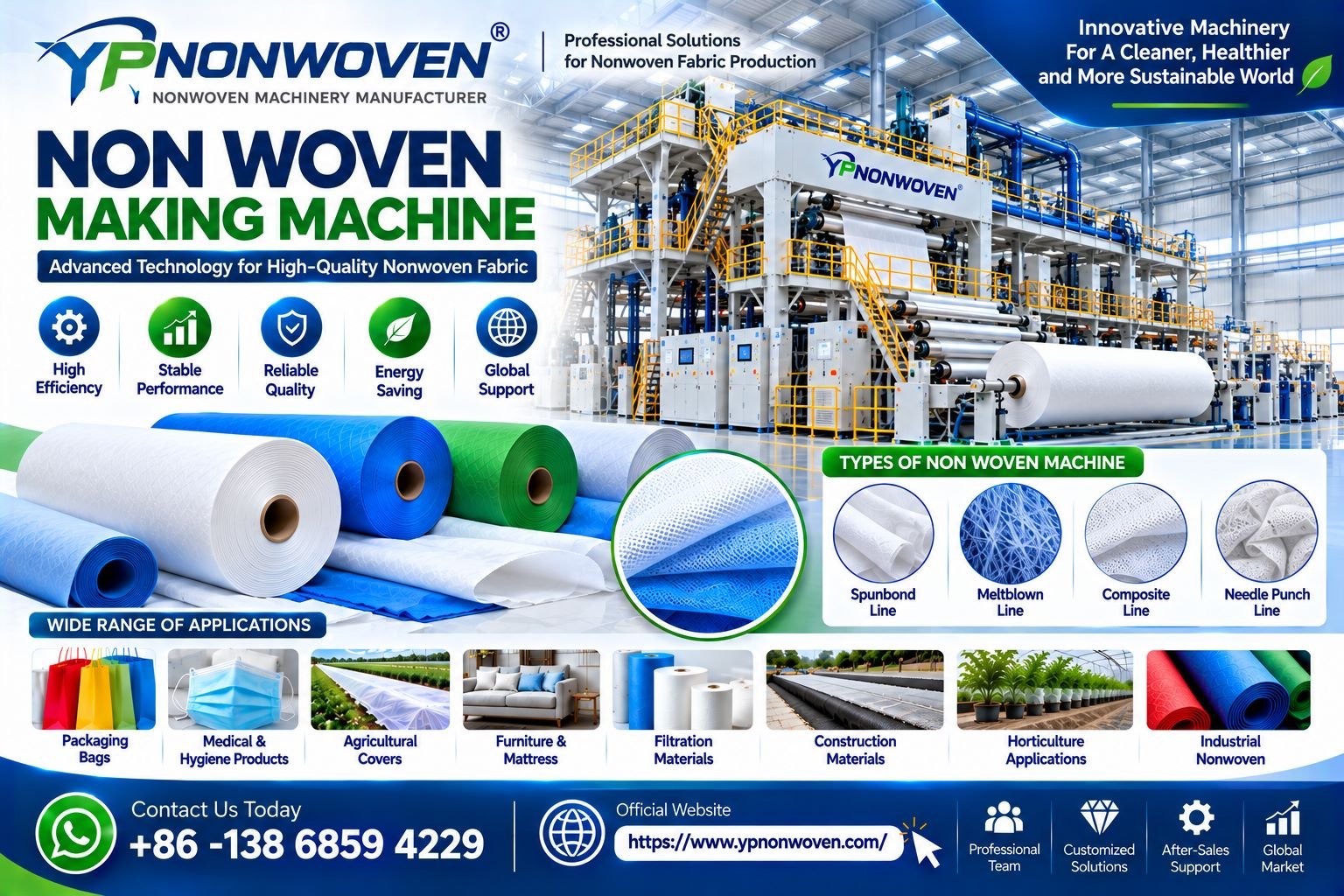
The textile manufacturing sector is continuing to explore efficient production technologies as industries seek lightweight materials, consistent fabric quality, and flexible manufacturing solutions. A modern Non Woven Making Machine enables manufacturers to produce engineered fabrics without traditional weaving or knitting, while a Non Woven Machine can support applications ranging from agricultural textiles to industrial filtration and packaging.
As businesses evaluate production investments, attention is shifting toward equipment reliability, automation, operating costs, and application-specific fabric performance.
For manufacturers establishing new facilities or upgrading existing operations, understanding nonwoven technology is essential for making informed machinery decisions.
A Non Woven Making Machine produces fabric-like materials by forming and bonding fibers or filaments through mechanical, thermal, or chemical processes.
Unlike woven textiles, nonwoven fabrics do not require yarns to be interlaced on conventional looms.
This manufacturing approach supports diverse material structures, depending on the selected production technology.
A Non Woven Machine may employ different manufacturing technologies, each designed for particular materials and product requirements.
Spunbond technology produces continuous polymer filaments that are arranged into a web and bonded into fabric.
Polypropylene spunbond materials are commonly used in shopping bags, agricultural coverings, furniture, and hygiene applications.
Meltblown systems produce fine polymer fibers using high-velocity air.
The resulting materials are suitable for selected filtration applications, including appropriately designed multilayer products.
Spunlace machinery uses high-pressure water jets to entangle fibers, producing flexible and often soft nonwoven fabrics.
Applications include cleaning wipes, personal care products, and specialized textile materials.
Needle punching mechanically entangles fibers to manufacture stronger or thicker nonwoven structures for selected industrial applications.
Common uses include geotextiles, automotive components, and technical fabrics.
The exact process depends on the selected technology. In a conventional polypropylene spunbond system, production generally follows these stages:
Modern production systems may monitor temperatures, pressures, machine speeds, and other processing conditions.
Nonwoven fabrics support multiple commercial sectors.
Packaging Industry: Reusable bags, protective packaging, and selected industrial covers.
Agricultural Sector: Crop protection fabrics, horticultural covers, and specialized agricultural materials.
Furniture Manufacturing: Mattress components, upholstery backing, and protective fabric layers.
Hygiene Products: Selected components for disposable personal care and hygiene applications.
Automotive Industry: Interior coverings, insulation materials, and technical textile components.
Filtration Industry: Engineered filtration media manufactured using suitable technologies.
Products intended for medical, protective, or filtration applications require additional performance testing and compliance with relevant standards.
Manufacturers should evaluate technology according to the desired fabric characteristics.
| Technology | Main Process | Typical Applications |
| Spunbond | Continuous filament formation | Packaging, agriculture, hygiene |
| Meltblown | Fine-fiber formation using air | Filtration materials |
| Spunlace | Water-jet fiber entanglement | Wipes, cleaning materials |
| Needle Punching | Mechanical fiber entanglement | Geotextiles, automotive textiles |
The equipment choice should reflect target customers, material specifications, and available manufacturing resources.
Before purchasing a Non Woven Making Machine, buyers should review technical and operational requirements.
Production Capacity: Confirm realistic output under expected manufacturing conditions.
Working Width: Select equipment matching intended fabric dimensions.
GSM Range: Verify the supported fabric basis weight, measured in grams per square meter.
Automation Features: Evaluate process controls, monitoring systems, and alarm functions.
Energy Consumption: Examine electricity and heating requirements.
Maintenance Accessibility: Consider spare parts availability and servicing arrangements.
Installation Support: Review commissioning, operator training, and technical assistance.
Manufacturers should request documented performance specifications rather than relying only on advertised maximum production speeds.
Consistent fabric quality is essential for maintaining customer confidence.
Manufacturers commonly evaluate fabric uniformity, thickness, tensile strength, elongation, appearance, and basis weight.
A poorly maintained Non Woven Machine may experience problems such as uneven web formation, inconsistent bonding, and production interruptions.
Routine inspection, preventive maintenance, and trained operators help maintain production consistency.
Purchasing nonwoven equipment involves more than the initial machine price.
Manufacturers should calculate expenses related to factory infrastructure, electricity, labor, raw materials, maintenance, installation, and spare parts.
Production planning should also account for downtime, rejected materials, and changing customer demand.
An effective investment strategy considers the total cost of ownership and expected commercial applications.
1. What is a Non Woven Making Machine?
It is industrial equipment that manufactures nonwoven fabric by forming and bonding fibers or filaments without conventional weaving.
2. What is a Non Woven Machine used for?
It produces nonwoven materials used in packaging, agriculture, hygiene, automotive, furniture, and industrial applications.
3. What raw materials are used in nonwoven production?
Common materials include polypropylene, polyester, viscose, and other suitable polymers or fibers, depending on the manufacturing technology.
4. What is the difference between woven and nonwoven fabric?
Woven fabric uses interlaced yarns, while nonwoven fabric is formed through fiber or filament bonding.
5. What does GSM mean in nonwoven manufacturing?
GSM means grams per square meter and indicates the fabric’s basis weight.
6. Which nonwoven technology is suitable for shopping bags?
Polypropylene spunbond technology is commonly used for suitable reusable shopping bag materials.
7. Can one nonwoven machine manufacture every type of fabric?
No. Different production technologies are required for different fabric structures and applications.
8. What factors affect nonwoven machine prices?
Production capacity, working width, automation, equipment configuration, and technical support influence costs.
9. How can manufacturers reduce nonwoven production waste?
Suitable process settings, preventive maintenance, operator training, and quality monitoring can help reduce waste.
10. How should businesses choose a nonwoven machinery supplier?
They should assess engineering capabilities, equipment specifications, installation support, maintenance services, and documented performance.
Department: Nonwoven Machinery and Industrial Business Communications
Email: info@ypnonwoven.com
Contact: +86 138 6859 4229
Official Website: https://www.ypnonwoven.com/