


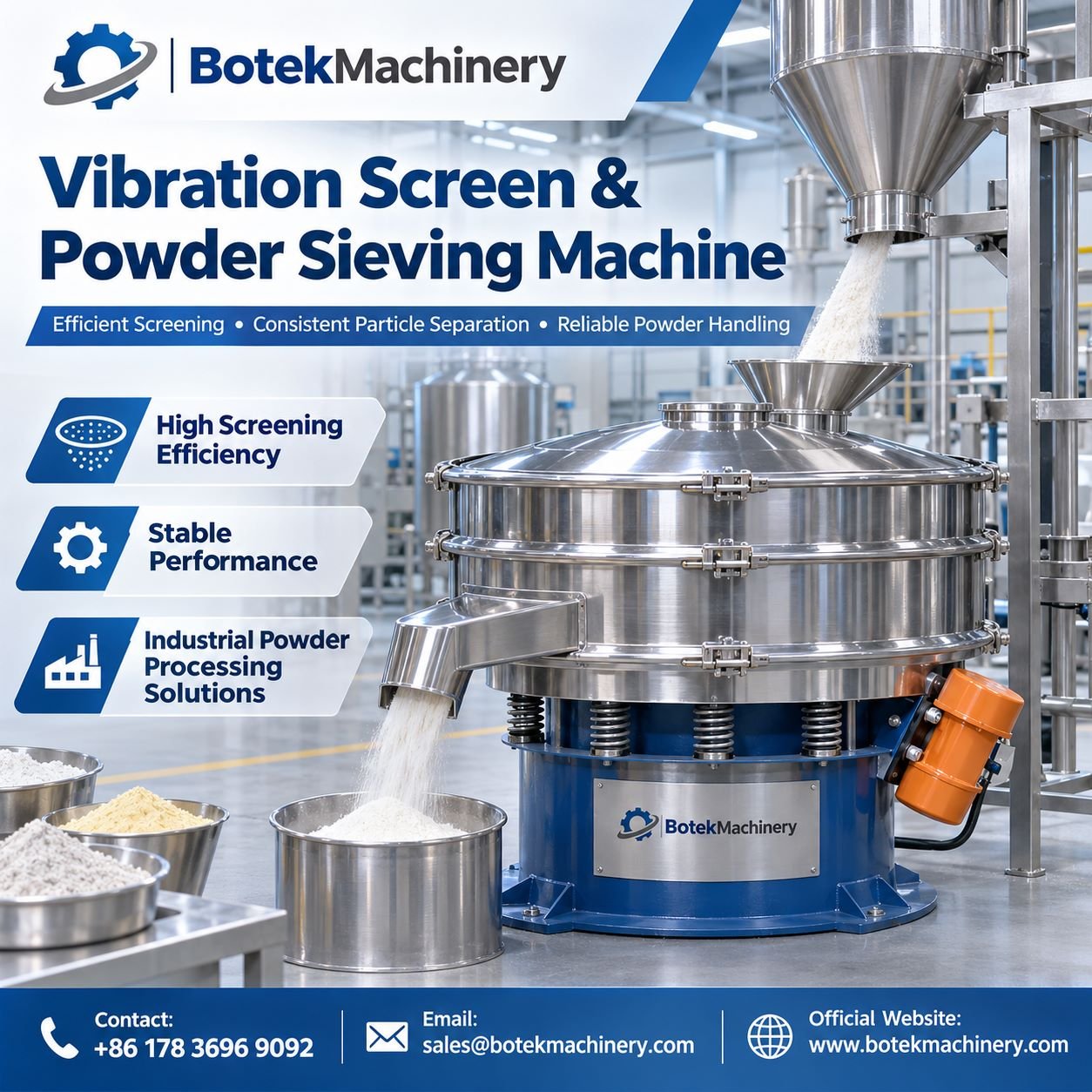
As industrial manufacturers place greater emphasis on product consistency, operational efficiency, and quality control, advanced screening equipment is becoming an important part of modern production systems. The vibration screen supports the separation and classification of bulk materials, while the powder sieving machine helps manufacturers achieve controlled particle size distribution and remove unwanted oversized particles.
From food processing and pharmaceutical manufacturing to chemical production, mineral processing, and cosmetics, reliable screening technology contributes to consistent material quality.
For businesses seeking to improve powder handling and production performance, understanding equipment capabilities, technical specifications, and maintenance requirements is essential.
A vibration screen is industrial equipment that uses controlled mechanical vibrations to separate materials according to particle size.
Materials are introduced onto a screening surface containing openings of a specified size. Vibration encourages smaller particles to pass through the screen while larger particles remain on the surface.
Depending on the equipment design, manufacturers can achieve material classification, oversize removal, and multiple particle size separations.
Common industrial applications include:
A powder sieving machine is equipment designed to separate powdered materials through a mesh or perforated screening surface.
Its primary purpose is to help achieve the required particle size characteristics and remove unsuitable oversized particles or agglomerates.
Depending on the design, a powder sieving machine may use vibration, centrifugal force, or another suitable screening mechanism.
Important applications include:
Ingredient Preparation: Screening dry materials before mixing or blending.
Quality Control: Removing unwanted oversized particles from suitable powder products.
Powder Classification: Separating materials into specified particle size fractions.
Production Line Integration: Supporting material preparation before packaging or additional processing.
Contamination Management: Retaining certain oversized foreign particles, although screening does not replace dedicated contamination detection systems.
The effectiveness of sieving depends on material flowability, mesh size, equipment capacity, and operating conditions.
Although these terms are closely related, they do not always describe identical equipment.
| Feature | Vibration Screen | Powder Sieving Machine |
| Main principle | Mechanical vibration | Screening through selected openings |
| Material handling | Powders, granules, bulk solids | Primarily powders and fine materials |
| Main purpose | Classification and separation | Powder screening and oversize removal |
| Available designs | Circular, linear, and other vibrating systems | Vibratory, centrifugal, and other systems |
| Key consideration | Vibration and screening capacity | Mesh accuracy and powder characteristics |
A vibrating screening system can also function as a powder sieving machine when designed for suitable powder applications.
The correct equipment should be selected according to the material being processed and the required separation results.
A properly configured vibration screen can help manufacturers achieve reliable material separation while supporting continuous or batch production.
Its effectiveness depends on several operating parameters.
Screening Frequency: Influences material movement across the screening surface.
Vibration Amplitude: Affects particle movement and separation behavior.
Screen Opening Size: Determines which particles may pass through the screen.
Feed Rate: Influences material loading and overall screening performance.
Material Characteristics: Particle shape, moisture content, and bulk density affect separation efficiency.
Correct equipment settings can reduce unnecessary processing interruptions and support more consistent material quality.
Selecting a suitable powder sieving machine requires careful consideration of construction, performance, and maintenance accessibility.
Important features include:
Some systems incorporate ultrasonic or mechanical screen-cleaning technologies to reduce mesh blinding when processing challenging materials.
Modern manufacturing often requires screening equipment to work alongside mixers, conveyors, mills, and packaging systems.
For example, a chemical processing facility may screen incoming raw materials before blending. A food manufacturer may use powder sieving to remove oversized agglomerates before packaging.
A properly integrated screening arrangement can help maintain material flow between production stages.
However, screening systems must be selected according to actual material properties and processing requirements.
Industrial facilities should also consider equipment layout, cleaning procedures, production capacity, and contamination prevention.
Regular maintenance is important for dependable screening performance.
Operators should inspect screen mesh, mounting components, vibration mechanisms, seals, and discharge connections.
Damaged screens may allow oversized material to enter the finished product, affecting quality.
Facilities processing combustible dust must assess ignition hazards, dust accumulation, grounding, and applicable explosion protection requirements.
Equipment should be isolated using approved procedures before inspection or servicing.
Preventive maintenance can help reduce unexpected downtime and support consistent product quality.
1. What is a vibration screen?
A vibration screen is industrial equipment that separates bulk materials according to particle size using controlled mechanical vibrations.
2. What is a powder sieving machine?
A powder sieving machine separates powdered materials through selected screening openings to support particle classification and quality control.
3. Which industries use vibrating screens?
Common applications include food processing, chemicals, pharmaceuticals, minerals, cosmetics, and agricultural manufacturing.
4. How does a vibration screen work?
Mechanical vibration moves material across a screening surface, allowing suitable smaller particles to pass through openings.
5. Can a powder sieving machine remove oversized particles?
Yes. Properly selected screening equipment can retain particles larger than the specified screen openings.
6. What affects screening efficiency?
Mesh size, vibration settings, feed rate, moisture content, particle shape, and material flowability influence performance.
7. Are powder sieving machines suitable for food manufacturing?
Yes, provided the equipment meets applicable material-contact, hygiene, cleaning, and food safety requirements.
8. What is screen mesh blinding?
Mesh blinding occurs when particles obstruct screening openings, reducing effective screening area and throughput.
9. Can vibration screens be integrated with conveyors?
Yes. Suitable screening equipment can operate with compatible conveying, feeding, and discharge systems.
10. How should businesses select a reliable screening equipment supplier?
Buyers should evaluate technical specifications, material testing capabilities, manufacturing quality, safety features, and maintenance support.
Department: Industrial Machinery and Business Communications
Email: sales@botekmachinery.com
Contact: +86 178 3696 9092
Official Website: https://www.botekmachinery.com/