


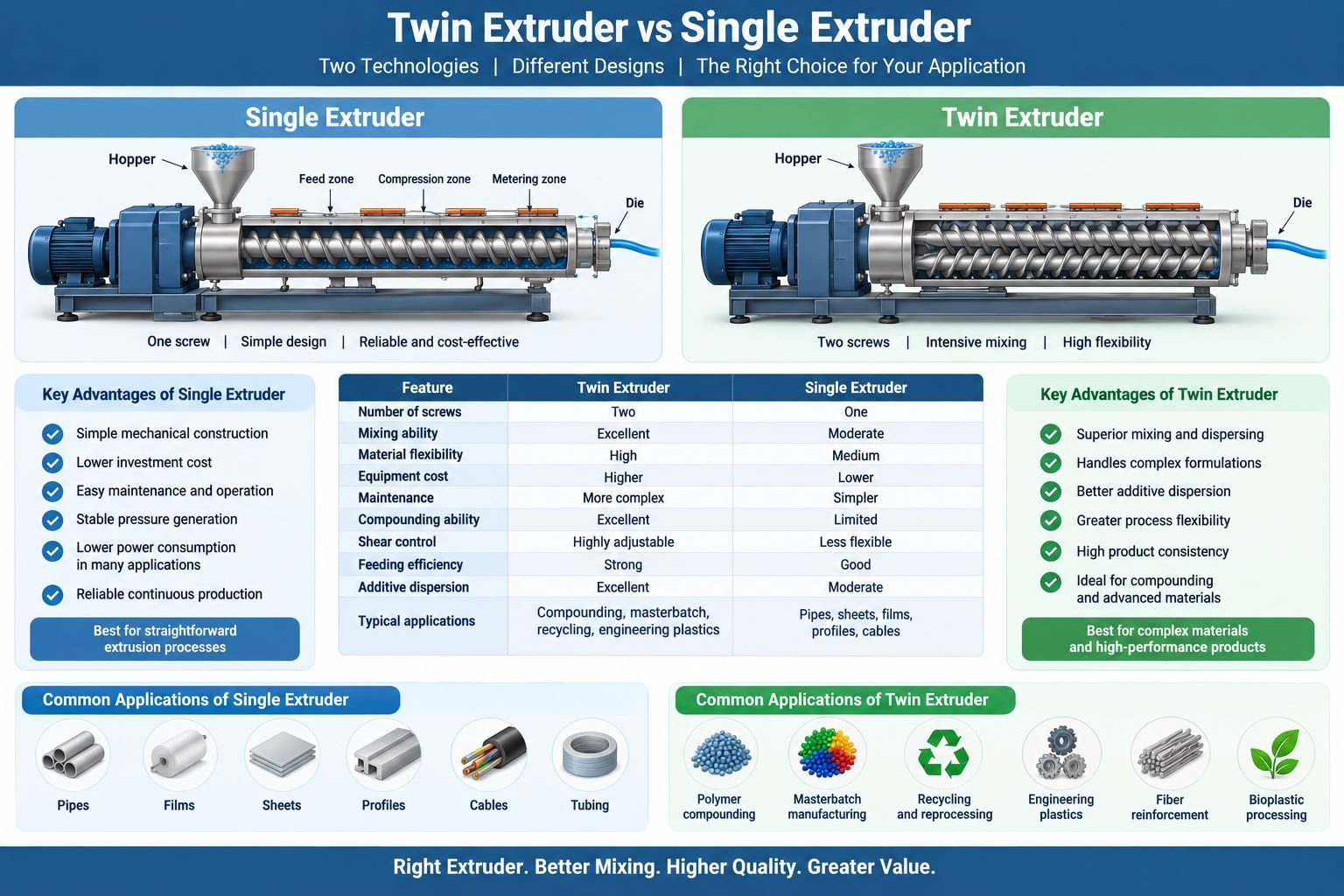
Modern plastics and polymer manufacturing depends heavily on extrusion technology. From pipes and profiles to engineering compounds, masterbatch, recycled plastics, and specialty polymers, extrusion provides an efficient way to transform raw materials into commercially usable products.
However, manufacturers planning an extrusion line frequently face one important question: should they invest in a twin extruder or a single extruder?
The answer is not simply about choosing the machine with more screws. Both technologies have distinct strengths. Understanding how they handle melting, conveying, mixing, pressure generation, additives, and production requirements can help businesses make a more informed investment.
Extrusion is a continuous process in which raw material enters a heated barrel and is transported forward by one or more rotating screws. Heat and mechanical energy soften or melt the polymer before it is pushed through a die.
The efficiency of this process affects several critical factors:
This is why screw configuration deserves careful attention when designing an extrusion line.
A single extruder contains one rotating screw inside a temperature-controlled barrel. It represents one of the most established technologies in plastics processing.
Material enters through a hopper and moves along the screw. During transportation, the material is compressed, heated, melted, homogenized, and finally pushed toward the die.
The technology is especially effective when manufacturers work with relatively uniform raw materials that do not require intensive compounding.
Despite advances in extrusion technology, single-screw systems remain extremely relevant.
Their popularity comes from several practical advantages:
For manufacturers producing conventional plastic products, a single extruder can provide an excellent balance between productivity and operating cost.
Single-screw extrusion is particularly suitable when the primary objective is melting and shaping rather than intensive material modification.
Typical applications include:
In these applications, consistent material transportation and pressure generation are often more important than aggressive mixing.
A twin extruder contains two screws operating inside the same barrel. Depending on equipment configuration, the screws may rotate in the same or opposite directions.
The interaction between these screws creates a highly controlled processing environment.
Instead of simply transporting and melting polymers, twin-screw technology can simultaneously perform feeding, mixing, kneading, dispersing, blending, devolatilizing, and compounding operations.
This versatility makes it particularly valuable for advanced polymer formulations.
Imagine trying to distribute a small quantity of pigment evenly throughout a large volume of polymer. Simply melting the materials together may not create sufficient uniformity.
A twin extruder continuously divides and recombines the material while applying controlled shear.
This improves both distributive and dispersive mixing.
Distributive mixing spreads ingredients evenly throughout the polymer without necessarily changing their particle size.
It helps ensure additives are not concentrated in isolated areas.
Dispersive mixing applies mechanical stress to break down agglomerated particles.
This is important when processing pigments, mineral fillers, reinforcing agents, and other materials that require fine dispersion.
Twin-screw machines are not all identical.
A co-rotating twin extruder has two screws rotating in the same direction. These systems provide excellent mixing and are widely used for polymer compounding and masterbatch manufacturing.
Counter-rotating screws turn in opposite directions. Their conveying and pressure characteristics make them useful for specialized applications, particularly certain PVC processes.
The appropriate configuration depends on material behavior and production requirements.
| Feature | Twin Extruder | Single Extruder |
| Screw system | Two screws | One screw |
| Mixing performance | Excellent | Moderate |
| Machine complexity | Higher | Lower |
| Initial investment | Higher | Lower |
| Compounding | Highly suitable | Limited |
| Additive dispersion | Excellent | Moderate |
| Maintenance | More specialized | Simpler |
| Material flexibility | High | Moderate |
| Process customization | Extensive | More limited |
| Typical use | Compounding | Product extrusion |
Neither machine wins every category. The application determines which technology creates greater value.
Polymer compounding involves modifying a base resin by adding other materials to achieve specific performance characteristics.
A formulation could include:
Every ingredient must be distributed correctly.
The twin extruder provides the intensive mixing and controlled residence time required to create homogeneous compounds.
This is why twin-screw machines are widely associated with masterbatch, engineering plastics, filled compounds, reinforced polymers, and specialty formulations.
One of the biggest differences between the technologies becomes visible when examining screw design.
The screw in a single extruder generally contains feeding, compression, and metering sections. These zones are optimized to transport, melt, and pressurize the polymer.
Many twin-screw machines use modular elements instead.
Processors can combine conveying elements, kneading blocks, mixing sections, and specialized elements according to the formulation.
This modular approach enables greater control over shear, residence time, mixing intensity, and material transportation.
Modern compounds rarely consist of only one ingredient.
Powders, fibers, pellets, liquids, and additives may need to enter the extrusion system at different locations.
A twin extruder can support multiple feeding systems, including side feeders and liquid injection points. This makes it easier to introduce sensitive ingredients after the polymer has already started melting.
Such flexibility can improve both processing stability and final material quality.
Removing unwanted gases can be an important part of polymer processing.
Twin-screw lines can incorporate atmospheric and vacuum venting zones that help remove moisture, trapped air, solvents, and other volatile substances.
This capability is valuable in recycling and specialty compounding, where incoming materials may contain moisture or volatile components.
A properly configured single extruder can also incorporate venting, but twin-screw systems generally provide greater processing flexibility for demanding devolatilization requirements.
It is tempting to assume that simpler machinery automatically means lower manufacturing costs.
A single extruder can indeed offer excellent energy efficiency when processing straightforward materials.
However, total process economics matter more than motor power alone.
A twin extruder may combine several operations into one continuous production stage. If mixing, compounding, additive incorporation, and devolatilization can occur within one system, manufacturers may reduce additional processing requirements.
Energy efficiency should therefore be measured against kilograms of acceptable finished product rather than simply installed machine power.
Maintenance is another important consideration.
The mechanical simplicity of a single extruder generally makes inspection, cleaning, screw servicing, and troubleshooting easier.
Twin-screw machines contain additional components and require accurate synchronization between screws, gearbox, and processing sections.
Operators may therefore need greater technical knowledge.
However, preventive maintenance, proper operating procedures, and correct screw configuration can support reliable long-term performance for both technologies.
The right answer starts with the material, not the machine catalogue.
Before investing, manufacturers should ask:
For conventional melting and shaping, a single extruder may be the practical choice.
For complex formulations, intensive mixing, polymer modification, or compounding, a twin extruder usually provides greater flexibility.
A twin extruder operates with two screws, while a single extruder uses one screw for material processing.
Twin-screw systems generally provide superior mixing because the interacting screws continuously redistribute material.
Yes. Single-screw extrusion is widely used for manufacturing PE and PP pipes, tubing, profiles, and similar products.
A twin extruder is generally preferred because masterbatch production requires effective pigment and additive dispersion.
Yes. Properly configured twin-screw systems can be used for recycling, blending, devolatilization, and modification of recycled polymers.
Twin-screw systems generally have higher initial costs because their mechanical and processing configurations are more sophisticated.
A single extruder is typically easier to maintain because it contains fewer screw and drive components.
Yes, but their mixing capability may be less suitable when large amounts of fillers or complex additive combinations require intensive dispersion.
Twin extrusion is widely used in plastics, polymer compounding, masterbatch, recycling, engineering materials, and specialty material manufacturing.
Selection should consider material properties, mixing requirements, capacity, final product specifications, energy efficiency, maintenance, and long-term production economics.
Read more – https://tandtlawassociates.com/twin-extruder-vs-single-extruder-deep-guide-to-extrusion-technology/